
Coffee for People With IBS: How to Find What Works for You
You may not have to give up coffee to manage IBS. The right choice depends on your personal triggers, and “low-acid” or decaf doesn’t automatically mean symptom-free. Finding coffee for people with IBS is less about seeking a universally safe bean and more about noticing how your body responds.
If you’re unsure whether caffeine, another feature of coffee, or what you add to it is behind your symptoms, that uncertainty is understandable. Black coffee is low in FODMAPs, but caffeine can still stimulate the gut, and ingredients such as regular milk may affect some people. Decaf contains less caffeine, not necessarily none, while low-acid coffee isn’t proven to suit everyone with IBS.
This guide separates common assumptions from practical ways to explore your own tolerance. Learn what to record, how to compare coffee, decaf, and add-ins, and how a small, controlled change may be more useful than quitting altogether. The goal is to make choices based on your experience, not on an IBS-safe promise.
Key Takeaways
- Coffee for people with IBS is a personal tolerance question, not a search for one universally safe option.
- Notice whether caffeine, other coffee characteristics, or additions to your cup may be linked to symptoms.
- Regular, decaf, and low-acid coffees differ, but those labels alone can’t predict how you’ll feel.
- Change one factor at a time and track your serving, timing, additions, and symptoms to spot patterns.
- Use what you learn to choose a coffee and format that suits you, and seek clinical guidance when needed.
Can People With IBS Drink Coffee? Start With Individual Tolerance
Yes. Some people with IBS tolerate coffee, while others notice digestive symptoms after drinking it. There’s no universal rule that everyone with IBS must avoid coffee, and no single coffee choice can be described as IBS-safe for everyone.
IBS, or irritable bowel syndrome, involves recurring abdominal pain and changes in bowel habits, such as diarrhea, constipation, or both. Symptoms can come and go, and the combination differs from person to person. The Irritable Bowel Syndrome (IBS) Overview provides foundational information, but a general description can’t predict how your body will respond to coffee.
Why coffee tolerance is not the same for everyone
One person may drink coffee without a noticeable change, while another may associate it with urgency or discomfort. Even for the same person, symptoms can vary with serving size, timing, stress, sleep, or what else they’ve eaten. That variation is a reason to observe patterns, not to assume every symptom has one cause.
Research about groups can suggest possible connections, but it can’t predict what will happen to an individual after their next cup. IBS symptoms and trigger patterns differ, too. A coffee that seems manageable for someone with constipation-predominant IBS may not suit someone else. A particular subtype doesn’t guarantee a particular response.
What coffee drinkers with IBS most need to know
Treat coffee as something to assess, not as a test for diagnosing IBS. Note what you drank and how you felt, while remembering that one uncomfortable morning doesn’t prove coffee was responsible. A pattern across repeated experiences is more informative than a single episode, though it still isn’t a substitute for medical advice.
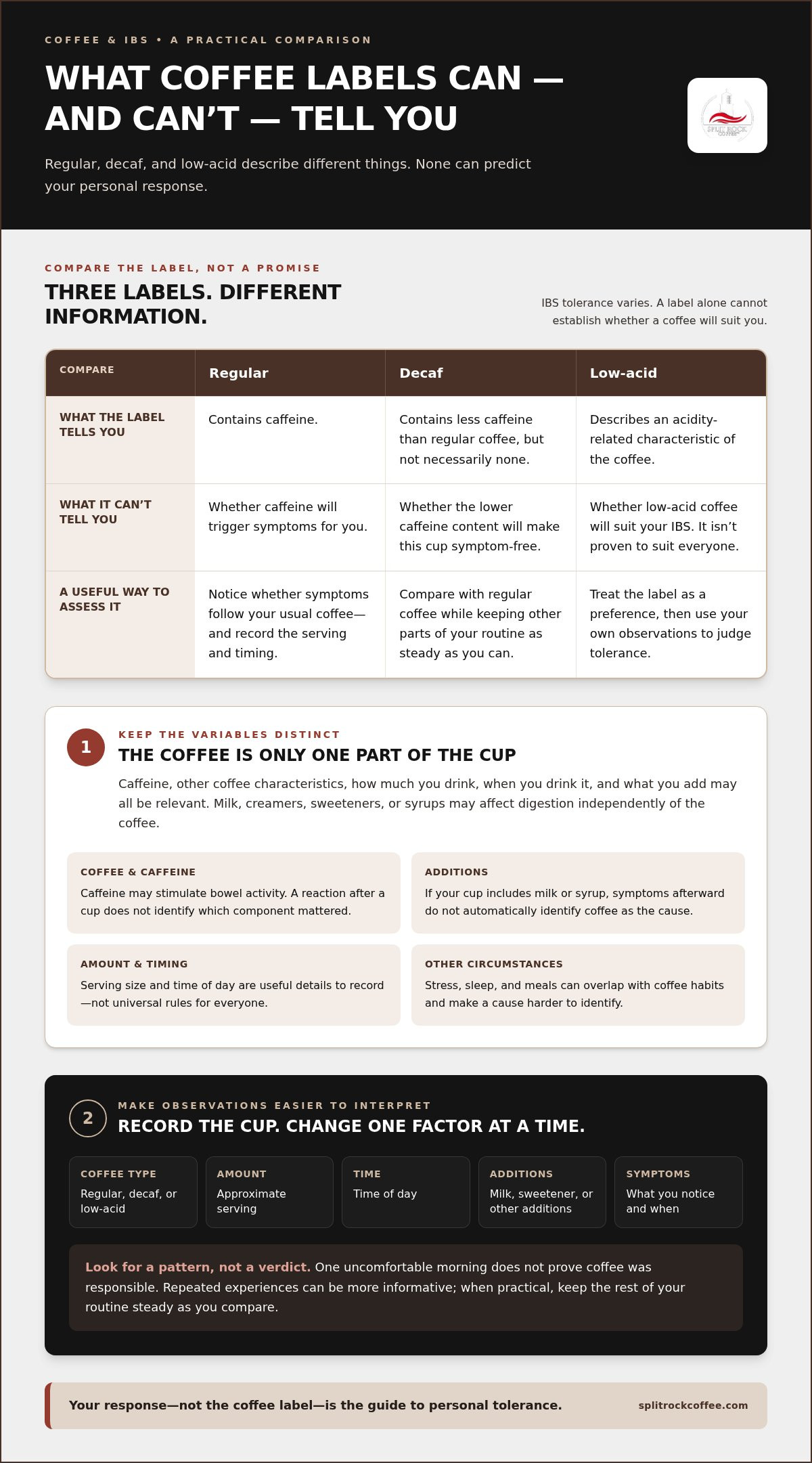
Keep the possible variables distinct: the coffee itself, its caffeine, how much you drink, when you drink it, and what you add. For example, if your usual cup includes milk and syrup, symptoms afterward don’t automatically identify coffee as the cause. Start by recording your normal routine, then compare one factor at a time.
You don’t have to choose between ignoring symptoms and giving up coffee forever. Start with curiosity and make decisions from your own observations. If symptoms are concerning, changing, or interfering with daily life, seek medical advice rather than relying on a coffee experiment to explain them. A clinician can help assess symptoms and discuss next steps, especially if you’re uncertain whether IBS is the right explanation.
How Coffee and Caffeine May Affect IBS Symptoms
Coffee can affect digestion, but there isn’t one pathway that explains every reaction. Caffeine may stimulate bowel activity, including contractions in the colon. For someone prone to diarrhea or urgency, that stimulation could be unwelcome; another person may not notice symptoms. The effect is plausible, but an IBS diagnosis alone can’t predict how you’ll respond.
Coffee may also influence stomach acid, which can contribute to upper digestive discomfort in some people. That’s different from proving coffee causes IBS symptoms. The NIDDK’s overview of IBS explains the condition and its symptoms, but a possible mechanism still can’t identify an individual’s trigger. A plausible mechanism is a reason to pay attention, not proof that coffee is causing your symptoms.
Caffeine, bowel activity, and symptom patterns
Caffeine is one factor worth observing because it can affect digestive activity. But coffee contains more than caffeine, and people may respond differently to regular and decaffeinated coffee. A reaction after a cup doesn’t tell you which component mattered. Nor does an association observed in a group establish cause and effect for an individual.
Consider the symptom and its timing as clues, not a verdict. If urgency tends to follow a stronger or larger serving, record that pattern. If discomfort appears inconsistently, note other circumstances as well. Stress, sleep, and meals can overlap with coffee habits, making a simple cause-and-effect conclusion difficult.
Coffee additions and routines can matter too
The drink around the coffee counts. Milk, creamers, sweeteners, and syrups add ingredients that may affect digestion independently of the coffee. If symptoms change after you switch creamers, for example, that doesn’t establish that the beans or caffeine were responsible. Avoid broad food restrictions based on one reaction; if you’re considering a restrictive diet, discuss it with a qualified health professional.
Serving size and timing are useful details to track, not universal rules. You might compare your usual cup with a smaller serving, or note whether you drink coffee with breakfast or on its own. Where practical, make one change at a time so the results are easier to interpret. Keep the rest of your routine as steady as you can.
For a clearer record, write down the coffee type, approximate amount, time of day, additions, and symptoms. That gives you something more useful to discuss with a clinician than a vague sense that coffee “always” or “never” causes trouble. If low acidity is one of your preferences, Split Rock Coffee offers low-acid coffee blends, but the label alone can’t establish IBS suitability. Your observations remain the guide.
Regular, Decaf, and Low-Acid Coffee: What Is Relevant to IBS?
These labels describe different things. Regular and decaf mainly differ in caffeine content, while “low-acid” describes an acidity-related characteristic of the coffee. Neither label tells you in advance whether a cup will suit your IBS symptoms. Consider which distinction matters to you, then judge by your own response.
| Coffee type | What the label tells you | What it can’t tell you |
|---|---|---|
| Regular | It contains caffeine. | Whether caffeine or another factor will trigger symptoms for you. |
| Decaf | It generally contains less caffeine than regular coffee. | That it’s caffeine-free or that you’ll tolerate it. |
| Low-acid | It’s marketed for a lower-acidity characteristic. | That it’s suitable for IBS or will prevent symptoms. |
Does decaf make coffee easier to tolerate?
If you suspect caffeine may be part of your response, decaf can be a useful comparison. Decaffeinated coffee generally has less caffeine, but it isn’t necessarily caffeine-free. A different response to decaf may offer a clue about your own pattern, but it doesn’t prove caffeine was the only factor. The drinks may differ in other ways, too.
Decaf is an option to test, not a guaranteed IBS solution. To compare it with regular coffee, keep the serving, timing, and additions as similar as reasonably possible. That makes the comparison more informative than changing several parts of your routine at once.
Does low-acid coffee help with IBS?
Acidity and IBS triggers are separate questions. A low-acid label doesn’t establish that a coffee is gentle on the gut or appropriate for every person with IBS. Split Rock Coffee offers low-acid blends as a coffee choice, not as an IBS treatment or a way to prevent a flare. Choose one if its characteristics appeal to you, then observe how you respond.
Keep your reason for trying it clear. If you’re exploring acidity, compare that choice without assuming it addresses caffeine sensitivity or other possible triggers. For more background, the site’s The Ultimate Guide to Low Acid Coffee covers acidity context, and Best Low Acid Coffee Beans in 2026 offers product-selection context. Those topics can inform a choice, but neither title is evidence that a particular coffee is IBS-safe.
For coffee for people with IBS, the useful question isn’t simply “regular, decaf, or low-acid?” It’s which distinction you want to explore and what changes in your symptoms when you do. Keep your comparison measured, and use your notes rather than a product label to guide the next cup.
How to Test Whether Coffee Is an IBS Trigger
A useful test starts with a clear picture of your current routine, not an abrupt overhaul. Coffee habits often involve several variables: type, amount, timing, and additions. Changing everything together can make it hard to tell what matters. This is an observation exercise, not a way to diagnose IBS or prove a cause.
Keep a simple coffee and symptom record
Use a notebook or phone note to capture details while they’re fresh. Record what you drank and how you felt in your own words, such as “cramping about an hour later” or “no noticeable change.” Avoid labeling a symptom as a confirmed coffee reaction after a single occasion.
Then follow a steady sequence:
- Observe your usual habits. Note your typical coffee type, approximate serving, time of day, and additions, along with symptoms and their timing. Include other context that may help explain a different day, such as a changed meal or disrupted sleep.
- Choose one variable to explore. You might compare your usual amount with a smaller serving, or compare regular coffee with decaf. Keep other parts of your routine as similar as practical. Changing one variable at a time can make personal patterns easier to interpret.
- Keep recording. Track the same details after the change. Note whether symptoms appeared, what they felt like, and when. The aim is to collect observations, not to force a particular outcome.
- Review for repeat patterns. Look back across multiple occasions. Ask whether a similar response followed the same type, amount, timing, or addition, and whether there were days that didn’t fit the pattern. One episode alone isn’t enough to settle the question.
When to pause or ask a clinician
Pause an experiment if it makes you feel worse or causes significant concern. Speak with a healthcare professional if symptoms are persistent, worsening, or affecting daily life. Coffee notes can help you describe what’s happening, but they can’t establish a diagnosis or rule out other causes.
Get professional guidance before making major dietary changes or starting a restrictive protocol. A clinician can help you decide what’s appropriate for your health and whether further assessment is needed. You don’t have to eliminate multiple foods or coffee altogether to gather useful information; keep the approach measured and focused.
Once you have a clearer sense of your preferences, explore Split Rock Coffee’s whole bean and ground coffee options as choices for your next comparison. No selection is an IBS treatment, so let your notes, rather than a label or promise, guide what you try.
Choosing Coffee With IBS: Make the Next Cup a Personal Decision
Your coffee choice doesn’t need to follow a universal IBS rule. Use what you’ve observed, consider which factor you’re testing, and choose a next step that feels manageable. If your notes suggest caffeine may matter, you might compare a lower-caffeine option. If an addition seems connected to symptoms, you could try changing that ingredient instead. Smaller adjustments are options, not requirements.
Match the coffee choice to what you observed
Look for repeat patterns in your record rather than relying on a general claim that one type suits everyone. If regular coffee seems linked with symptoms, decaf could be one comparison. If you’re interested in low-acid coffee, treat acidity as a separate preference to explore, not proof of IBS suitability. Keep your serving and routine as consistent as you can while testing a change, and avoid declaring a winner from one cup.
Your preferred format matters, too. Split Rock Coffee offers whole bean and ground coffee, so you can choose the format that fits your usual preparation. Keeping your preparation familiar may make it easier to compare cups without changing several things at once. The aim is to choose based on your preferences and observations, not a product label that promises a particular health result.
Explore coffee options without expecting a cure
Split Rock Coffee offers low-acid blends and The Gold Standard Coffee Beans. These are coffee choices, not IBS-specific treatments, and neither should be expected to prevent symptoms. A monthly subscription is another way to receive coffee regularly, but it’s a convenience option, not a health intervention. Let your own experience guide whether a selection suits you.
If symptoms remain difficult to manage, or you’re considering substantial changes to what you eat or drink, discuss your plan with a healthcare professional. Their guidance can help you make decisions in the context of your health, rather than relying on an online promise or an isolated reaction.
For coffee for people with IBS, the most useful decision is grounded in your experience: what you noticed, which variable you explored, and what you want to try next. Keep the process steady and flexible. If you’re ready to choose coffee based on your preferences, explore Split Rock Coffee.
Make Your Next Cup a Thoughtful Choice
Your next step doesn’t have to be a permanent rule. Let your notes guide one manageable choice, then adjust as you learn more. The best coffee for people with IBS is the one that fits your preferences and personal tolerance, not a label promising the same result for everyone.
If you’re ready to explore your options, Split Rock Coffee offers low-acid blends and The Gold Standard Coffee Beans in whole bean or ground formats. Founded in 2013, the company is a Disabled Veteran-Owned Small Business. These are coffee choices, not treatments or guarantees about IBS symptoms.
Explore Split Rock Coffee’s selections and choose a coffee that feels right for your next careful comparison. Stay curious, take it one cup at a time, and trust the process you build for yourself.
Frequently Asked Questions
Can coffee make IBS symptoms worse?
It can coincide with or contribute to symptoms for some people, but it isn’t a trigger for everyone. For example, urgency after a large morning coffee could relate to the serving, caffeine, timing, or what you ate with it. Note the details before drawing conclusions. A recurring pattern is more informative than one uncomfortable day. If symptoms persist, worsen, or concern you, discuss them with a qualified healthcare professional.
Is decaf coffee better for people with IBS?
Decaf may be worth comparing if you suspect caffeine, but it isn’t guaranteed to feel easier. Decaffeinated coffee generally contains less caffeine than regular coffee, though it may still contain some. If you’re comparing products, check their current information rather than assuming all decaf has the same caffeine content. Keep your cup size and additions similar during the comparison, and record whether your symptoms differ.
Can people with IBS drink low-acid coffee?
Some people with IBS may choose low-acid coffee, but its acidity label can’t promise that it will prevent symptoms. Acidity and caffeine are different considerations, and a lower-acidity description doesn’t establish how your digestive system will respond. If you try one, note what changed and how you felt afterward. Don’t treat a marketing description as medical guidance, especially if symptoms are persistent or concerning.
How much coffee can you drink with IBS?
There isn’t one amount that suits everyone with IBS. Your response may differ depending on the coffee, caffeine, time of day, and the rest of your routine. Rather than treating someone else’s serving as your limit, note the approximate amount you drink and what follows. If you’re unsure what’s appropriate for you, or symptoms are difficult to manage, ask a healthcare professional for advice tailored to your health.
Does caffeine-free coffee still affect IBS?
It may still be relevant to your symptoms, because removing caffeine doesn’t remove every other feature of coffee or what you add to it. Also, decaffeinated coffee generally contains less caffeine, but may not be entirely caffeine-free. If you’re trying a product described as caffeine-free, check its specific information. Persistent symptoms or plans for major dietary changes are good reasons to seek guidance from a qualified healthcare professional.
Should I stop drinking coffee if I have IBS?
Not necessarily. Some people with IBS can keep coffee in their routine, while others find that it seems connected to symptoms. You could first consider a modest change, such as adjusting an addition or serving, instead of making a broad restriction on your own. If you’re thinking about removing coffee or other foods long-term, discuss the plan with a clinician so it fits your individual health needs.
Can milk or sweeteners in coffee trigger IBS symptoms?
They may be relevant for some people, so consider what’s in the cup as well as the coffee. If your usual drink contains milk and a sweetener, for instance, note the type and amount rather than recording it simply as “coffee.” To explore a possible connection, change one addition at a time. A qualified healthcare professional can offer personalized dietary guidance if symptoms continue or restrictions seem necessary.


