Coffee Subscription Cost Comparison: Price Per Cup and Extra Fees
A coffee subscription isn’t automatically the cheaper option per cup. For a useful coffee subscription cost comparison, add the coffee price and shipping, then divide by the number of cups you brew. Compare that result with grocery-store coffee and account for extras you regularly buy. A low bag price alone can hide the real cost.
It makes sense to look beyond the headline price: delivery frequency, bag size, brewing strength, and shipping all affect what you spend and how quickly you use each order. This guide shows you how to calculate your per-cup cost, compare subscription coffee with grocery-store options, and spot fees or add-ons that can push your budget higher. You’ll also get a straightforward way to decide whether convenience, choice, and a dependable supply are worth the difference for your coffee routine. No guesswork. Just a fair comparison based on what you actually drink and pay.
Key Takeaways
- Compare subscription and grocery coffee by cost per cup, not just the price printed on the bag.
- Estimate how many cups your usual brewing dose yields; bag size and coffee strength can change the result.
- Include delivery charges in your calculation, and weigh free-shipping thresholds against the extra coffee you’d need to order.
- Match delivery frequency to how quickly you drink coffee so convenience doesn’t turn into excess spending or unused beans.
Are coffee subscriptions worth it?
A subscription’s value depends on the coffee, bag size, delivery charges, and how much you brew. Compare those details with grocery-store options before deciding whether the convenience is worth the total cost.
Subscription and Grocery-Store Coffee Prices
Grocery-store coffee may have a lower shelf price, while specialty subscriptions can offer more variety in origin and roast. Compare each bag’s price with its weight and the number of cups you actually brew. A small sampler, for instance, may cost more per cup than a full bag even if its shelf price is lower.
For whole bean or ground coffee, the cheapest subscription is generally the value tier, but bag size and delivery charges affect the final comparison. A 16-ounce bag offers more coffee than a 12-ounce bag, so compare equal weights rather than choosing by the printed price alone.
Subscription Discounts and Bag Prices
Some roasters discount recurring orders, but the saving matters only after you include shipping and bag size. Add the coffee price and shipping for each delivery, then divide by the cups you expect to brew. This makes it easier to compare a smaller discounted bag with a larger grocery-store option.
Bag format matters, too. Samplers commonly contain 4 to 6 ounces, while full bags may contain more; weigh variety against the amount you’ll use before the next delivery.
Coffee Subscription Price Tiers
Value, mid-tier, and premium subscriptions describe price ranges, not a universal quality scale. Specialty coffee may reflect its origin and selection, while grocery-store coffee may suit everyday convenience. Compare the coffee you prefer, the bag’s weight, and shipping to see which option fits your routine.
Subscription policies differ. Cancellation stops future renewals, pausing delays delivery, and skipping bypasses a scheduled order. Compare these options before choosing a recurring plan.
| Option | Bag or tier | Delivery and flexibility |
|---|---|---|
| Grocery-store whole bean | Everyday bag | Buy as needed |
| Grocery-store ground | Everyday bag | Buy as needed |
| Value subscription | Value tier | Recurring delivery |
| Mid-tier subscription | Mid-tier | Recurring delivery |
| Premium subscription | Premium tier | Recurring delivery |
| Sampler subscription | 4-to-6-ounce bags | More variety per order |
Compare equal bag weights, cup yields, delivery charges, and the flexibility to pause, skip, or cancel.
How Do I Calculate the Real Per-Cup Cost of My Subscription?
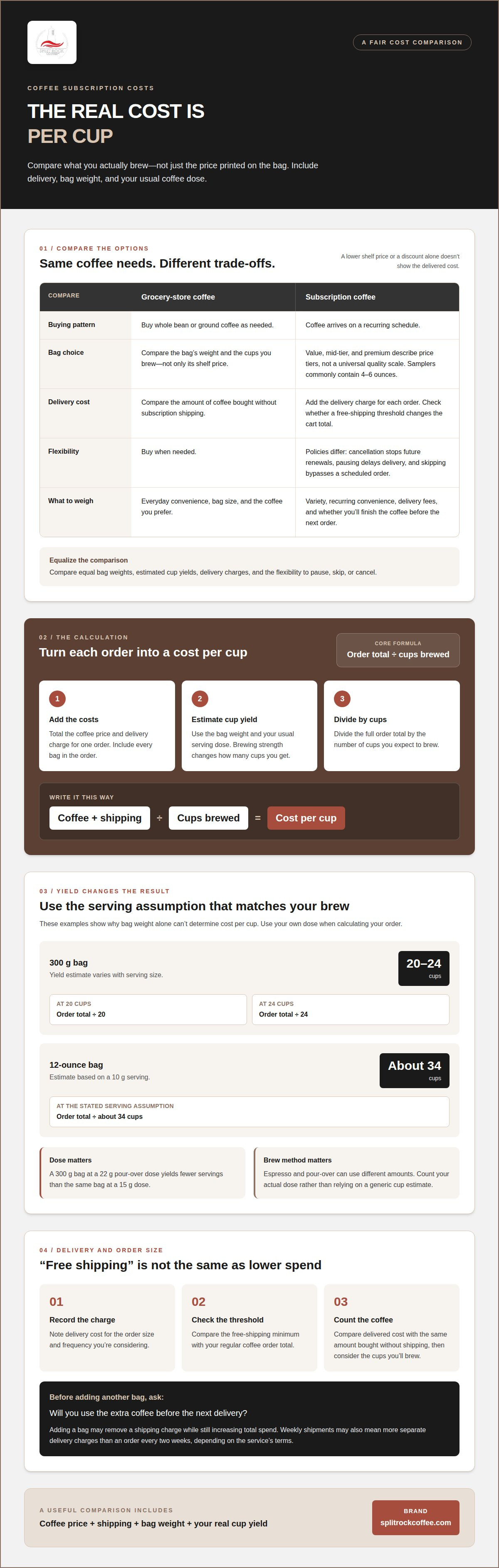
Use the full amount paid for each delivery, then divide it by the cups brewed from that coffee. The calculation is simple, but the yield changes with serving size, brewing method, and strength. A 300g bag can yield roughly 20 to 24 cups, while a 12-ounce bag can yield about 34 cups using a 10g serving assumption. Keep each estimate tied to its serving assumption.
- Add the costs. Include the coffee and delivery charge for one order. If the subscription includes more than one bag, total the order before calculating.
- Estimate cup yield. Use the bag’s weight and your usual dose. A 300g bag yielding 20 cups gives a different result from one yielding 24.
- Divide total order cost by cups. This gives the actual cost per cup, including delivery.
For example, label an order total “T” and the number of cups “C.” Divide T by C. If a 300g bag produces 20 to 24 cups, calculate both ends: T divided by 20 and T divided by 24. The range shows how brewing strength shifts your result without assuming every drinker uses the same dose.
Espresso and pour-over can use different amounts of coffee, so count your actual dose rather than relying on a generic cup estimate. A 300g bag used at 22g per pour-over cup yields fewer servings than the same bag used at a 15g dose. Record the dose for a week, then use that selection of real servings in your calculation.
For weekly deliveries, calculate each order separately if the bag size or selection changes. Add the cost of every bag and shipping, then divide by the cups you expect to brew before the next delivery. Recalculate if you change your brewing dose or coffee. Leftover beans or running short can help you refine your estimate.
Shipping fees and free-shipping thresholds
Shipping affects a subscription’s delivered cost, especially when small orders arrive frequently. Compare the shipping charge for each delivery with any order minimum for free shipping. These are general examples, not a universal rule or a quote for a specific subscription.
Use this three-step check before comparing plans:
- Record the delivery charge for the order size and frequency you’re considering.
- Check the free-shipping threshold and compare it with the cart total for your regular whole bean or ground coffee order.
- Compare the delivered order with the same amount of coffee bought without shipping, then consider how many cups you’ll brew.
A free-shipping threshold can make a larger order seem appealing, but extra coffee only makes sense if you’ll use it. If your usual order falls below the minimum, adding a bag may remove the shipping charge while increasing your total spend. Include the extra coffee in your plan rather than treating “free shipping” as a saving by itself.
Delivery frequency matters, too. Weekly shipments may mean more separate delivery charges than an order every two weeks, depending on the service’s terms. But a larger, less frequent shipment may not suit your brewing pace or flavor preferences. Match the quantity to how quickly you finish the coffee, so whole beans don’t accumulate between deliveries.
For a fair coffee subscription cost comparison, add shipping to the coffee price for each delivery, then divide that total by the cups you expect to brew. Keep the brewing method and serving size consistent across plans. Otherwise, a stronger cup or different method can make one option seem more expensive, even when delivery terms are similar. Recalculate when order size or frequency changes.
How much does coffee subscription delivery cost, including shipping?
The delivered cost is the coffee charge plus shipping for each order. To compare plans fairly, divide that combined total by the cups the order yields. The shipping cost per cup depends on how many cups you brew from the order, so divide the delivery charge by your estimated cup yield.
Use the same calculation for each subscription and keep the serving size consistent. A stronger brew uses more coffee per cup, leaving fewer servings in the bag and assigning more of the shipping cost to each cup. Your brewing method and dose affect the result, not just the bag’s listed weight.
Delivery frequency also changes the total. If a plan sends one bag per order, more frequent deliveries may mean more shipping charges over time. A larger order can spread one delivery charge across more coffee, but only if you’ll use the extra beans. A schedule that outpaces your brewing can leave coffee sitting unused.
- Record the full order total: include the coffee and shipping charge.
- Estimate the order’s cup yield: use the bag weight and your normal dose.
- Divide total cost by cup yield: repeat for each plan using the same brewing assumptions.
- Compare delivery schedules: account for how often orders arrive and how much coffee you finish between shipments.
To compare a one-bag delivery with a multiple-bag delivery, divide each order’s shipping charge by its expected cups. Then consider whether the larger shipment fits your routine. A lower shipping cost per cup isn’t useful if the coffee arrives faster than you can brew it.
Build your comparison around actual order size, shipping, and your coffee use. Find a coffee delivery routine that fits the way you brew.
Split Rock Coffee: The Gold Standard Coffee Beans
Split Rock Coffee offers The Gold Standard Coffee Beans for everyday brewing, along with whole bean and ground options. If recurring deliveries suit your routine, the Monthly Coffee Subscription offers a way to plan your supply. Choose the format that works with your brewing setup.
Use your per-cup calculation to guide your decision: consider how much coffee you use, which format you prefer, and whether recurring delivery fits your household. If you’d rather avoid a recurring order, buy coffee without a subscription. Matching your brewing habits to the format helps keep the purchase purposeful.
For help deciding which option fits your coffee routine, contact Split Rock Coffee.
Choose a Coffee Routine That Holds Up
Your tastes, schedule, and brewing habits can change. Treat a coffee subscription cost comparison as a practical decision tool, not a permanent verdict. If you brew more often, switch methods, or want a different flavor profile, revisit what suits your day. A good choice fits both the cup you enjoy and the routine you can maintain.
Split Rock Coffee offers smooth, stomach-friendly roast options as another choice for your daily routine. Consider what you want from your next order, whether a different coffee experience or a regular supply. Let your preferences guide the decision; a subscription is optional. The right fit is the one that works for your everyday rhythm.
Ready to take that next step? Explore coffee options with Split Rock Coffee and choose a path that suits your routine. A thoughtful choice is a strong place to begin.
Frequently Asked Questions
What Hidden Fees Push Your Real Cost Higher?
Shipping, recurring delivery charges, and optional additions can raise your spending beyond the bag price. Adding an item to reach a free-shipping threshold, for example, still increases the order total. Check whether shipping recurs with each delivery and include any extras you usually select. That gives you a clearer picture of your spending over time.
What are the monthly prices of popular coffee subscriptions in the US?
There’s no single monthly total for every coffee subscription. Spending depends on the coffee, quantity, delivery schedule, and shipping terms. To estimate a plan’s monthly cost, multiply the price of one delivery by the number of deliveries in the month, then add shipping. This helps you compare your likely order pattern without assuming every subscription works alike.
How do coffee subscription prices compare per ounce or per cup?
For a per-ounce comparison, divide the coffee price by its stated weight in ounces. For a per-cup comparison, divide the delivered order total by the servings you brew. A useful coffee subscription cost comparison keeps the brewing dose consistent across options. Otherwise, a stronger cup uses more coffee and changes how many servings each bag provides.
How do specialty coffee subscriptions compare with grocery coffee subscriptions?
Specialty subscriptions can make origin and roast selection part of the buying experience, while grocery stores offer products stocked for regular shopping. Compare what matters to you in the cup: flavor, whole bean or ground format, and the chance to try different coffees. Consider whether a subscription’s selection suits what you enjoy brewing, not just how it arrives.
Do coffee subscriptions offer discounts for longer plans or first-time customers?
Discounts depend on the subscription’s terms. Some plans discount an initial order, while others reduce the cost of recurring purchases. Check how long the offer lasts, which orders qualify, and whether it requires a longer commitment. Compare the total over the period you plan to subscribe, rather than choosing based only on the first shipment’s promotion.
How do subscription costs vary by delivery frequency and bag size?
More frequent deliveries may mean more separate charges, while larger bags change how much coffee each order supplies. Compare a plan that delivers one bag weekly with one that sends a larger shipment every two weeks. Estimate the number of orders in your billing period and match each order’s quantity to your household’s actual use. This shows which schedule better fits your routine.


