How Coffee Acidity Is Measured and What the Results Mean
Coffee’s bright flavor can’t be captured by one number. How coffee acidity is measured depends on the method: pH tests the brewed liquid, titratable acidity measures how much base it takes to reach a set endpoint, and HPLC identifies specific acids. Brewed coffee commonly falls between pH 4.85 and 5.13, but that reading alone doesn’t tell you how sour or lively a cup will taste.
You may already know that some coffees taste brighter than others. The reason involves more than a single pH reading: coffee variety, roast development, brewing, and the balance of acids all shape the cup and how you perceive it. This guide explains what pH and titratable acidity reveal, how roasting changes acid composition, and why coffees can taste different even when their measurements look similar. You’ll learn how to interpret the results and connect them to flavor.
Key Takeaways
- Use pH to understand the brewed liquid, and titratable acidity to see how its acids respond during a controlled test; neither measurement alone fully predicts flavor.
- Read acidity alongside taste: a bright or tangy cup reflects the balance of acids and other flavor compounds, not just one lab result.
- Roast development changes the mix of acids, so roast level can influence both measured acidity and the character in your cup.
- Bean variety, growing conditions, and brewing choices all shape acidity; explore Split Rock Coffee’s Low Acid Coffee Blends if you’re looking for a gentler-tasting option.
Coffee acid composition and flavor perception
Coffee contains more than 30 different organic acids, and their balance shapes flavor rather than producing one simple “acid” taste. Citric acid, malic acid, and acetic acid can contribute tangy or bright notes, while acidity can also balance bitterness. Chlorogenic acid occurs in nearly a dozen molecular configurations, called isomers, adding complexity to the coffee’s chemical profile.
The measurements describe different things. A pH test assesses brewed coffee as a liquid, while titratable acidity measures how much base is needed to reach a chosen endpoint. Neither result represents the coffee’s total acid concentration. Titratable acidity also depends on acid dissociation, buffering compounds, and the endpoint selected for the test.
For example, titratable acidity to pH 8 measured 71 ± 9 mg CQA per gram of coffee grounds in a brewed-coffee sample. That figure is expressed as caffeoylquinic acid equivalents, not a direct count of every acid molecule. A pH reading and this titration result therefore answer different questions about the same cup.
HPLC provides another view by identifying and quantifying selected compounds. In a brewed-coffee sample, HPLC detection of 3-, 4-, and 5-caffeoylquinic acids measured 27 ± 6 mg CQA per gram of coffee grounds. Unlike titratable acidity, which accounts for all acids in the sample, this HPLC result covers those caffeoylquinic acids.
Brewing conditions affect what ends up in the cup. Longer brewing and lower water temperatures may lower acidity, while hotter water can extract acids differently. Cold brew combines a long steep with cool water, so its acidity profile may differ from hot-brewed coffee. Strength matters, too: in tested drip coffees, titratable acidity tracked total dissolved solids. A stronger brew may therefore measure higher, even when the beans are unchanged. Consider the test method and brewing conditions together to understand why a measured value may not match the cup’s perceived flavor.
Measuring coffee acidity with the pH scale
A pH test measures the acidity of brewed coffee as a liquid. Brewed coffee commonly measures between pH 4.85 and 5.13, below neutral.
Interpreting the Logarithmic pH Scale
The pH scale describes how acidic or alkaline a liquid is, with neutral readings between the two. It’s logarithmic, so a change of one pH unit represents a tenfold change in acidity, not a small, even step.
For example, a sample at pH 5 is more acidic than one at pH 6 by a tenfold factor on this scale. That distinction helps explain why close-looking readings can represent meaningful chemical differences. Still, pH describes the concentration of hydrogen ions in the liquid, not the full amount of acids present or the cup’s perceived sourness.
Coffee pH Ranges
Brewed coffee generally falls between pH 4.85 and 5.13, while pH 7 is neutral. As a broad comparison, coffee sits below milk or saliva at pH 6 and above tomato juice or beer at pH 4.
Tea, juice, and soda vary by type and formulation, so their names alone don’t establish a reliable pH ranking against coffee. A direct comparison requires testing each brewed or poured sample using the same method. A pH result also can’t establish whether coffee will trigger reflux or affect tooth enamel: it measures the drink, not an individual health outcome.
Equipment for Home pH Testing
To test coffee at home, use a pH meter with a probe and a clean cup for the brewed sample. Follow the meter’s instructions, place the probe in the coffee, and wait for a stable reading before recording it.
Meters generally measure acidity or alkalinity within 0.1 to 0.2 pH units, so treat small differences with care. Test samples at similar temperatures and brewing strengths for a more useful comparison. A meter reading can show whether one cup is more acidic by pH, but it can’t identify every acid or replace a titration test.
Roast development and titratable acidity
Roasting transforms the acids in coffee beans, so roast level changes both their measured composition and potential flavor. The relationship isn’t a simple, steady decline.
Roasting and Acid Profiles
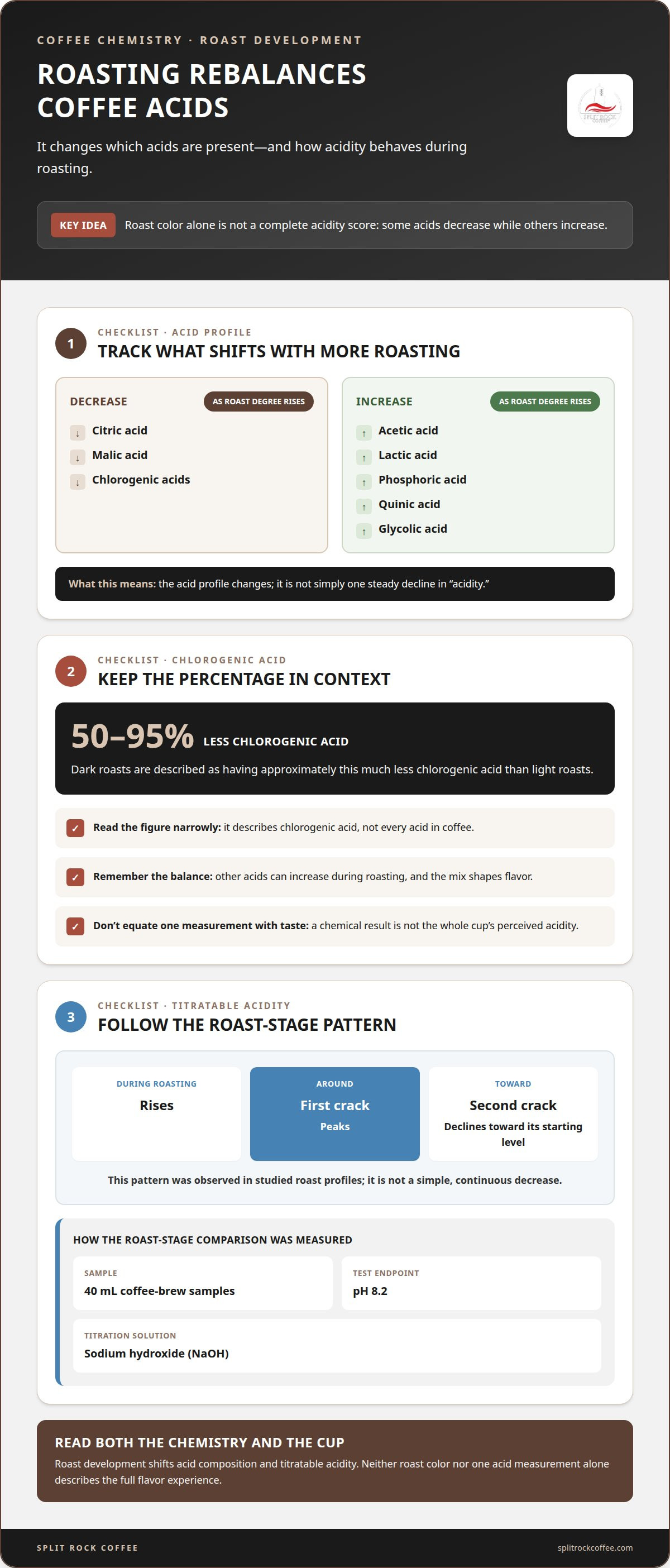
Heat shifts the balance of acids as coffee roasts. As roast degree increases, citric, malic, and chlorogenic acids decrease, while acetic, lactic, phosphoric, quinic, and glycolic acids increase. The profile changes, rather than just the amount of one acid. A darker roast can therefore taste different without every acid moving in the same direction.
Flavor reflects this changing mix. To compare roasts, consider both the specific acids and the overall measurement rather than treating roast color as a complete acidity score.
Roast Level and Chlorogenic Acid
Chlorogenic acid generally declines as roasting progresses, making roast level a useful clue to its relative amount. Dark roasts are described as having approximately 50-95% less chlorogenic acid than light roasts.
That range describes chlorogenic acid, not every acid in coffee or the cup’s total perceived acidity. Other acids can increase during roasting, and taste also depends on the balance of compounds. A lighter roast may retain more chlorogenic acid, while a darker roast may still contain other acids that shape its profile. This distinction helps prevent one chemical measurement from standing in for the whole flavor experience.
Titratable Acidity in Roast Development
Titratable acidity tracks how a brewed sample responds to a base during testing, and it can shift across a roast profile. In studied profiles, it rose during roasting, peaked around first crack, then declined toward its starting level by second crack.
In the 2024 roast research, researchers titrated 40 mL coffee-brew samples with sodium hydroxide to an endpoint of pH 8.2. This controlled endpoint made it possible to compare roast stages using the same test approach. The result shows why roast development matters: acidity can rise and fall during roasting, even as individual acids follow different patterns. A roast label alone can’t capture that progression.
Acidity differences among coffees
Coffee acidity varies with bean species, growing elevation, and origin, so no single profile represents every cup. Arabica beans are generally considered more acidic than Robusta beans, while coffees grown at higher elevations tend to show higher acidity than those grown lower down. These are useful patterns, not complete flavor predictions: roast development and brewing also influence the cup.
Measured examples show how origin can differ. In one experiment, Kenyan coffee measured pH 4.3, Panamanian coffee measured pH 4.5, and Sumatran coffee measured pH 4.6. Those readings describe the brewed samples’ pH, not a universal score for every coffee from Kenya, Panama, or Sumatra. A different roast or brew can produce a different result.
Flavor adds another layer. A brighter cup may taste tangy, while acidity can also balance bitter notes. Specialty coffee isn’t automatically high or low in acidity; species, growing conditions, roast, and preparation all contribute. Tasters may perceive sourness differently from what pH alone suggests, so tasting and measurement answer related but distinct questions.
For a useful comparison, keep preparation consistent: brew each coffee using the same method, water temperature, and strength, then compare the taste. If one sample tastes sharper, note whether it also seems more sour or simply more vivid. This helps avoid crediting origin for a difference that brewing may explain. Treat variety and elevation as clues, then judge each coffee as brewed.
If you prefer a gentler cup, explore Low Acid Coffee Blends as an option alongside these origin and flavor differences.
Split Rock Coffee: Low Acid Coffee Blends
Split Rock Coffee offers Low Acid Coffee Blends for readers seeking an option described as lower in acidity. When comparing cups by pH or flavor, remember that one reading doesn’t describe every aspect of a coffee’s taste. Your brewing method and preferred flavor profile matter, too.
Choose Whole Bean and Ground Coffee options, or explore The Gold Standard Coffee Beans. A Monthly Coffee Subscription offers a convenient way to make coffee part of your routine. These options provide a practical next step if you want to spend less time interpreting acidity measurements and focus on finding coffee that suits your preferences.
For more information about your options, contact Split Rock Coffee.
Choose Your Next Cup with Confidence
Understanding how coffee acidity is measured can help you make more informed choices, but your preferred flavor is the final guide. Use measurements to compare coffees, then pay attention to what you enjoy in the cup and how you prepare it. Technical results are a practical starting point, not a rulebook.
If you’re ready to make a change, consider which coffee format and routine suit you best. Split Rock Coffee offers a Monthly Coffee Subscription, an optional way to make coffee part of your day. Choose the experience you want, whether that means exploring a different profile or settling into a regular ritual.
For help exploring your options, reach out to Split Rock Coffee. Take the next step at your own pace, and let each cup help you refine what tastes right to you.
Frequently Asked Questions
How is coffee acidity measured?
The practical answer to how coffee acidity is measured is by testing brewed coffee or analyzing its chemical compounds. A pH meter gives a reading for the liquid, while titration records how much base is needed to reach a chosen endpoint. HPLC can identify selected acids. To compare two coffees meaningfully, keep the brewing method and strength consistent, then interpret the measurement alongside taste.
What is pH and titratable acidity in coffee?
pH describes hydrogen-ion activity in brewed coffee, while titratable acidity reflects how the sample responds to added base during a test. They aren’t interchangeable. Two cups, for example, can have similar pH values but differ in titratable acidity because their acids and buffering compounds differ. The titration endpoint also affects the result, so comparisons require the same endpoint and test conditions.
How do researchers measure coffee acidity in a lab?
Researchers can titrate a measured coffee sample with sodium hydroxide, recording how much is needed to reach a defined pH endpoint. A 2024 UC Davis roast-profile study used 40 mL samples and an endpoint of pH 8.2. Researchers can also use HPLC to quantify selected caffeoylquinic acids. These approaches answer different questions: one captures acidity from all acids, the other targets particular compounds.
What pH range is typical for brewed coffee?
Brewed coffee typically measures pH 4.85 to 5.13. That range is a useful reference for the liquid, not a complete prediction of how sour a cup will taste. If you compare coffees at home, test them using similar brewing conditions and interpret small differences cautiously. A pH reading describes acidity on that scale; it doesn’t identify which acids are present.
How does coffee acidity vary by bean, roast level, and brewing method?
Acidity varies with bean species, growing conditions, roast development, and preparation. Arabica is generally considered more acidic than Robusta, and higher-elevation coffees tend toward higher acidity. Roasting changes the balance of individual acids. Brewing matters, too: grind size, water temperature, and steeping time affect extraction. For a fair taste comparison, change one variable at a time, such as the roast, while keeping the brewing method consistent.
How does perceived acidity differ from measured pH in coffee?
Perceived acidity is the sour or bright quality a person tastes; pH is a chemical reading of the brewed liquid. A 2021 study in ACS Food Science & Technology found perceived sour intensity in tested drip coffees correlated weakly with pH and strongly with titratable acidity. So a lower pH doesn’t automatically mean a cup will taste sharper. Strength and the balance of flavors also shape perception.


