
Coffee for Interstitial Cystitis: How to Find Your Personal Triggers
Can coffee for interstitial cystitis be a personal choice rather than an automatic no? If your morning cup feels comforting but you’re unsure whether it may contribute to urgency, discomfort, or a flare, that uncertainty is real. Coffee affects people with IC/BPS differently, and neither caffeine nor acidity tells the whole story for everyone.
You don’t have to guess or give up a familiar ritual without understanding your own response. This guide explains why coffee may bother some bladders, why a low-acid label isn’t a promise of symptom relief, and how to cautiously track symptoms and discuss concerns with a clinician. You’ll also learn how to compare factors such as caffeine, acidity, and serving choices while making room for your own experience. If you decide to keep coffee in your routine, low-acid blends, including those from Split Rock Coffee, are one characteristic to explore, not a treatment or guarantee. The aim is steady, informed decision-making, with your comfort and care at the center.
Key Takeaways
- Coffee may affect IC/BPS symptoms for some people, but there’s no universal safe-or-unsafe rule.
- Acidity and caffeine are different coffee characteristics, so consider them separately when observing your response.
- Track your usual intake and symptoms, then change one variable at a time to look for patterns.
- Compare factors such as roast, serving size, brewing strength, and timing rather than assuming decaf or a particular coffee is better for everyone.
- Explore coffee for interstitial cystitis through personal observations and clinician guidance. Low-acid blends are an option to consider, not a promise of relief.
Coffee and interstitial cystitis: what the connection may mean
Looking into coffee for interstitial cystitis can raise a difficult question: is your cup contributing to symptoms, or is the timing a coincidence? Interstitial cystitis/bladder pain syndrome (IC/BPS) involves bladder-related pain, pressure, or discomfort, often alongside urinary symptoms such as urgency or frequency. The experience differs from person to person. The Interstitial cystitis overview provides broader background, but no general description can tell you how a particular coffee will affect your bladder.
Some people with IC/BPS identify coffee as a possible symptom trigger. That observation matters, but it isn't proof that coffee causes IC/BPS or affects everyone in the same way. Symptoms can fluctuate, and several factors may change at once. A cup followed by discomfort is a pattern worth noticing, not a diagnosis or a verdict on every coffee.
Can coffee trigger symptoms for everyone with IC?
No single coffee rule fits everyone. Personal sensitivity, usual intake, and symptom patterns vary, so one person may notice a connection while another may tolerate coffee. Avoiding it isn't mandatory for everyone, and tolerance today doesn't guarantee the same response in every situation.
Coffee can be a personal symptom trigger, but it isn’t a universal cause of IC/BPS. Keeping that distinction clear helps you investigate your own experience without adopting someone else’s restrictions as your rule.
What this guide can and cannot tell you
This guide offers general education, not a way to diagnose or treat IC/BPS. It can help you think clearly about a possible link and observe your own response. It can't establish what is causing your symptoms or replace medical advice tailored to you.
If symptoms are concerning, changing, or interfering with daily life, seek guidance from a healthcare professional. Don’t assume new or worsening symptoms are simply a coffee reaction. A clinician can help assess your concerns and discuss appropriate next steps.
For practical observation, start with what you already drink and how you feel rather than making several changes at once. Note the coffee, amount, timing, and any symptoms you notice, then look for patterns across your notes. This isn't about forcing a conclusion or giving up a familiar routine prematurely. It’s a steady way to gather useful information and bring specific questions to a clinician. The next sections explore which coffee characteristics you might compare and how to approach that process cautiously.
Acidity, caffeine, and bladder sensitivity: what is different?
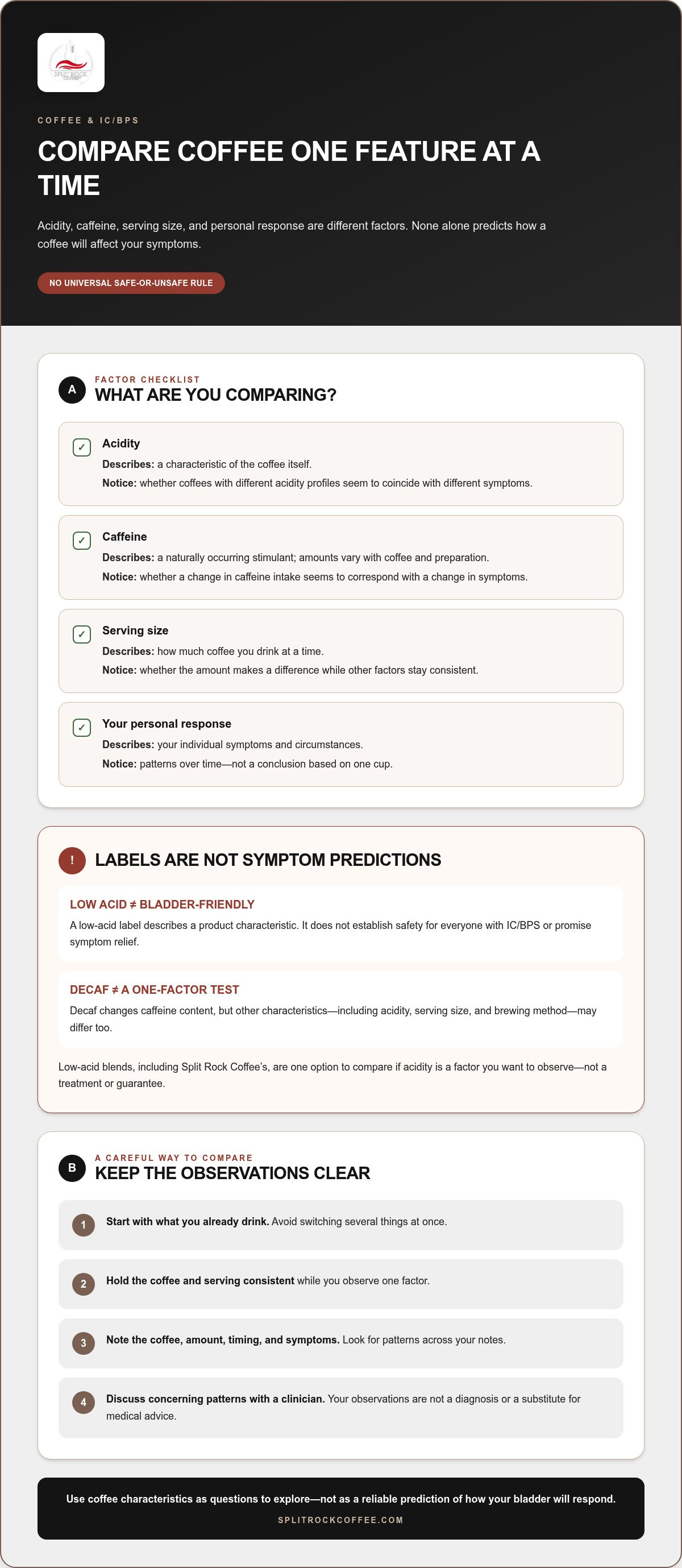
“Low acid” and “low caffeine” describe different things. Acidity relates to the coffee’s chemical profile; caffeine is a naturally occurring stimulant. Neither characteristic alone can tell you whether a particular coffee will affect your IC/BPS symptoms. The symptoms and potential causes of IC can vary, so use these features as questions to consider, not as a reliable prediction of how your bladder will respond.
| Factor | What it describes | What you can observe |
|---|---|---|
| Acidity | A characteristic of the coffee itself | Whether coffees with different acidity profiles seem to coincide with different symptoms |
| Caffeine | A component of regular coffee, present in different amounts depending on the coffee and preparation | Whether changing caffeine intake seems to correspond with a change in your symptoms |
| Serving size | How much coffee you drink at a time | Whether amount makes a difference while other factors stay consistent |
| Personal response | Your individual symptoms and circumstances | Patterns over time, rather than a conclusion based on one cup |
Does low-acid coffee mean bladder-friendly coffee?
No. A low-acid label describes a product characteristic; it doesn't establish that a coffee is safe for everyone with IC/BPS or that it will relieve symptoms. Claims about acidity or stomach comfort also don't demonstrate a bladder benefit. These are distinct experiences, and a product description can't predict your personal response.
Split Rock Coffee’s low-acid blends are one option to consider if acidity is a characteristic you want to compare. Treat the label as a starting point for your own observations, not as a treatment claim or a promise of relief.
Could caffeine matter more than acidity?
Caffeine may be a separate variable to track, but there’s no universal answer about whether it matters more. Regular and decaffeinated coffee differ in caffeine content, and choosing decaf doesn't isolate every other feature, including acidity, serving size, or brewing method. Consider caffeine and acidity separately rather than assuming either one explains a symptom.
If you’re exploring coffee for interstitial cystitis, avoid switching several things at once. Keep the coffee and serving consistent while you observe one factor, then discuss concerning patterns with a clinician. If you decide to compare acidity as one variable, explore Split Rock Coffee’s low-acid blends without treating “low acid” as a guarantee about symptoms.
How to compare coffee choices when you have IC/BPS
Compare one feature at a time, and separate what you enjoy in the cup from what you notice in your symptoms. Regular and decaffeinated coffee aren’t universally better or worse for IC/BPS. Decaf changes caffeine content, but it may also differ in taste and other coffee characteristics, so it isn’t a perfect one-variable test. Roast descriptions and product details can help you choose what to compare, but they aren’t medical evidence or a prediction of symptom relief.
Which coffee characteristics are useful to compare?
| Characteristic | What to note | How to use it |
|---|---|---|
| Caffeine status | Regular or decaffeinated | Record the choice; don’t assume one is better for your symptoms. |
| Roast description | Light, medium, dark, or the wording on the package | Use it to distinguish coffees, not to infer a health effect. |
| Serving size | The amount in your usual cup | Keep it consistent while comparing other features. |
Brewing strength and timing can matter to your observations, too. A larger or stronger cup may differ from your usual serving, while drinking coffee at a different time may make patterns harder to interpret. Write down the details rather than relying on memory. A low-acid blend is another product characteristic you can evaluate, not a therapeutic category or guarantee. For broader context on what acidity means in coffee, see this low-acid coffee guide.
Does brewing method change the decision?
It changes the cup. The brewing method, coffee amount, and water used can affect how strong or flavorful it tastes, but that alone doesn’t establish an IC-specific effect. If you’re observing your response, keep the method and recipe steady while you compare another variable. That way, you’re less likely to mistake a change in preparation for a change linked to roast or caffeine status.
If pour-over is your regular method, use the same approach and proportions from cup to cup. The pour-over brewing guide can help you keep preparation consistent. The aim isn’t to find a universally “safe” coffee. It’s to make a fair comparison, guided by your preferences and careful symptom notes.
How to test whether coffee is a personal trigger
A careful test starts with observation, not a dramatic change. Coffee for interstitial cystitis isn’t a universal formula, so your goal is to notice whether your own symptoms seem to follow a consistent pattern. A diary can help you organize those observations, but it can’t diagnose IC/BPS or prove that coffee caused a symptom.
- Establish a baseline. Note your usual coffee routine and symptoms before changing anything. Keep other habits as steady as you reasonably can.
- Record what happens. Log your coffee and symptoms, including relevant changes in your day.
- Review for patterns. Look across your notes rather than drawing a conclusion from one cup or one difficult day.
Change only one coffee variable at a time, such as serving size or caffeine status. Switching the roast, brewing method, timing, and amount together makes it hard to tell which change might relate to a different response. This is an observation strategy, not a prescribed elimination plan. There’s no schedule here for cutting out coffee or reintroducing it.
What should you record in a coffee and symptom diary?
Keep the notes simple enough to maintain. Include the coffee type, approximate serving, whether it was regular or decaffeinated, how it was prepared, and when you drank it. Record symptoms and other relevant changes, such as a different routine or another food or drink you’re tracking. Describe what you noticed without labeling coffee as the cause. Your notes can support a more focused conversation with a clinician, but they can’t diagnose IC/BPS.
When should you pause testing and get medical advice?
Pause self-testing and seek medical guidance if symptoms worsen, change, or concern you. Talk with a qualified clinician before making major dietary changes, especially if you’re considering restricting several foods or drinks. Avoiding coffee isn’t a substitute for professional care, and you don’t need to handle persistent symptoms alone.
Bring your diary to an appointment if it helps explain what you’ve noticed. A clear record of your routine and symptoms gives you a practical starting point for discussing next steps, without treating a possible pattern as a diagnosis or a guarantee.
If you choose to compare coffee options as part of your observations, explore Split Rock Coffee’s low-acid blends as one characteristic to evaluate, not as a treatment for IC/BPS.
Choosing coffee with IC: a careful next step
There isn’t one coffee rule for everyone with IC/BPS. Let your own observations guide the decision, not broad claims that coffee is always safe or always off-limits. If your notes suggest a pattern, consider it useful information to discuss with a qualified clinician, not proof that coffee caused symptoms. Persistent, changing, or concerning symptoms deserve medical guidance, and choosing or avoiding a particular coffee isn’t a substitute for care.
Where coffee for interstitial cystitis may fit into your routine
Split Rock Coffee’s low-acid blends offer one coffee characteristic to compare if you’ve decided to keep coffee in your routine. “Low acid” doesn’t promise bladder comfort or fewer flares, and it doesn’t make a blend an IC treatment. Flavor preference and individual tolerance are personal. For broader product-selection context, explore this low-acid coffee bean guide.
Make your next choice with confidence
Read product descriptions to understand what you’re choosing, then compare one characteristic at a time using an approach that fits your routine. Split Rock Coffee offers whole bean and ground coffee, so you can choose the format that suits how you prepare a cup. A monthly subscription is another option for people who already know they want coffee in their routine; it isn’t a symptom-management strategy.
If you’re evaluating a low-acid option, use the low-acid coffee bean guide as a starting point for comparing product characteristics. Keep your own observations at the center, and give personal medical advice priority over any product description. A thoughtful choice respects both your preferences and your health.
Choose Your Next Cup with Confidence
Coffee for interstitial cystitis isn’t a universal yes or no. Your own symptom patterns matter more than broad claims, and tracking one change at a time can help you notice what seems relevant. Acidity, caffeine, serving size, and brewing choices are separate factors to consider, not guarantees of how your bladder will respond.
If you decide to keep coffee in your routine, Split Rock Coffee’s low-acid blends offer one characteristic to explore, without promising symptom relief. Choose whole bean or ground coffee to suit how you prepare your cup, and let personal preference guide the choice. If symptoms persist, change, or concern you, put medical guidance first.
Founded in 2013, Split Rock Coffee is a Disabled Veteran-Owned Small Business. When you’re ready, explore Split Rock Coffee’s low-acid blends as part of your own careful evaluation. Take it one step at a time, and make an informed choice that respects both your comfort and your care.
Frequently Asked Questions
Can you drink coffee if you have interstitial cystitis?
Some people with IC/BPS may tolerate coffee, while others notice symptoms after drinking it. There isn’t a universal rule that everyone should avoid coffee or that everyone can drink it comfortably. If you’re considering coffee for interstitial cystitis, note what you drink and how you feel, and look for patterns rather than relying on a single experience. Discuss persistent or concerning symptoms with a healthcare professional.
Is low-acid coffee better for interstitial cystitis?
There’s no guarantee that low-acid coffee will be better for your bladder or relieve IC/BPS symptoms. “Low acid” describes a coffee characteristic, not a proven treatment category. You can consider it as one variable in your personal observations, but don’t assume it predicts your response. Taste preference and bladder sensitivity are individual, and product descriptions can’t replace medical guidance tailored to your symptoms.
Can caffeine make IC symptoms worse?
Caffeine may be a symptom trigger for some people, but it won’t affect everyone with IC/BPS the same way. If you suspect a connection, note the coffee type, serving size, and timing alongside any symptoms. Keep other factors as steady as you can while observing a possible pattern. If symptoms persist or worsen, speak with a clinician rather than relying on caffeine changes alone to manage them.
Does decaf coffee trigger interstitial cystitis symptoms?
It can for some people. Decaffeinated coffee has less caffeine than regular coffee, but it’s still coffee and may differ in other characteristics, including acidity, taste, and preparation. That means switching to decaf doesn’t guarantee symptom relief or reveal exactly which factor matters to you. If you compare it with regular coffee, track your intake and symptoms, and avoid changing several parts of your routine at once.
How can I tell if coffee is a trigger for my bladder symptoms?
Use a simple diary to look for repeated patterns. Record the coffee type, approximate amount, caffeine status, preparation, timing, and symptoms, along with other relevant changes in your day. Review the notes over time instead of drawing a conclusion from one cup. If you decide to compare coffees or habits, change one variable at a time. A diary supports discussion with a clinician but can’t diagnose IC/BPS.
What happens if coffee seems to cause an IC flare?
If you notice symptoms after coffee, treat that as a reason to pay attention, not proof that coffee caused the flare. Avoid using a product change as a substitute for care. If symptoms are concerning, worsening, changing, or persistent, contact a healthcare professional for guidance. Before making major dietary restrictions, discuss your plan with a qualified clinician, especially if you’re considering removing several foods or drinks.
Does coffee acidity affect the bladder?
It’s not possible to predict an individual bladder response from coffee acidity alone. Acidity and caffeine are separate characteristics, and a low-acid label doesn’t establish that a coffee is bladder-friendly or will ease IC/BPS symptoms. Stomach comfort, coffee acidity, and bladder symptoms aren’t interchangeable measures. If acidity is something you want to compare, track it as one factor while keeping other parts of your routine consistent.


