How to Brew Pour Over Coffee: A Disciplined Guide
Consistency in your morning ritual is not a matter of chance; it's a matter of discipline. For many, the first cup of the day is a gamble between a sour, under-extracted mess and a bitter brew that leaves your stomach in knots by noon. You deserve better than a roll of the dice. Learning how to brew pour over coffee with precision is the fastest way to reclaim your morning and ensure every sip honors the craft. It's about more than just caffeine. It's about the steady hand and the purposeful choice of beans that serve your body as well as your palate.
We understand the frustration of a kitchen counter cluttered with gear that yields inconsistent results. You want a clean, flavorful cup that doesn't trigger acid reflux or mid-morning discomfort. This guide promises to transform your brewing process into a repeatable mission, balancing technical accuracy with the soul of a craftsman. We'll break down the essential gear, the "why" behind every pour, and the specific steps required to achieve a low-acid, Gold Standard result every single time you step up to the carafe.
Key Takeaways
- Master the mission-critical steps of how to brew pour over coffee to achieve a clean, professional-grade cup that honors the craft every morning.
- Discover how to select the right gear and why high-quality paper filters are non-negotiable for achieving peak flavor clarity and removing unwanted oils.
- Learn the precise 22g to 350g ratio and the importance of pre-heating your vessel to maintain the thermal stability required for a consistent extraction.
- Identify how to adjust grind size and water temperature to eliminate bitterness and fine-tune your brew for a balanced, repeatable result.
- Understand the synergy between disciplined technique and low-acid Gold Standard beans to enjoy a flavorful ritual that is gentle on your stomach.
Why Pour Over is the Gold Standard for Precision Brewing
Pour over brewing is the ultimate expression of control. Unlike automatic machines that saturate grounds with uneven temperatures and inconsistent flow, this manual method puts the power in your hands. You are the one pouring hot water over a bed of grounds, allowing gravity to pull the liquid through a filter and into your vessel. This is the foundation of learning how to brew pour over coffee. It requires a steady hand, a focused mind, and a commitment to the process. It's not just a way to make a drink; it's a way to ensure every variable is accounted for.
The primary advantage of this method is clarity. Paper filters act as a precision barrier, trapping fine sediment and heavy oils that often lead to a muddy mouthfeel or a lingering, unpleasant aftertaste. What remains is a clean, vibrant cup that showcases the true profile of the bean. For those who demand excellence, this level of scrutiny is non-negotiable. It allows the subtle notes of Gold Standard beans to shine through without being masked by debris. You get a cup that is as sharp and focused as your morning mission.
The Science of Extraction and Digestive Comfort
Extraction is a delicate balance. Water acts as a solvent, dissolving coffee solids to create flavor. If the water stays in contact with the grounds for too long, you end up with over-extraction. This results in the harsh, bitter burn that ruins a morning and irritates the stomach. By mastering the flow rate, you control the extraction time. This precision makes the method the perfect partner for low acid coffee. You get the flavor without the digestive fallout. A disciplined pour ensures that the water extracts only the best components of the bean, leaving the heavy, bitter acids behind. It's about achieving a balanced cup that serves your body's needs.
Ritual vs. Convenience: The Split Rock Philosophy
Convenience is often the enemy of quality. While a push-button machine offers speed, it lacks the soul and discipline of a manual brew. We believe that a purposeful morning starts with a mission. Taking five minutes to focus on your pour isn't a waste of time; it's a ritual that centers your mind for the day ahead. This isn't just about caffeine. It's about the standard you set for yourself. When you understand how to brew pour over coffee with a sense of duty, that discipline carries over into everything else you do. You aren't just making fuel. You are honoring a legacy of quality and service. This deliberate action creates a sense of momentum that carries you through the toughest tasks with resilience and pride.
Essential Gear: Assembling Your Pour Over Kit
Precision requires the right equipment. You wouldn't enter a high-stakes mission with uncalibrated tools, and your morning brew is no different. Choosing your brewer is the first step in mastering how to brew pour over coffee. The Hario V60 offers a conical shape for maximum control, while the Chemex provides a heavier, cleaner body due to its proprietary filters. For those seeking consistency with less fuss, the Kalita Wave’s flat bottom ensures an even extraction every time. Each tool has its own cadence, but all demand respect for the process.
Don't settle for a blade grinder. It creates uneven particles that lead to a muddy, inconsistent cup. A burr grinder is your primary asset here, providing the uniform grounds necessary for a balanced extraction. Pair this with a gooseneck kettle. The thin, curved spout isn't for aesthetics; it's a tactical necessity that allows you to direct the flow of water with surgical precision. This control prevents dry spots and ensures every ground is saturated at the exact moment you intend. High-quality paper filters are also non-negotiable. They are the final gatekeeper, ensuring a clean finish by removing sediment that would otherwise cloud the flavor.
The Precision Tools: Scale and Timer
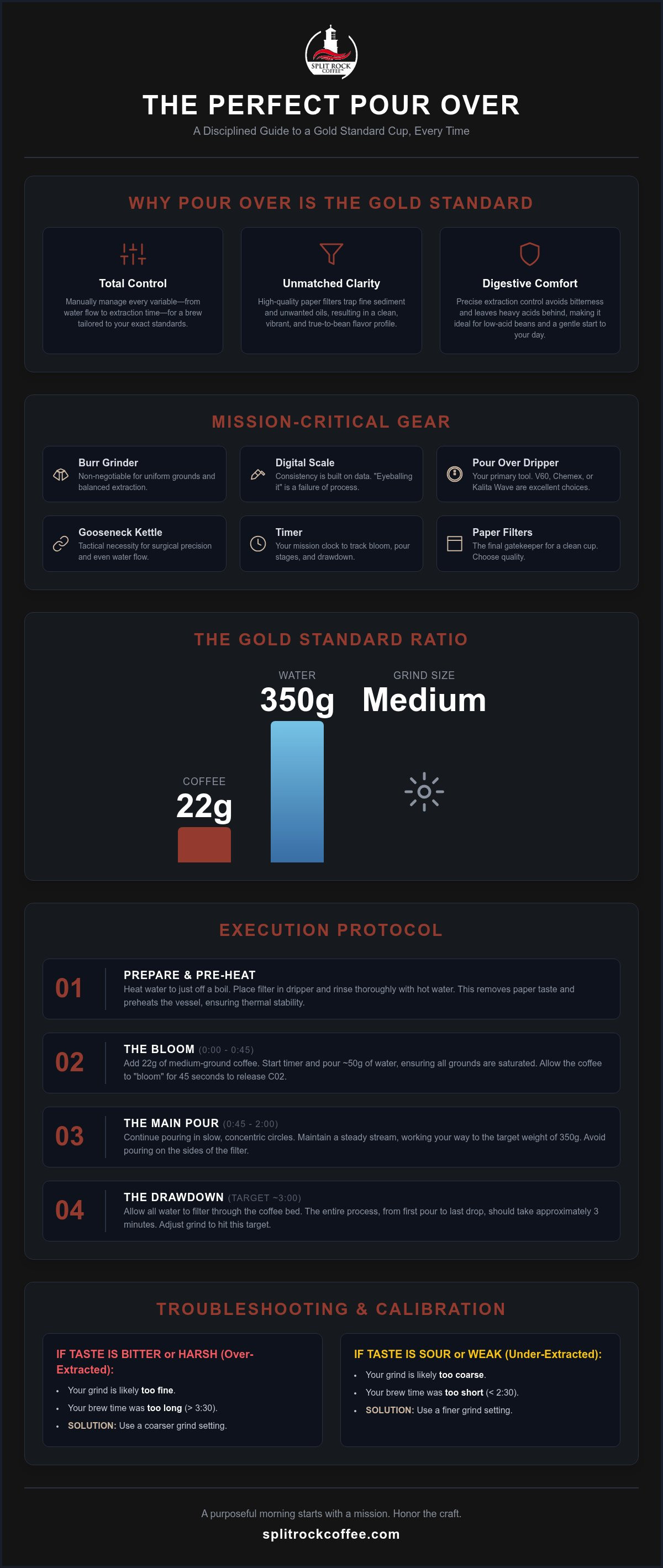
In a disciplined kitchen, "eyeballing it" is a failure of process. Consistency is built on data. A digital scale allows you to maintain a strict 1:16 or 1:17 coffee-to-water ratio, ensuring your brew is neither weak nor overpowering. Your timer serves as the mission clock. It tracks the bloom, the pour stages, and the final drawdown. If your brew time fluctuates wildly from day to day, you'll never achieve the repeatable excellence that defines a true craftsman. Success is found in the details of the measurement.
Selecting Your Fuel: The Gold Standard
The clarity of a pour over means there is nowhere for low-quality beans to hide. Every flaw in the roast or the bean itself will be front and center. This is why we recommend starting with the best low acid coffee beans available. When you use beans roasted for the Gold Standard, you ensure that the delicate flavors are preserved without the harsh acidity that irritates the stomach. It's about fueling your body with integrity.
Always opt for whole bean over pre-ground when possible. Grinding just seconds before you brew preserves the volatile aromatics that give coffee its character. If you're ready to upgrade your morning ritual, exploring our Low Acid Coffee Blends is the best way to ensure your high-end gear is matched by superior fuel.
Step-by-Step: Executing the Perfect Pour Over
Execution is where theory meets reality. To master how to brew pour over coffee, you must treat every movement as an intentional act. Start by rinsing your paper filter with hot water. This simple step removes any lingering wood pulp taste and pre-heats your carafe. Thermal stability is critical; a cold vessel steals heat from your brew and stalls the extraction process, leading to a flat, uninspired cup. Discard the rinse water before you begin. Weigh out exactly 22g of your Gold Standard beans and grind them to a medium-coarse consistency, similar to sea salt. Place the grounds in the filter and tap the sides gently to create a level surface. Zero your scale. You are now ready to begin.
The Bloom: Initiating the Mission
The first pour is the most critical phase of the extraction. Start your timer and gently pour 44g of water over the grounds, ensuring every particle is saturated. This stage, known as the bloom, allows the coffee to "degas." You'll see bubbles rising to the surface as carbon dioxide escapes the beans. Wait 30 to 45 seconds for this process to complete. Skipping the bloom traps gas inside the grounds, which repels water and leads to an uneven, sour extraction. Patience here ensures the rest of your brew has a clear path to excellence. It's the moment where the coffee prepares to give up its best flavors.
Once the bloom is finished, begin your main pour. Use slow, concentric circles starting from the center and moving outward. Avoid pouring directly against the paper filter, as this allows water to bypass the coffee grounds entirely. Maintain a steady hand and a consistent flow rate. If you are using a pulse pour technique, add water in 50g to 75g increments to keep the agitation consistent. This level of focus honors the craft and the community of growers who produced these beans. It's a deliberate process that requires your full attention.
The Final Drawdown and Finish
As you reach your final target of 350g, watch the water level carefully. You want the grounds to settle into a "flat bed" at the bottom of the filter as the water draws down. A concave or sloped bed suggests your pour was uneven, meaning some grounds were over-extracted while others were ignored. Your total brew time should fall within the 3:00 to 4:00 minute window. If it finishes too fast, your grind is likely too coarse; if it drags on, your grind is too fine. Mastery comes from observing these results and adjusting your next mission accordingly. When the last drop falls, remove the filter immediately to prevent any bitter over-extraction from tainting the clean profile you've worked to build.
Mastering the Variables: Grind, Water, and Temperature
Precision is not a static goal; it's a constant recalibration. Once you understand the mechanics of how to brew pour over coffee, your focus must shift to the variables that dictate the final flavor profile. Grind size is your most powerful lever. It controls the surface area exposed to water, which directly impacts how quickly flavor is extracted. If your grounds are too coarse, the water passes through too quickly, leaving the best flavors behind. If they are too fine, the water stalls, leading to a bitter, over-extracted mess. Every adjustment you make should be intentional and documented.
Water quality is the silent partner in your brew. Since coffee is roughly 98% water, using tap water laden with chlorine or heavy minerals will mask the purity of your Gold Standard beans. Always use filtered water to ensure a clean canvas. Temperature control is equally vital. Light roasts are denser and require higher heat, typically around 205°F, to break down the complex cell structures. Conversely, darker roasts are more soluble and fragile. Using water that is too hot on a dark roast will scorch the beans, resulting in an ashy, unpleasant taste. For these, a lower range of 195°F to 198°F is often the sweet spot.
The Flavor Adjustment Framework
Learning to troubleshoot your brew is what separates the amateur from the craftsman. Use your palate as a diagnostic tool. If your cup tastes sour, salty, or thin, you've likely under-extracted the coffee. To fix this, grind your beans finer or increase your water temperature. If the result is unpleasantly bitter, dry, or astringent, you've over-extracted. In this case, grind coarser or lower your temperature. Your objective is a balanced, lingering finish that highlights the natural sweetness of the roast without any harshness or burn.
Water Chemistry for the Disciplined Brewer
Avoid the temptation to use distilled water. While it sounds pure, it lacks the essential minerals like calcium and magnesium that act as "magnets" to pull flavor compounds out of the grounds. Without these minerals, your coffee will taste flat and lifeless. Maintaining a temperature range between 195°F and 205°F ensures maximum efficiency during the extraction mission. This range is critical because it dictates which acidic compounds are released and which are left behind. If you want to ensure your water is meeting its match, pair your technique with our Whole Bean and Ground Coffee for a result that honors your dedication to quality.
Agitation also plays a tactical role. The force and height of your pour create turbulence in the brewer. More agitation increases the extraction rate, while a gentle, low pour keeps it steady. By controlling the speed and height of your gooseneck kettle, you can fine-tune the intensity of the brew. It's a level of scrutiny that ensures every cup is a testament to your discipline.
The Split Rock Mission: Elevating Your Daily Brew
Mastering how to brew pour over coffee is a testament to your discipline. However, even the most precise technique cannot save a sub-par bean. At Split Rock Coffee, we understand that your morning fuel is a critical component of your daily readiness. Our Gold Standard Coffee Beans are selected with a level of scrutiny that honors the craft and the community we serve. We don't just roast coffee; we curate an experience that balances high-end performance with digestive comfort. Every batch is a commitment to excellence, ensuring that your manual brew is as clean and vibrant as the mission you're about to undertake.
Founded in 2013, Split Rock Coffee is a Service-Disabled Veteran-Owned Small Business. This isn't just a label; it's the core of our identity. When you choose our beans, you aren't just buying a product. You're supporting a legacy of service and a mission to provide high-quality sustenance to those who demand the best from themselves. We believe in purposeful craftsmanship. That means meticulous attention to detail in our roasting process, ensuring that we deliver low-acid profiles that won't hold you back. It's about resilience, pride, and a shared commitment to a greater cause.
Pairing Low Acid Beans with Pour Over Precision
The pour over method is uniquely suited to our Low Acid Coffee Blends. Because this technique highlights clarity and removes heavy oils, it allows the smooth, nuanced flavors of our roasts to take center stage without the interference of bitter sediment. This is where precision meets protection. You get to enjoy the ritual you love while protecting your gut from the irritation often associated with high-acid brews. Our 'Gold Standard' is the benchmark because it proves you don't have to sacrifice flavor for comfort. It's a balanced approach for the disciplined brewer who refuses to settle for anything less than peak performance.
Join the Subscription Mission
Consistency is the hallmark of a successful operation. To ensure your morning ritual never falters, our Monthly Coffee Subscription provides a reliable stream of fresh-roasted fuel directly to your doorstep. You can customize your delivery frequency to match your consumption, ensuring you always have the right amount of Whole Bean or Ground Coffee on hand. It's the ultimate tactical advantage for your kitchen. By joining the subscription mission, you secure your supply and continue to support a veteran-owned business dedicated to quality and social responsibility. Don't leave your morning to chance. Secure your fuel and stay focused on the work that matters.
Master the Morning Mission
Your morning ritual is the foundation of your day. By focusing on the variables of grind, water, and temperature, you've moved beyond convenience to a state of purposeful action. You understand the necessity of the bloom and the surgical precision required for a flat bed. Mastering how to brew pour over coffee is more than a skill; it's a commitment to the craft. This steady discipline ensures every cup is clean, vibrant, and gentle on your body.
As a Service-Disabled Veteran-Owned Business, we maintain a Gold Standard Quality Guarantee that honors our heritage. Our specialized low-acid roasting process eliminates the bitter acidity that stalls your progress, providing sustenance that fuels your day without the burn. You've mastered the technique; now secure the fuel that meets your high benchmarks. Our beans are roasted with the same scrutiny you bring to your brew.
Fuel your morning mission with Split Rock Gold Standard Beans
Step up to the carafe with pride. Your perfect cup is a testament to your discipline.
Frequently Asked Questions
What is the best coffee-to-water ratio for pour over?
A ratio of 1:16 or 1:17 is the gold standard for a balanced cup. For every gram of coffee, you'll use 16 to 17 grams of water. This equates to roughly 22g of coffee for a 350g brew. Precision is your ally here. Using a scale ensures you don't compromise the mission with guesswork. It's the most reliable way to maintain the integrity of your daily fuel.
Why does my pour over coffee taste bitter?
Bitterness is a clear signal of over-extraction. This happens when your grind is too fine, your water is too hot, or your brew time has exceeded the four-minute mark. To fix this, adjust your grind to be coarser or lower your water temperature to around 195°F. Mastering how to brew pour over coffee requires observing these defects and recalibrating your process for the next morning mission.
Can I use a regular kettle instead of a gooseneck kettle?
You can use a regular kettle, but you'll sacrifice the surgical precision needed for a consistent extraction. A gooseneck kettle is a tactical tool designed for flow control. It allows you to direct water exactly where it needs to go without flooding the coffee bed. If you're stuck with a standard kettle, pour slowly and try to maintain a steady, thin stream to avoid disrupting the grounds.
What is the best grind size for pour over coffee?
Aim for a medium-coarse grind that resembles the texture of sea salt. If the grounds are too fine, they'll clog the filter and cause a bitter, slow drawdown. If they're too coarse, water will rush through, leaving you with a weak, sour cup. Consistency is vital. Using a burr grinder ensures each particle is uniform, which is the foundation of a professional-grade extraction every single morning.
How long should the total pour over brewing process take?
The entire process should take between 3:00 and 4:00 minutes from the first pour of the bloom to the final drawdown. If your brew finishes in under three minutes, your grind is likely too coarse. If it drags on past four minutes, your grind is probably too fine. Tracking this window with a timer helps you maintain the discipline required for repeatable, high-quality results that honor the craft.
Does pour over coffee have more caffeine than drip coffee?
Pour over coffee typically contains a similar amount of caffeine to standard drip coffee, but the manual nature of the brew gives you more control. Since you're often using a higher coffee-to-water ratio and a more efficient extraction, the caffeine content can feel more potent. The final count depends on your specific dose and the type of beans you've selected to fuel your day and your mission.
Why is my coffee blooming so much (or not at all)?
A vigorous bloom is a sign of fresh, high-quality beans releasing carbon dioxide. If your grounds don't rise or bubble, the beans are likely old and have lost their volatile aromatics. This degasification is essential because it prevents the gas from repelling water during the main pour. Ensuring your coffee is fresh-roasted is the best way to guarantee a healthy bloom and a vibrant flavor profile that serves your palate.
Is pour over coffee better for people with acid reflux?
This method is excellent for those with sensitive stomachs because the paper filter removes oils and sediment that can trigger irritation. When you learn how to brew pour over coffee using our low acid coffee blends, you create a cup that honors your health and your ritual. It's about enjoying a clean, flavorful experience without the digestive fallout. Precision brewing allows you to extract flavor while leaving harsh acids behind.


