Coffee Roast Levels and Acidity: A Disciplined Guide to Better Brews in 2026
What if the "bright" morning cup you love is actually the very thing sabotaging your mission by mid-afternoon? You shouldn't have to choose between a high-performance brew and a stomach that doesn't revolt. Understanding the complex relationship between coffee roast levels and acidity is the first step toward a more disciplined, enjoyable routine. As a veteran-owned business, we believe your fuel should be as reliable as your resolve. We don't settle for "good enough" when it comes to the science of the bean.
You've likely felt that sharp, uncomfortable burn after your second cup, wondering if your days of enjoying coffee are coming to an end. It's a common fear, but it's often based on a misunderstanding of how heat alters the bean. This guide will master the science of how roasting transforms coffee acidity so you can choose the perfect fuel for your palate and your gut. We'll explore the chemical shift from light to dark roasts, clarify the difference between flavor notes and pH, and help you select the Gold Standard Coffee Beans that provide the energy you need without the heartburn you've been dreading.
Key Takeaways
- Learn to distinguish between "bright" flavor notes and the actual pH levels that impact your digestive health.
- Discover how the heat applied during various coffee roast levels and acidity transformations can effectively neutralize stomach-irritating compounds.
- Identify the specific roast profiles that offer high-performance energy without the risk of heartburn or acid reflux.
- Understand the disciplined roasting process required to achieve the Gold Standard of gut-friendly, premium fuel.
- Gain the confidence to select specialized low-acid blends that support your mission without causing physical discomfort.
Understanding the Dual Nature of Coffee Acidity
Acidity isn't a single enemy to be defeated. It's a complex spectrum that defines both the character of your brew and how your body reacts to it. For those of us who rely on coffee as essential fuel, understanding the relationship between coffee roast levels and acidity is mission-critical. Many coffee drinkers confuse the vibrant, citrus-like "brightness" of a specialty bean with the chemical pH level that causes digestive distress. They aren't the same thing. You can enjoy a cup that tastes lively and crisp without suffering through the afternoon with a burning chest.
Perceived Acidity vs. Chemical pH
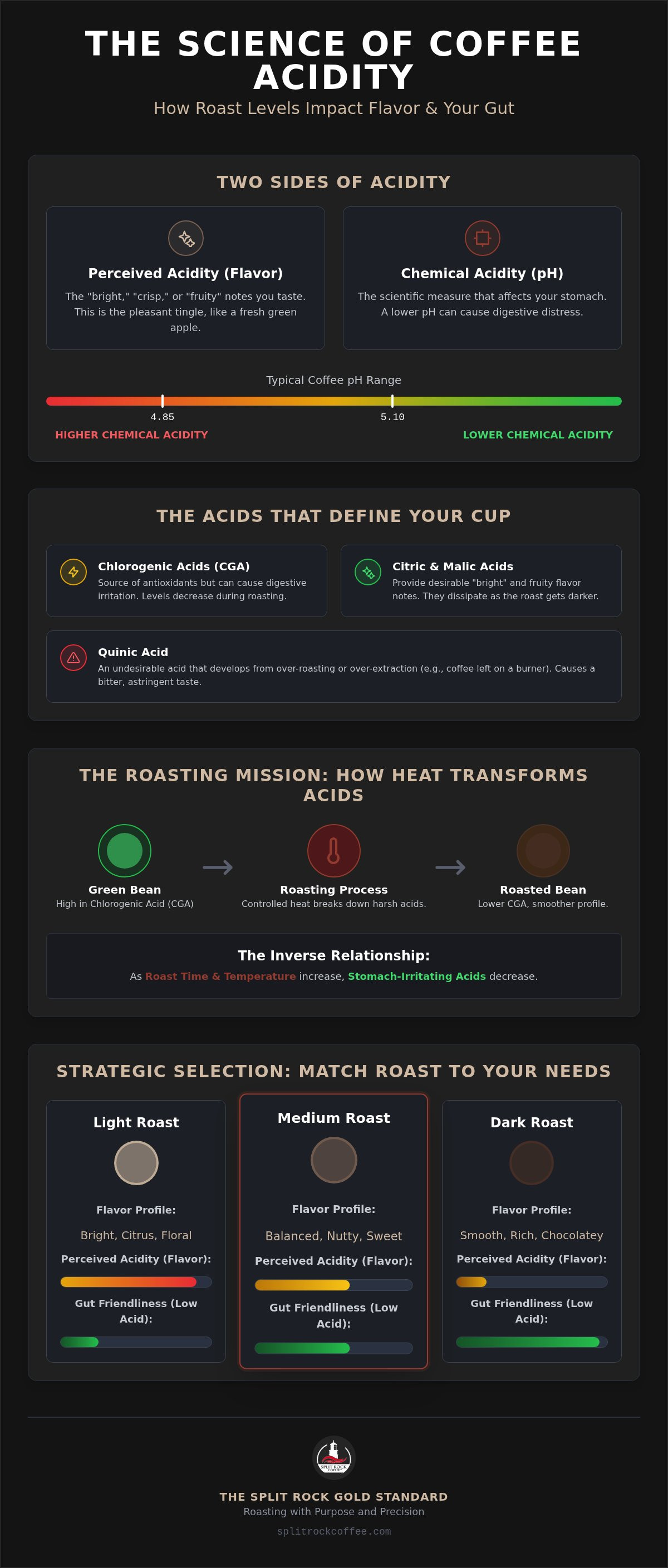
Our tongues are trained to identify "brightness" as a quality marker. It's that pleasant tingle on the sides of your mouth that reminds you of a fresh green apple or a ripe lemon. This is perceived acidity. However, your stomach cares about chemical pH. Most standard coffees fall between a pH of 4.85 and 5.10. Coffee pH is the measure of hydrogen ion concentration affecting stomach sensitivity. A lower number on this scale means higher chemical acidity. The goal for many is to find a balance where the flavor remains excellent, but the pH is high enough to be gentle on the gut.
The Acids That Define Your Cup
Inside every green bean is a chemical battlefield of organic acids. These compounds change as the roaster applies heat. Chlorogenic acids (CGA) are the primary source of both antioxidant benefits and digestive irritation. While they're vital for health, too much CGA can lead to the production of excess stomach acid. Understanding Low-Acid Coffee requires looking at how these CGAs break down during the roasting process. If the roast isn't handled with precision, these acids remain at levels that trigger reflux.
Citric and malic acids provide those sought-after fruity notes. They're delicate and often dissipate as the roast gets darker. On the other hand, quinic acid is a different beast. It's the bitter, astringent acid that develops when coffee sits on a burner too long or is over-extracted. As a veteran-owned business, we apply military discipline to our roasting to ensure these acids are balanced. We focus on the Gold Standard Coffee Beans, where we manage these chemical levels to provide a cup that serves your palate and honors your health. Understanding these levels is the first step in your coffee mission. We don't just roast for flavor; we roast for performance and longevity.
The Roasting Mission: How Heat Transforms Chemical Compounds
Roasting is a calculated operation. It's where raw potential meets the discipline of the heat. To truly master coffee roast levels and acidity, you must view the roaster as a forge. We aren't just changing the color of the bean; we are orchestrating a series of complex chemical reactions that determine whether your morning cup will be a source of strength or a cause of discomfort. Every second in the drum matters. Every degree of temperature change is a tactical decision that impacts the final chemical profile of your brew.
The mission begins with the drying phase. Here, we remove moisture to prepare the bean for the chemical combat ahead. If moisture remains, the bean steams rather than roasts, which ruins the flavor profile and prevents proper acid transformation. Once the bean is dry, the Maillard Reaction takes over. This is the critical stage where sugars and amino acids interact to create the rich, savory flavors that define a premium brew. As the internal pressure builds, we reach the "First Crack." This audible pop is a tactical turning point that signals the bean's transition into the light and medium roast spectrum. It is the exact moment the roaster must decide how much acidity to preserve and how much to transform through further heat exposure.
Thermal Degradation of Acids
Heat acts as a primary catalyst to break down the harsh compounds that lead to stomach pain. There's a clear, inverse relationship at play: the longer the beans are subjected to controlled heat, the lower the levels of chlorogenic acid (CGA) become. This degradation is why darker roasts are generally gentler on the gut than their lighter counterparts. However, achieving the Gold Standard Coffee Beans requires more than just high heat. It demands a meticulous balance of time and temperature to ensure the chemical load is reduced while the bean's unique character is preserved. We don't just burn the acid away; we transform it with purpose.
The Development of Quinic Acid
Discipline is required to avoid over-roasting. If the heat is applied too aggressively or for too long, the bean begins to develop quinic acid. This is the bitter, astringent compound that gives some dark roasts a burnt, unpleasant finish. The goal is to hit the "sweet spot" where the bright, digestive-triggering acids have dissipated, but the quinic acid hasn't yet taken over the profile. Finding this balance is what separates a mediocre cup from a truly superior fuel source. If you're looking for a brew that hits this mark every time, our Low Acid Coffee Blends are designed to provide maximum flavor with minimal irritation.
Comparing Roast Profiles: From Bright Light to Smooth Dark
Choosing your roast is more than a matter of taste. It's a tactical choice that dictates how your body handles its daily fuel. When we examine coffee roast levels and acidity, we see a clear trade-off between the vibrant, complex notes of the bean's origin and the digestive comfort provided by the roasting process itself. As a veteran-owned team, we know that selecting your gear matters. Coffee is no different. You need to understand the data before you can master the brew.
We've analyzed the attributes to provide a clear comparison that many sources overlook. Here is how the mission-critical attributes shift across the spectrum:
- Light Roast: High flavor acidity; High CGA; Vibrant and Floral; Lowest digestive protection.
- Medium Roast: Balanced acidity; Moderate CGA; Caramelized and Nutty; Moderate digestive protection.
- Dark Roast: Low flavor acidity; Lowest CGA; Smoky and Bold; Highest digestive protection.
Light Roast: The Brightest Objective
Light roasts are the brightest objective. To understand what is a light roast coffee, you must look at what the heat leaves behind. These beans are pulled from the roaster shortly after the first crack, preserving the highest levels of chlorogenic acids (CGA). While this origin character is prized for its complexity, it's often the harshest on sensitive stomachs. Light roasts lack certain protective compounds that only develop with longer heat exposure. Specifically, they have lower levels of N-alkanoyl-5-hydroxytryptamides, a compound found in darker roasts that helps shield the stomach. Without this protection, the high CGA levels can trigger a significant increase in gastric acid production.
Dark Roast: The Smooth Discipline
Dark roasts are the result of smooth discipline. They trade flavor brightness for total digestive comfort. By extending the roast time, we achieve the lowest CGA levels possible. There is a chemical secret hidden in these dark beans: they contain a specific compound that actively signals the stomach to produce less acid. This makes dark roasts the tactical choice for those who enjoy espresso or milk-based drinks but want to avoid the burn. They provide a bold, smoky experience that stays gentle on your system. For those who need a truly stomach-safe option, choosing low acid coffee ensures you aren't sacrificing your health for your morning routine. It's about finding the Gold Standard Coffee Beans that support your mission without the physical cost.
Strategic Selection: Matching Roast Levels to Your Digestive Needs
You need to know your own baseline before you can optimize your performance. Are you chasing the complex, floral high of a light roast, or are you simply trying to survive the morning without a bottle of antacids? Selecting the right fuel requires an honest assessment of your digestive tolerance. While we have already explored how heat transforms the bean, your choice of the raw material itself is the first line of defense in the battle against heartburn. Understanding coffee roast levels and acidity is only the first phase of the operation; the next is applying that knowledge to your specific needs.
Consistency is the backbone of any successful mission. You cannot maintain peak performance if your fuel source is erratic. Settling for high-acid, stale grocery store coffee when you run out of the good stuff is a gamble with your gut health that you don't need to take. A monthly coffee subscription ensures you always have a reliable, stomach-friendly roast on hand. It removes the temptation to settle for inferior alternatives, keeping your routine disciplined and your body ready for action.
Choosing the Right Beans
Not all beans are created equal at the starting line. Arabica beans are our Gold Standard for a reason. They naturally contain less caffeine and lower acid levels than Robusta beans. Elevation also plays a critical role in the chemical makeup of the harvest. High-elevation beans often develop more complex flavor acidity, while lower-elevation beans typically yield a naturally lower-acid profile. Finding the best low acid coffee beans is a mission focused on both premium quality and digestive safety. We scrutinize every origin to ensure the beans we select can withstand the roasting process without becoming an irritant.
Brewing Discipline for Lower Acid
Your roast choice is only half the battle. How you prepare that coffee can either support or sabotage your digestive needs. Cold brew is a powerful tactical maneuver for those with extreme sensitivity. By using time instead of heat for extraction, you can achieve a smoother cup that often feels significantly less acidic on the stomach. If you prefer hot coffee, keep your water temperature around 195 to 205 degrees Fahrenheit. Water that is too hot can over-extract bitter quinic acids. Using paper filters is another disciplined choice; they are superior at trapping certain lipid-bound acids that metal filters often let through. For a brew that respects your gut and your palate, explore our low-acid options today.
The Split Rock Gold Standard: Roasting with Purpose and Precision
We don't just roast coffee; we fulfill a mission. At Split Rock Coffee, we apply the same military discipline we learned in service to the science of the bean. Our status as a Service-Disabled Veteran-Owned Small Business (SDVOSB) isn't just a label on a bag. It's a promise that we never cut corners on your daily fuel. We understand that for many, coffee is mission-critical sustenance. When you're managing the relationship between coffee roast levels and acidity, you need an expert who values precision over profit. We've seen what happens when equipment fails or standards slip; we won't let that happen to your morning cup.
Our Roasting Philosophy
Every batch of our Gold Standard Coffee Beans undergoes meticulous scrutiny. We've spent years balancing the clinical science of pH levels with the intuitive art of craft roasting. It's about more than hitting a temperature target. It's about ensuring every bag provides the sustenance and service our community deserves. We refuse to let a sensitive stomach dictate your potential or limit your day. Our Low Acid Coffee Blends were crafted specifically for those who refused to quit the mission just because of a little heartburn. We've taken the tactical steps to reduce the chemical load while preserving the premium flavor profile that high-performance individuals demand. By monitoring the interplay between coffee roast levels and acidity throughout the entire roasting cycle, we ensure that the final product is both a culinary triumph and a digestive relief.
Join the Subscription Mission
Discipline is most effective when it's automated. A morning routine shouldn't be a struggle against pain or poor-quality beans. Our Monthly Coffee Subscription is designed to keep your routine sharp and your gut protected. You get fresh-roasted delivery direct to your door, ensuring you never have to resort to the high-acid, stale options found on grocery store shelves. It's a commitment to your long-term health and your daily focus. We handle the logistics so you can focus on the work that matters. If you're a purposeful craftsman who demands excellence, it's time to elevate your standards and secure a fuel source that respects your body. Shop our Low Acid Blends and join a community that values quality, resilience, and a better brew.
Elevate Your Standards for Better Brews
Mastering the science of your morning fuel is a mark of true discipline. You now understand how heat acts as a catalyst, breaking down harsh compounds to protect your gut while preserving the flavor you demand. By navigating the nuances of coffee roast levels and acidity, you've gained the tactical advantage needed to enjoy your daily ritual without physical compromise. You don't have to settle for the burn when you choose beans roasted with purpose and precision.
As a Disabled Veteran-Owned Small Business, we take pride in providing the premium Gold Standard Quality that high-performance individuals require. Our dedicated Low Acid Coffee Blends are crafted for those who refuse to quit the mission. It's time to fuel your body with a roast that respects your health and your palate. We're here to ensure your sustenance never comes at the cost of your comfort.
Experience the Mission: Shop Our Low Acid Coffee Blends
Stay disciplined, stay focused, and enjoy a brew that works as hard as you do.
Frequently Asked Questions
Does light roast or dark roast have more acid?
Light roast coffee generally contains higher levels of chlorogenic acid and a lower pH level compared to dark roast. During the roasting process, heat acts as a catalyst to break down these acidic compounds. As a veteran-owned team, we know that darker roasts spend more time in the roaster; this extended heat exposure effectively reduces the chemical load on your stomach. A dark roast is the tactical choice for digestive comfort and sustained performance.
Is low acid coffee better for acid reflux?
Low acid coffee is specifically engineered or selected to reduce the triggers that cause acid reflux. By focusing on beans with a naturally higher pH or using roasting techniques that degrade irritants, these blends minimize gastric acid production. For those on a mission to maintain their daily routine without the burn, choosing specialized Low Acid Coffee Blends is a proven strategy to protect the gut while staying fueled and focused on the task at hand.
Can roasting coffee longer make it less acidic?
Roasting coffee for a longer duration is the primary method for reducing its acidic profile. As the beans reach higher temperatures, the chlorogenic acids responsible for digestive distress begin to break down into other compounds. This transformation is central to understanding coffee roast levels and acidity. A disciplined roasting approach ensures that the beans stay in the heat long enough to neutralize harshness without crossing into a burnt territory that compromises the final flavor.
What is the pH level of the least acidic coffee?
The least acidic coffees typically reach a pH level between 5.5 and 6.0, whereas standard specialty coffee often sits closer to 5.0. While we don't invent specific numbers for every batch, the objective is always to move the bean further away from the acidic end of the scale. Achieving this balance requires precision and high-quality beans that can withstand the roasting process while maintaining their premium, Gold Standard integrity and mission-critical flavor profile.
Are Arabica beans less acidic than Robusta beans?
Arabica beans are the superior choice for those seeking a lower-acid profile. They naturally contain about half the caffeine of Robusta beans, and caffeine is a known stimulant for gastric acid production. Additionally, Arabica beans typically have fewer chlorogenic acids. This is why we exclusively use Arabica for our Gold Standard Coffee Beans, ensuring that your fuel is as clean and efficient as possible for your daily operations and your long-term health.
How can I make my coffee less acidic at home?
You can reduce acidity at home by adjusting your brewing tactics. Using a coarser grind and cooler water temperatures prevents the over-extraction of bitter acids. Switching to paper filters also helps, as they trap oily compounds that metal filters often miss. For the most significant reduction, consider a cold brew method. It uses time instead of heat to extract flavor, resulting in a cup that is much gentler on the stomach and easier to digest.
Does adding milk to coffee reduce its acidity?
Adding milk can help neutralize the acidity in your cup due to its calcium content. Calcium acts as a buffering agent that can slightly raise the pH level of the beverage, making it less irritating to the stomach lining. While this is a helpful field adjustment, starting with a naturally low-acid roast remains the most effective way to ensure your morning routine doesn't end in digestive discomfort or a mission-stalling burn that slows you down.
Is cold brew coffee actually lower in acid than hot coffee?
Cold brew coffee is significantly lower in acid because the extraction process relies on cold water over a long period. Many drinkers find that cold brewing results in a much smoother profile than hot brewing methods. This makes it a powerful maneuver for anyone navigating the complexities of coffee roast levels and acidity. It delivers a smooth, high-performance fuel source that respects your digestive system's boundaries and keeps you in the fight.


