Best Espresso Beans 2026: Low Acid Fuel Guide
You pull a perfect, syrupy shot of espresso, only to wait for the inevitable burn in your chest rather than the kick of the caffeine. It's a compromise no one should have to make. For many, the ritual of making espresso with low acid coffee feels like a search for a ghost, a myth that promises flavor without the fallout. You want the fuel for your daily mission, but your stomach demands a ceasefire. We understand that discipline shouldn't mean enduring discomfort. Excellence is found in the balance.
We agree that a morning latte should be an act of preparation, not a cause for pain. You deserve a rich, professional-grade experience that respects your digestive health. This guide promises to show you exactly how to enjoy bold espresso without the digestive burn by choosing the right low-acid beans. We'll break down why standard roasts often fail you, how to identify regions like Sumatra or Brazil for smoother results, and where to find high-quality beans that meet the Gold Standard. It's time to reclaim your morning ritual with a reliable, high-quality source of fuel.
Key Takeaways
- Identify the "Espresso Acid Conflict" to understand how high-pressure extraction pulls excess chlorogenic acids into your cup.
- Select beans from low-altitude origins like Brazil or Sumatra for a naturally smoother profile that respects your digestive health.
- Master the technical discipline of making espresso with low acid coffee by adjusting your brew temperature to 195°F - 200°F.
- Prioritize whole bean Gold Standard Coffee Beans over pre-ground options to maintain the integrity of the flavor and the quality of the crema.
- Reclaim your morning ritual with a reliable strategy for pulling bold, professional shots that fuel your mission without the burn.
Why Most Espresso Beans Cause Heartburn
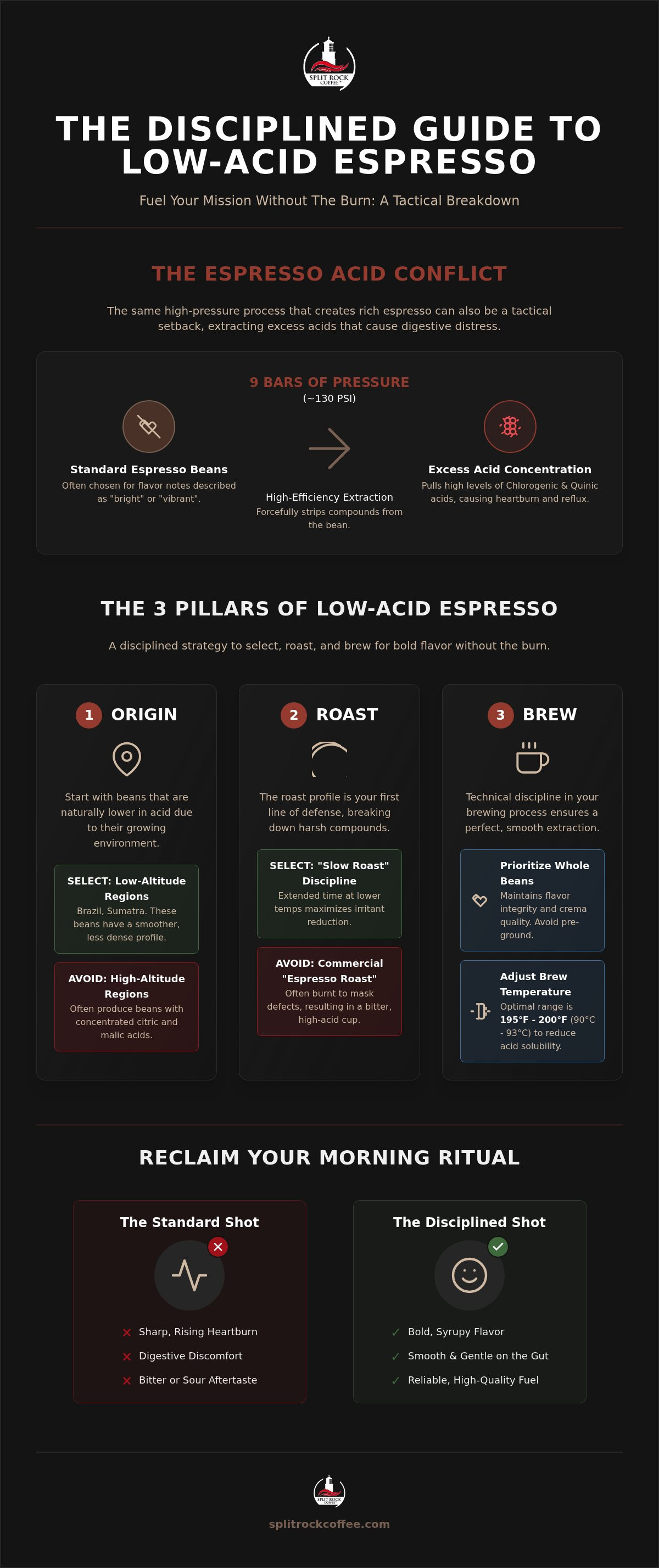
Espresso is more than a beverage; it is a concentrated tool for performance. However, for many, the ritual of extraction leads to a tactical setback known as the Espresso Acid Conflict. This conflict arises because the very process that creates that beautiful, thick crema also acts as a high-efficiency solvent for compounds that irritate the stomach. When you are making espresso with low acid coffee, you are actively choosing to bypass the chemical triggers that turn a morning boost into a day-long struggle. Most traditional espresso roasts focus on a dark, oily exterior, yet these oils are often a sign of internal bean degradation that can actually increase gastric distress.
The core of the issue lies in chlorogenic acids. These natural compounds are found in all coffee cherries, but their concentration varies wildly based on altitude and roasting discipline. To better understand the science, it helps to define the parameters: What is low-acid coffee? It essentially refers to beans that have been handled to minimize these irritants while maintaining the structural integrity of the flavor. Without a disciplined approach to bean selection, the high-pressure environment of the espresso machine will extract these acids in concentrations far higher than a standard drip brew. This is why a bean that tastes fine in a French press might cause immediate heartburn when pulled as a double shot.
The Pressure Factor: Extraction vs. Acidity
Your espresso machine operates at roughly 9 bars of pressure, which is approximately 130 pounds per square inch. This force is necessary to emulsify oils and create the signature body of a true espresso, but it also increases the solubility of acidic precursors. While a barista might describe a shot as having "vibrant acidity," for a person with a sensitive stomach, that is simply a code word for discomfort. During the espresso process, the extraction of quinic acid increases as the water temperature and pressure work in tandem to strip the bean of every available compound. If the bean isn't specifically chosen for its low-acid profile, you are essentially forcing irritants directly into your system under high intensity.
The Symptoms of a Poorly Chosen Bean
Discipline requires knowing the difference between a caffeine-induced surge and a chemical burn. Coffee jitters are a common side effect of high caffeine intake, but the sharp, rising heat of acid reflux is a sign that your beans have failed you. There is a common misconception that simply choosing a dark roast will solve the problem. In reality, many dark roasts are oily and stale, which can actually trigger more bile production and worsen the burn. Our mission is to identify beans that survive the intense pressure of the portafilter while remaining gentle on the gut. Making espresso with low acid coffee is the only way to ensure your fuel doesn't become your foe during your daily mission.
Roasting Discipline: What Makes the Best Coffee Beans for Espresso?
Roasting is an act of precision. It requires a deep understanding of how thermal energy interacts with the cellular structure of the bean to neutralize the harsh compounds that cause digestive distress. When you are making espresso with low acid coffee, the roast profile is your first line of defense. To see how other premium brands apply fresh perspectives to old-world Italian roasting traditions, you can check out Bambi Nonno Coffee. At Split Rock Coffee, we apply the Gold Standard Coffee Beans roasting methodology. This isn't just about achieving a specific color; it's about a disciplined application of heat that breaks down acidic precursors while preserving the essential oils that create a rich, syrupy crema.
The term "espresso roast" is often used as a marketing shield for low-quality, over-roasted beans. Many commercial roasters push beans to the point of carbonization to mask defects, resulting in an oily surface that quickly turns rancid. This creates a bitter, high-acid cup that triggers heartburn. True excellence in espresso comes from choosing beans with the resilience to withstand high-pressure extraction without surrendering their smoothness. We focus on beans from low-altitude origins, such as Brazil and Sumatra, because these environments naturally produce beans with a lower density and a more subdued acid profile from the start.
While light roasts are celebrated for their "brightness," that brightness is often a concentrated dose of citric and malic acids. For the espresso enthusiast with a sensitive stomach, these roasts are a liability. Darker roasts generally have lower acidity because the roasting process physically degrades the chlorogenic acids over time. However, the discipline lies in the "slow roast" technique. By extending the roast time at lower temperatures, we can maximize the reduction of irritants without burning the sugars. You can explore our coffee roast levels and acidity guide to see how this balance is struck. This technical scrutiny is supported by Harvard's analysis of coffee and health, which highlights how different roasting methods impact the chemical composition and health benefits of your daily cup.
Bean Density and Pressure Resistance
Making espresso with low acid coffee requires a bean that can handle 9 bars of pressure without becoming sour. This is where the Maillard reaction becomes critical. This chemical reaction between amino acids and reducing sugars creates the deep, chocolatey notes we crave in a professional shot. Harder, high-altitude beans often retain more density and moisture, which can lead to uneven roasting and a sharp, acidic finish in the portafilter. By selecting beans with specific density profiles, we ensure that the heat penetrates the core of the bean evenly. This results in a stable, low-acid foundation for your espresso. If you're ready to upgrade your morning mission, consider starting with our Low Acid Coffee Blends for a smoother experience.
Evaluating the Best Low Acid Espresso Beans in 2026
Selecting the right fuel requires a standardized framework for evaluation. When making espresso with low acid coffee, you must look beyond the initial taste and consider the long-term impact on your resilience. A disciplined assessment focuses on four pillars: acid profile, body, crema quality, and stomach feel. A high-quality bean shouldn't just taste good in the moment; it should settle comfortably, allowing you to focus on your mission rather than your digestion. This approach is backed by a scientific review of acids in coffee, which demonstrates how species and roast levels significantly alter the concentration of irritants.
Freshness is the cornerstone of this evaluation. Choosing whole bean over pre-ground is the only disciplined path for a home barista. Once coffee is ground, the surface area increases, leading to rapid oxidation and the loss of the volatile oils responsible for a thick crema. Stale coffee often develops a flat, sour profile that mimics high acidity, adding unnecessary stress to your system. We recommend a degassing period of five to seven days after roasting. This allows carbon dioxide to escape, ensuring that the high-pressure extraction process doesn't result in a turbulent, bitter shot that irritates the stomach lining.
The Gold Standard Selection
The benchmark for excellence in 2026 remains our Gold Standard Coffee Beans. A premium low-acid espresso bean should present a profile rich in chocolate, toasted nut, and subtle smoke. When you perform a visual inspection, look for a matte finish or a very light sheen rather than a heavy coating of oil. Uniformity in size and color indicates a disciplined roasting process where heat has reached the core of every bean. You can find our curated list of the best low acid coffee beans to see how we rank these essential characteristics for peak performance.
The Subscription Advantage
Consistency is the ally of a healthy gut. Switching between random brands often leads to stomach surprises as your body reacts to varying acid levels and roasting qualities. A monthly coffee subscription ensures you never face a morning without the proper fuel. It removes the guesswork from your inventory management, keeping you ready-to-fuel at all times. By maintaining a reliable source of high-quality beans, you establish a baseline of digestive comfort that supports your daily objectives without interruption. This steady supply allows you to master your machine settings for one specific bean, resulting in professional-grade shots every single morning.
The Disciplined Brew: How to Pull a Low Acid Espresso Shot
Execution is where strategy meets reality. You have selected the right beans, but the physics of extraction can still betray your stomach if your technique is undisciplined. Making espresso with low acid coffee requires a specific set of parameters designed to limit the solubility of harsh compounds. While standard barista training often pushes for high heat and tight ratios to maximize "brightness," our mission is different. We seek a smooth, rich profile that provides sustained energy without the biological cost of heartburn.
Temperature control is your most effective tool. Most espresso machines are factory-set to roughly 200°F to 205°F, but for low-acid results, you should aim for a range between 195°F and 200°F. Lowering the temperature reduces the kinetic energy of the water, making it less likely to strip away the stubborn quinic acids that remain after roasting. Additionally, we advocate for the "Ratio Mission." Instead of the traditional 1:2 yield (e.g., 18g in, 36g out), try a 1:2.5 ratio. This slight dilution softens the concentration of acids while highlighting the chocolatey notes of our Gold Standard Coffee Beans.
Equipment discipline is often overlooked. Rancid coffee oils trapped in your group head or portafilter screen will oxidize and become highly acidic over time. This buildup creates a bitter, irritating finish regardless of bean quality. Clean your machine daily. A disciplined maintenance routine ensures that every shot is a fresh representation of the bean's true profile. Making espresso with low acid coffee is only half the battle; maintaining your equipment is the other.
Dialing In Your Low Acid Beans
Precision in grind size is non-negotiable. If your grind is too coarse, the water will rush through, creating a sour, under-extracted mess. If it's too fine, the water stalls, over-extracting bitter compounds. Adjust your grinder in small increments until you achieve a steady, syrupy flow. For the best results, you should aim for a total pull time of 25-30 seconds to ensure a balanced extraction that captures flavor without the bite. If you find your shots are consistently too sharp, consider switching to our Low Acid Coffee Blends to simplify the dialing-in process.
Taming the Remaining Acid with Milk
For those who prefer a latte or flat white, milk acts as a natural buffer. The calcium in dairy and certain alternatives helps neutralize the remaining chlorogenic acids before they reach your stomach lining. If you're avoiding dairy due to acid reflux, choose your alternative wisely. Oat milk is often the best choice for its creamy texture and low-acid profile, whereas almond milk can sometimes be too thin to provide a meaningful buffer. Crafting the perfect low-acid latte is about more than just taste; it's about creating a protective, smooth fuel for your day.
Split Rock Coffee: Fueling Your Mission Without the Burn
Split Rock Coffee was forged in the spirit of service and purposeful action. Since 2013, we have operated with a clear objective: to provide the high-quality fuel necessary for those who lead disciplined, mission-driven lives. As a Service-Disabled Veteran-Owned Small Business, we understand that excellence is the result of unwavering standards. This philosophy extends from our heritage to the roastery, where we meticulously craft our Gold Standard Coffee Beans to meet the highest benchmarks of quality and digestive comfort. We don't just sell coffee; we provide the sustenance for your daily objectives.
In the evolving coffee landscape of 2026, reliability is a premium asset. Making espresso with low acid coffee is no longer a niche preference; it is a tactical choice for those who refuse to let physical discomfort dictate their performance. Our Low Acid Coffee Blends are the product of a refined roasting process that respects the structural integrity of the bean. We have spent over a decade perfecting the balance between high-pressure resilience and smooth, low-acid profiles. This ensures that your morning ritual remains a source of strength rather than a digestive liability. We handle the technical discipline of the roast so you can focus on the execution of your day.
Excellence in Every Cup
Choosing a low-acid path is a commitment to your long-term health and readiness. By reducing the chemical triggers that cause gastric distress, you allow your body to focus on the mission at hand. This transition shouldn't mean sacrificing the bold, chocolatey notes of a professional espresso. If you are ready to master the science and strategy behind this choice, read our ultimate guide to low acid coffee. We invite you to experience the difference that Gold Standard Coffee Beans can make in your daily performance and overall well-being.
Supporting the Mission
Every bag of Split Rock Coffee is a testament to transparency, resilience, and service. We are a community-focused brand that acts as a bridge between high-end craftsmanship and social responsibility. When you are making espresso with low acid coffee from our roastery, you are supporting a veteran-owned small business that prioritizes people over corporate shortcuts. We take pride in our sourcing and our disciplined roasting process, which honors the legacy of those we serve. Join our community of purposeful drinkers and experience a better way to fuel your life. Shop Split Rock Coffee Today and reclaim your morning without the burn.
Reclaim Your Morning Ritual
The path to a professional-grade espresso shouldn't be blocked by digestive discomfort. By understanding the discipline of roasting and the physics of extraction, you can enjoy a bold, rich shot that honors your health. We've explored how low-altitude beans and slow-roasting techniques neutralize irritants; we've also seen how precise temperature control ensures a smooth finish. Making espresso with low acid coffee is a strategic choice that allows you to focus on your mission rather than the burn in your chest. It's about finding a reliable source of fuel that meets the highest benchmarks of excellence.
Split Rock Coffee has been dedicated to this mission since 2013. As a Service-Disabled Veteran-Owned Small Business, we stand behind our work with a Gold Standard Quality Guarantee. We invite you to join our community of purposeful coffee drinkers who demand more from their morning cup. Your daily objectives deserve the best support possible. Secure Your Daily Fuel: Shop Gold Standard Low Acid Espresso Beans and experience the difference that disciplined craftsmanship makes. Stand ready for whatever the day brings.
Frequently Asked Questions
Are dark roast beans always lower in acid for espresso?
Darker roasts are typically lower in acid because the prolonged heat application breaks down chlorogenic acids. However, a disciplined roast is more important than just a dark color. Many commercial dark roasts are simply burnt, which creates bitter compounds that irritate the stomach. Our Gold Standard Coffee Beans focus on a slow-roasting process that ensures acid reduction while preserving the natural, chocolatey oils essential for a high-quality espresso crema.
Can I use regular low-acid coffee beans in an espresso machine?
You can certainly use any low-acid bean in your espresso machine as long as you have a high-quality grinder. The key is achieving a fine, uniform grind size to create the necessary resistance for the pump. While any of our Low Acid Coffee Blends will perform well, choosing whole bean options ensures the oils remain intact until the moment of extraction, providing a richer body and more stable crema.
Does the espresso machine pressure affect the acidity of the coffee?
High-pressure extraction at 9 bars significantly increases the solubility of acidic compounds compared to drip brewing. This intensity is why making espresso with low acid coffee is a tactical necessity for those with sensitive stomachs. The pressure forces water through the puck with enough energy to strip away irritants that would otherwise remain in the grounds during a slower, gravity-fed brewing process like a standard pour-over.
How do I know if my espresso beans are truly low acid?
Verification comes down to origin, elevation, and roasting technique. Beans grown at lower altitudes, such as those from Brazil or India, naturally possess a lower acid profile than high-mountain varieties. You should also look for a matte finish on the bean. Excessive surface oil often indicates a roast that was too fast or too hot, which can lead to a bitter, acidic finish that disrupts your daily mission.
What is the best water temperature for brewing low acid espresso?
The ideal range for pulling a low-acid shot is 195°F to 200°F. Water that is too hot acts as a harsh solvent, pulling out stubborn quinic acids that contribute to heartburn. By keeping your machine in this slightly lower temperature window, you ensure a balanced extraction. This technical discipline allows the natural sweetness of the bean to shine through while keeping the shot gentle on your digestive system.
Will adding milk to my espresso help with acid reflux?
Adding milk or a calcium-rich alternative can provide a protective buffer for your stomach lining. The proteins and minerals in dairy help neutralize the remaining acids in your cup. If you prefer plant-based options, oat milk is a reliable choice for maintaining a smooth profile. This combination creates a soft fuel source that sustains your energy levels without the risk of a mid-morning acid flare-up or digestive discomfort.
Is low acid coffee less caffeinated than regular espresso beans?
Low-acid coffee contains essentially the same amount of caffeine as standard roasts. While the roasting process successfully reduces acidic precursors, caffeine is a very stable molecule that survives high heat. You don't have to sacrifice your alertness or your mission-readiness to protect your stomach. You get the full potency of a professional espresso shot with a significantly lower risk of the acid burn associated with commercial brands.
How long do low acid espresso beans stay fresh?
Low-acid beans are best used within four weeks of their roast date. Freshness is vital when making espresso with low acid coffee because stale beans undergo oxidation, which produces a sour flavor that mimics high acidity. Storing your beans in an airtight, opaque container at room temperature preserves the Gold Standard quality. This disciplined storage routine ensures that your fuel remains effective and your stomach remains calm every morning.


