
How to Reduce Acid in Coffee with Eggshells: A Practical Guide
Can eggshells really take the bite out of coffee, or is this a kitchen-table myth? If you’ve searched how to reduce acid in coffee with eggshells, the short answer is that the method may mellow a cup, but it isn’t a proven fix for heartburn. Eggshells contain calcium carbonate, which may interact with coffee acids and affect taste. A smoother cup, however, doesn’t mean the coffee will prevent or relieve reflux.
It’s easy to confuse a sharp or sour flavor with the discomfort some people feel after drinking coffee. They’re not the same thing. If you add anything to your brew, handle it carefully and pay attention to cleanliness and flavor.
This guide explains what eggshells may do, how to try the method cautiously, and how to assess the result in your own cup. If it doesn’t suit your taste, you’ll also find other practical options, including choosing low-acid coffee beans. Keep the test simple, the handling careful, and your expectations realistic.
Key Takeaways
- Separate coffee’s chemical acidity from the sharp or sour notes you taste; they describe different things.
- For how to reduce acid in coffee with eggshells, treat the method as an optional taste experiment, not a validated technique. There is no established household ratio.
- Assess aroma, bitterness, sharpness, and sediment separately to see what changed.
- If the result doesn’t suit you, compare other brewing choices or beans rather than relying on eggshells alone.
- Explore Split Rock Coffee’s Low Acid Coffee Blends as another bean-selection option, available whole bean or ground.
Can eggshells reduce acid in coffee? What the trick actually claims
Eggshells may change a brew, but the result isn’t guaranteed. The idea behind how to reduce acid in coffee with eggshells is that calcium carbonate in the shells could interact with some acidic compounds as coffee brews. This proposed buffering effect may soften the cup’s perceived sharpness. A taste change alone, however, doesn’t prove that the coffee’s acidity has measurably decreased or that the method works consistently.
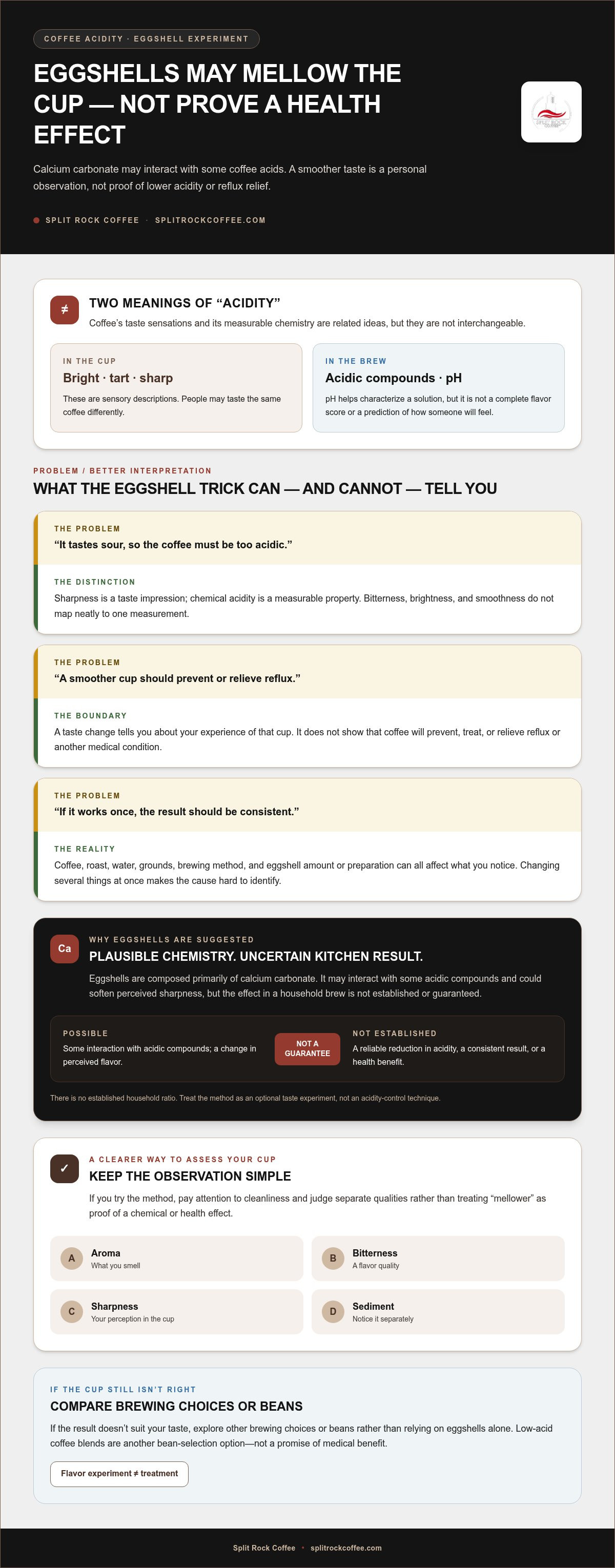
The distinction matters because “acidity” has two meanings in coffee conversations. Chemically, it refers to acidic compounds and properties that can be measured. In tasting, it describes sensations such as brightness, tartness, or sharpness. These qualities contribute to coffee’s character, but they don’t map neatly to a single chemical measurement.
What people mean by acidity in coffee
In the cup, acidity might remind you of citrus or tart fruit, while an unpleasant sharpness can seem sour or harsh. These descriptions are subjective: two people may taste the same coffee differently. pH measures how acidic or alkaline a solution is, but it doesn’t capture every compound that shapes aroma, flavor, or how coffee feels on the palate. On its own, pH can’t tell you whether a brew will taste bright, balanced, or sharp.
Perceived sharpness describes the cup; stomach symptoms describe your body, and one doesn’t establish the cause of the other. Coffee’s flavor acidity and stomach acid aren’t interchangeable. If coffee seems smoother after an eggshell experiment, that tells you about your taste experience. It doesn’t show that the brew will prevent, treat, or relieve reflux or another medical condition.
Why eggshells are suggested
Eggshells are composed primarily of calcium carbonate, as described in this overview of eggshell composition and uses. Calcium carbonate is alkaline, which helps explain the home remedy’s logic: it may buffer some acids in the brew and make the taste seem milder. But that chemical possibility isn’t proof that household eggshells reliably reduce coffee acidity. The amount, brewing conditions, and coffee itself can all affect what you notice.
Think of it as a kitchen experiment, not a dependable acidity-control technique. Coffee contains many compounds that contribute to its flavor, so one ingredient won’t necessarily change every note or remove the sensation you dislike. A less sharp-tasting result also can’t predict whether you’ll experience discomfort after drinking it. If symptoms are the concern, don’t use eggshells as treatment or a substitute for medical advice. For a taste test, keep the question simple: did this particular brew become more pleasant to you?
How eggshells may interact with coffee: chemistry, taste, and limits
The eggshell theory rests on plausible chemistry, but the result in a kitchen is less certain. Calcium carbonate can react with acids under suitable conditions. If some dissolves into the brew, it could buffer some acidic compounds. That possibility doesn’t tell us how much interaction happens during ordinary coffee brewing or whether you’ll notice a consistent difference in the cup.
Coffee isn’t a single acid in a mug. It contains a mix of acids and other compounds that contribute to flavor and aroma. Research discussed in this scientific overview of coffee acidity and pH considers coffee pH and compounds such as chlorogenic acids. The takeaway isn’t that one ingredient controls the whole brew. A change in one chemical measure may not translate into a predictable change in taste.
What a change in pH can and cannot tell you
pH describes the acidity of a solution; it isn’t a complete flavor score. A reading can help characterize brewed coffee, but it can’t tell you on its own whether the cup will taste bitter, bright, or smooth. Those impressions depend on a broader mix of compounds and sensory cues. A pH shift also can’t predict how an individual will tolerate coffee or explain any symptoms they experience.
Bitterness and acidity aren’t interchangeable. A cup might seem less bitter without a meaningful change in measured acidity, or taste sharper even if a pH test barely changes. Without controlled measurements and tasting conditions, “mellower” is a useful personal observation, not proof that the brew’s acidity has been lowered.
Why the result can vary from cup to cup
Even a careful home trial has several moving parts: the coffee and its roast, the water, the grounds, the brewing method, and the amount and preparation of eggshell. Change several things at once and you can’t confidently identify what caused a flavor difference. A result with one coffee maker or batch also doesn’t establish that the method will work the same way with other beans, equipment, or drinkers.
A taste experiment can tell you whether you enjoy a cup; it can’t establish a health effect. Keep that boundary in mind when weighing how to reduce acid in coffee with eggshells. If you’re curious, judge the result as a flavor experiment, not a treatment or a reliable measure of what your body will experience.
- Possible chemical effect: Calcium carbonate may buffer some acidic compounds, but the effect in a household brew isn’t established.
- Possible sensory change: Bitterness, sharpness, and overall flavor may shift independently of a measured pH change.
- Limits of the test: Changing several brewing variables at once makes it hard to identify the cause of a difference.
If you’d rather compare beans than adjust a brew, Split Rock Coffee’s Low Acid Coffee Blends offer another way to explore a different cup, without implying a medical benefit.
How to try eggshells in coffee: a cautious step-by-step method
If you’re curious about how to reduce acid in coffee with eggshells, treat it as a small taste experiment, not a proven way to control acidity. There’s no established household eggshell-to-coffee ratio, so an exact recipe would suggest a level of precision the method doesn’t have. Keep the trial modest, make the comparison fair, and stop if the result isn’t pleasant.
Prepare the shells and grounds carefully
Eggshells can carry residue and may pose a food-safety risk if handled carelessly. Wash your hands and use clean tools and surfaces. Rinse the shells thoroughly, remove visible membrane or egg residue, and let them dry completely before crushing. Discard shells that are dirty, cracked before use, or otherwise questionable. Follow reliable guidance such as the USDA’s advice for handling eggs. Rinsing and drying are careful handling steps, not a guarantee that shells are free of harmful bacteria.
Once dry, crush the shells finely to reduce the chance of large pieces ending up in the grounds or cup. Finer pieces are easier to distribute and spot, but crushing doesn’t make the shells safe or prove that they’ll affect the brew. Don’t use shells if you’re uncertain about their condition or handling.
Brew a small comparison batch
A controlled comparison helps you notice what changed without pretending to prove why. Use the same coffee, water, grind, and brewing method for both batches. Keep one as your plain-coffee reference, then add only a small amount of prepared shell to the other. There’s no established quantity to use as a standard. Brew each batch separately, following the same process, and keep shell pieces out of the finished drink.
- Set up two small batches. Measure the coffee and water consistently, and use the same equipment and brew time.
- Change one thing. Leave the control batch plain. Add a small amount of crushed shell only to the test batch.
- Strain and inspect. Check the brewed coffee for visible shell particles before tasting. If any remain, don’t drink that batch.
- Taste separately. Notice sharpness, bitterness, aroma, and texture as distinct qualities. Write down what you observe rather than relying on a single impression.
Keep expectations grounded. A difference may come from the shell, small variations in brewing, or your own perception; one trial can’t isolate the cause. Brewing with hot water also shouldn’t be treated as a substitute for safe shell handling. If the coffee tastes unpleasant, has an off smell, or contains shell particles, discard it. There’s no need to drink a cup that doesn’t meet your standards.
Judging results and choosing ways to soften coffee
A useful test doesn’t end with “better” or “worse.” Separate what you notice: does the aroma seem different? Is bitterness stronger or milder? Does the coffee taste sharp, and is there grit or sediment in the cup? These details help you decide whether the change suits your palate, without treating a flavor impression as proof of a measurable acidity change or health benefit.
If the eggshell batch tastes better, or worse
If one small test seems promising, repeat the comparison another time with the same coffee, water, grind, and brewing method. A second tasting can help you see whether the difference holds up, though it still won’t establish a chemical or medical effect. If you can’t detect a clear improvement, skip the shells rather than increasing an untested amount. Stop using the method if the coffee tastes chalky, gritty, or otherwise unpleasant.
Keep notes in plain language. “Less bitter, same aroma, gritty finish” tells you more than a single score. Record whether the test batch had visible sediment, too. A change in texture may make a cup less enjoyable even if its sharpness seems reduced. There’s no need to keep adjusting an experiment that doesn’t produce a cup you want to drink.
Choose an approach that matches your goal
If your goal is flavor, start with the variable you most want to change. Comparing beans keeps your brewing routine familiar. Adjusting a brewing choice lets you explore how the same coffee tastes under different conditions. Eggshells add another step and more uncertainty. Change one factor at a time and taste the results side by side when practical. None of these approaches reliably prevents symptoms.
For broader context on choosing beans by flavor and other preferences, explore this low-acid coffee guide. If you want to compare specific bean options, the guide to the best low-acid coffee beans can help you consider that route instead of modifying each brew. Choose coffee this way to find a cup you enjoy, not to predict how your body will respond.
- Eggshell experiment: It takes little extra effort to test, but the outcome is uncertain and may affect texture.
- Bean comparison: Lets you explore different flavor profiles while leaving your usual brewing process intact.
- Brewing adjustment: Lets you compare cups using the same beans, though results depend on the changes you make.
If coffee regularly brings on symptoms, discuss your concerns with a qualified healthcare professional rather than relying on a taste test to explain them. For a bean-based alternative to experimenting with how to reduce acid in coffee with eggshells, explore Split Rock Coffee’s Low Acid Coffee Blends, available in whole-bean and ground formats.
When eggshells are not the answer: explore Split Rock Coffee options
A kitchen experiment is only one way to approach a cup that tastes too sharp or simply isn’t your preference. If eggshells leave grit behind, make the brew unpleasant, or produce no clear difference, set them aside. Choosing coffee by its flavor and format is a more direct next step. It won’t predict or guarantee how your body will respond, but it can help you find a cup you enjoy without adding anything to the grounds.
Explore coffee choices beyond the eggshell method
Split Rock Coffee offers Low Acid Coffee Blends alongside The Gold Standard Coffee Beans. “Low acid” describes the coffee offering, not a medical treatment or a promise of relief from reflux or sensitivity. Your experience depends on your palate and how you prepare your cup. Compare coffees by the qualities you notice, such as aroma, bitterness, brightness, and overall balance.
If you want more context before choosing, the guide to low-acid coffee offers broader perspective on selecting beans. Use it to consider what you value in a brew, then choose based on taste rather than assuming a particular coffee will have the same effect for everyone.
Make the next cup a deliberate choice
Start with the format that fits your routine. Whole-bean coffee lets you grind the beans as part of your preparation, while ground coffee is ready to use in your usual brewing process. Split Rock Coffee offers both formats for its coffee. Choose the one that suits how you make coffee and the flavor you want to explore.
If you prefer a recurring option, Split Rock Coffee also offers a monthly coffee subscription. It’s an option for making coffee part of your regular routine. Whether you choose a blend, The Gold Standard Coffee Beans, whole bean, or ground, keep your aim simple: find a cup that tastes right to you.
How to reduce acid in coffee with eggshells may have brought you here, but you don’t have to keep adjusting a brew that isn’t working for your palate. Split Rock Coffee was founded in 2013 and is a Disabled Veteran-Owned Small Business. Explore a coffee option that fits your taste and routine, and let the next cup be a considered choice, not a chemistry experiment. Explore Split Rock Coffee.
Choose Your Next Cup with Confidence
Your next step after asking how to reduce acid in coffee with eggshells can be simpler than another kitchen experiment: decide what you want your coffee to taste like. Think about the qualities you enjoy, the flavors you’d rather avoid, and how much effort you want to spend adjusting each brew. That gives you a practical way to explore new beans and refine your everyday cup.
Keep your standards personal. A coffee that tastes balanced to one person may feel too bright or too bold to another, and no single method can promise a particular experience. Let your preferences guide your choice, and give a new coffee a fair tasting before deciding whether it belongs in your routine.
If you’re ready to explore a different direction, take a look at Split Rock Coffee’s Low Acid Coffee Blends and Gold Standard Coffee Beans in whole-bean and ground formats. Explore Split Rock Coffee’s low-acid blends and Gold Standard beans, then make your next cup a deliberate choice. Good coffee starts with a brew that feels right for you.
Frequently Asked Questions
Do eggshells actually reduce the acidity of coffee?
They may interact with some acidic compounds, but it isn’t established that a home method reliably reduces coffee’s acidity. A cup that tastes softer doesn’t necessarily have a measurable chemical change. If you’re testing how to reduce acid in coffee with eggshells, keep the claim modest: judge whether you like the flavor, not whether you’ve proven an acidity change. A taste test can’t establish a health effect.
How many eggshells should I put in a pot of coffee?
There’s no established household amount of eggshell per pot, so a specific shell count would be guesswork. Avoid treating a recipe shared online as a tested standard or scaling it up because the first cup tastes unchanged. If you choose to experiment, use a small separate batch and a very small amount, then decide whether the flavor is worth repeating. Don’t increase the quantity to chase a particular result.
Can eggshells make coffee less bitter?
They might change the taste enough for a cup to seem less bitter, but the result isn’t dependable. Bitterness can also come from the beans or how the coffee was brewed, so eggshells aren’t a precise fix for that flavor. If bitterness is the main issue, try changing one brewing variable at a time, such as grind or brew time, and compare the cups. That makes it easier to identify what may have caused the difference.
Is it safe to put eggshells in coffee grounds?
Not automatically. Eggshells can have residue and may carry harmful bacteria, and rinsing or drying them shouldn’t be treated as a guarantee of safety. Follow reliable food-safety guidance for handling eggs and shells, and discard any shell that seems dirty or questionable. If you can’t prepare and handle the shells with confidence, skip the experiment. Don’t drink the brew if shell pieces or gritty residue make it into your cup.
Can eggshell coffee help with acid reflux?
There’s no good basis for treating eggshell coffee as a way to prevent or relieve reflux. A smoother taste doesn’t show that the drink will affect symptoms, and people may respond differently to coffee. If you notice recurring discomfort, keep track of what you drink and when symptoms occur, then discuss your concerns with a qualified healthcare professional. Don’t use eggshells or a coffee-tasting experiment as a substitute for medical advice.
Does eggshell coffee change the taste?
It can, but the direction and size of the change aren’t predictable. You might notice a different balance of bitterness or sharpness, or find the cup’s texture less pleasant if fine shell particles remain. The coffee itself can also mask or amplify subtle differences. Taste the brew before adding milk, sweetener, or flavorings, since those additions can make it harder to tell what the eggshell experiment changed.
What can I try if eggshells do not make my coffee taste less acidic?
Skip the shells rather than adding more, then try a different bean or adjust your brewing routine one step at a time. A different grind, brew time, or coffee choice may better suit your preferred flavor, though none guarantees a change in symptoms. Split Rock Coffee’s Low Acid Coffee Blends offer a bean-selection alternative, available whole bean or ground. Consider them for taste, not as reflux treatment.


