Low Acid Coffee vs Regular Coffee: The Disciplined Guide to a Stomach-Friendly Brew
What if the very fuel meant to power your morning mission is the same thing sabotaging your focus? You've likely felt that sharp, familiar burn of heartburn just as you're finishing your first cup. It is a frustrating choice to make between the mental clarity you need and the physical discomfort you're forced to endure. You aren't alone in this struggle. Many dedicated coffee drinkers find themselves stuck in a cycle of morning caffeine followed by midday stomach distress, wondering if they have to give up their favorite brew forever.
Understanding the actual differences between low acid coffee vs regular coffee is the first step toward reclaiming your ritual. This guide breaks down the roasting science and bean selection that separates a harsh, acidic brew from a smooth, stomach-friendly alternative. We will explore how a disciplined approach to the craft can reduce irritation without sacrificing the bold flavor you demand. You'll learn the truth about pH levels, roasting times, and bean origins. By the end of this mission, you will know exactly how to choose a coffee that supports your health and your high standards for excellence.
Key Takeaways
- Understand how the pH scale dictates your daily comfort, moving from the standard 4.7 level to a smoother 6.0 range that respects your stomach.
- Master the fundamental differences of low acid coffee vs regular coffee by identifying how slow conduction roasting breaks down harsh irritants.
- Learn about NMP, a natural compound generated during prolonged roasting that signals your body to decrease acid production.
- Equip yourself with a strategic checklist to evaluate bean origin and roast profiles, ensuring your morning ritual supports your mission.
- Discover how a disciplined, veteran-led approach to crafting Low Acid Coffee Blends ensures a premium experience without the burn.
Defining the Battle: What Sets Low Acid Coffee Apart from the Regular Brew?
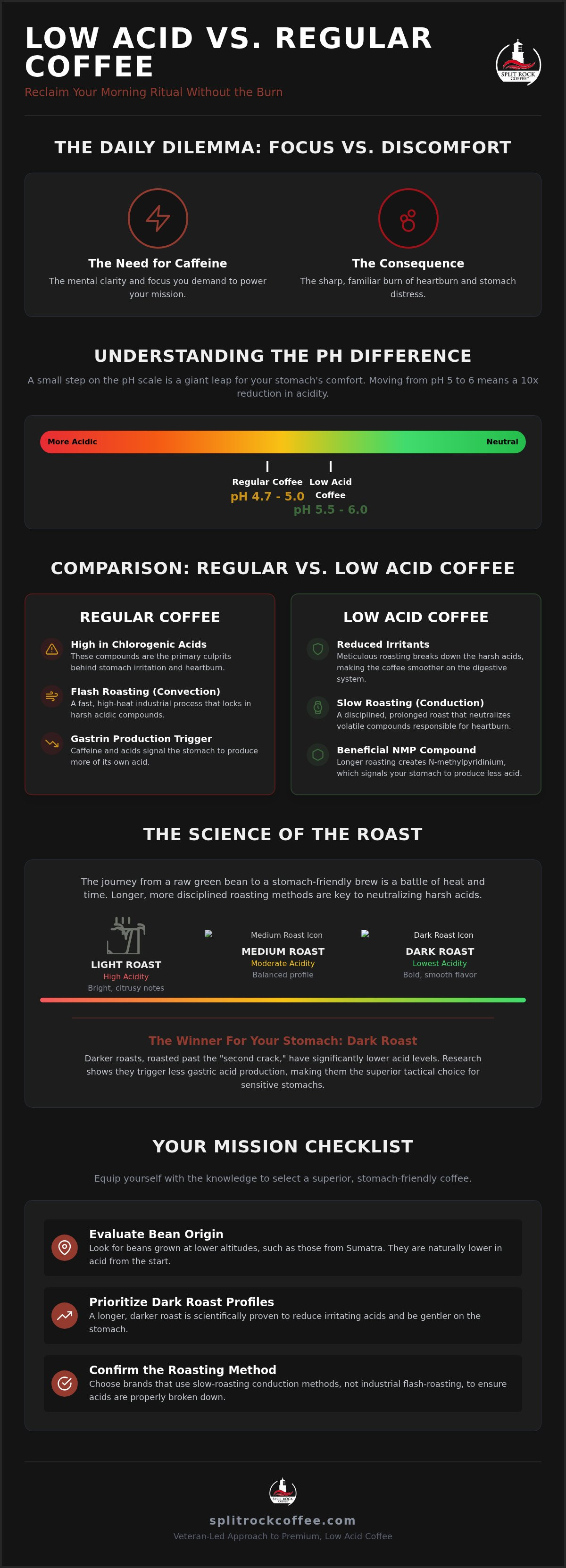
The morning ritual should be a moment of preparation, not a source of pain. When we look at the core differences between low acid coffee vs regular coffee, we are looking at a fundamental shift in how the bean is treated. Regular coffee is often mass-produced using flash-roasting techniques. This convection-heavy process is fast and efficient for the manufacturer, but it leaves behind high concentrations of chlorogenic acids. These acids, combined with the way caffeine triggers gastrin production in the stomach, are the primary culprits behind that mid-morning burn. Low acid coffee is different. It represents a commitment to a roasting process that intentionally reduces these irritants through precise time and temperature control.
The numbers tell the story. Standard coffee typically registers between 4.7 and 5.0 on the pH scale. In contrast, varieties specifically crafted for low acidity reach between 5.5 and 6.0. While this might seem like a small margin, the chemical reality is far more significant. This shift creates a brew that respects your digestive system while still delivering the bold, resilient flavor you expect from a premium bean.
Is Low Acid Coffee just a marketing term?
In a crowded market, it's easy to dismiss new labels as gimmicks. However, Low-acid coffee is rooted in specific bean sourcing and meticulous roasting discipline. There's a clear distinction between beans that are naturally low in acid, often grown at lower altitudes in regions like Sumatra, and those that are processed to remove acidity. At Split Rock, we view this as a mission-critical product. It isn't about jumping on a trend. It's about providing a tool for those who refuse to let stomach discomfort disrupt their daily mission. We select beans that possess a natural resilience and then roast them to perfection.
How does the pH scale affect your morning cup?
The pH scale is logarithmic. This means a single point of movement represents a ten-fold change in acid concentration. Moving from a pH of 5.0 to 6.0 isn't a minor tweak; it's a massive reduction in the acidic load your stomach must process. To put this in perspective, orange juice often sits around a 3.5, making it significantly more acidic than even the most aggressive dark roast. Comparing low acid coffee vs regular coffee reveals that the goal for any sensitive drinker is to move as close to a neutral environment as possible. Choosing a low acid option allows you to maintain your high-quality ritual without forcing your body into a defensive crouch every morning.
The Science of the Roast: How Heat and Time Dictate Acidity
The transformation from a raw green bean to a finished roast is a process of extreme discipline. In the roastery, heat and time are the only tools we have to dismantle the chemical compounds that cause stomach distress. When analyzing low acid coffee vs regular coffee, the most striking difference is the roasting methodology. Regular coffee is often flash-roasted using high-velocity convection heat. While this method is efficient for industrial-scale production, it fails to provide the time necessary for chlorogenic acids to break down. These acids remain trapped within the bean, waiting to be released into your morning cup.
Our approach favors slow-roasting through conduction. By allowing the beans to make direct contact with the heated drum over a longer duration, we initiate a thorough chemical breakdown. The science behind how roasting and brewing affect acidity reveals that time is the ultimate variable. This methodical application of heat ensures that the volatile compounds responsible for heartburn are neutralized before they ever reach your kitchen. It's a commitment to the craft that prioritizes the drinker's resilience over the manufacturer's speed.
Dark Roast vs Light Roast: Which wins for your stomach?
For those managing GERD or sensitive stomachs, the roast level is a tactical decision. Light roasts are prized for their bright, citrusy profiles, but those flavor notes are the literal presence of acid. As a bean roasts longer, it eventually reaches the "second crack." This is a critical milestone where the cellular structure of the bean changes and acidic compounds dissipate significantly. Research indicates that darker roasts actually trigger less gastric acid production in the stomach compared to their lighter counterparts. Choosing a dark roast is a disciplined trade-off; you sacrifice high-toned acidity for a smooth, chocolatey finish that respects your digestive health. To complement this smooth finish and maintain your mission of a gut-friendly cup, you might visit Leaner Creamer for their selection of healthy, clean-label creamers.
Success in the roastery requires a meticulous heat curve. We start with strategic sourcing, selecting beans from low-altitude regions like Brazil where the environment naturally produces lower-acid fruit. These beans are then subjected to a controlled roast that targets the breakdown of irritants while preserving the bean's integrity. Split Rock roasts for quality and gut health by maintaining a steady, purposeful heat that honors the heritage of the bean. If you're ready to experience the difference that precision makes, consider starting your journey with The Gold Standard Coffee Beans today. This level of scrutiny ensures that your morning sustenance supports your body rather than working against it.
Beyond the pH Scale: Why Your Stomach Reacts Differently to Low Acid Coffee
Focusing solely on the pH scale is like looking at a mission's map without checking the terrain. It gives you part of the picture, but it misses the chemical reality of how your body processes the brew. When we compare low acid coffee vs regular coffee, we must look at the compounds that actively manage your stomach's environment. It isn't just about reducing the acid present in the liquid; it's about providing your body with the tools to handle digestion without the burn. This biological interaction is what separates a standard morning cup from a truly stomach-friendly ritual.
The role of N-methylpyridinium (NMP)
One of the most significant discoveries in coffee science is a compound called N-methylpyridinium, or NMP. This molecule is a natural byproduct of the roasting process. It serves a vital function: it signals the stomach's parietal cells to decrease the production of hydrochloric acid. In many "regular" coffees, especially light roasts that are pulled from the heat early, NMP levels are remarkably low. This leaves your stomach without its natural "off switch" when caffeine arrives, leading to the discomfort that disrupts your morning mission.
Our disciplined roasting process focuses on maximizing NMP. By allowing the beans the time they need in the drum, we facilitate the chemical conversion that creates this beneficial compound. A darker, more thorough roast isn't just a flavor preference. It's a calculated move to ensure your morning sustenance remains pain-free. When NMP levels are high, the likelihood of experiencing that sharp, mid-morning heartburn drops significantly. This is the difference between a coffee that just sits in your stomach and one that actively works with your biology to maintain balance.
Caffeine and the 'Burn' Factor
We must also address the caffeine factor. Caffeine is a natural stimulant that can trigger acid reflux by relaxing the lower esophageal sphincter. When this muscle relaxes, stomach acid can travel back up the esophagus, causing the familiar burn. This happens regardless of the coffee's initial pH. For some, the combination of high caffeine and high acidity in regular coffee is a double strike against their comfort. It is a physical toll that no one should have to pay for a moment of clarity.
For those on the most sensitive missions, managing both variables is key. While our low acid coffee vs regular coffee comparison shows clear benefits in pH and NMP levels, some drinkers find total relief by choosing decaffeinated low acid options. This removes the stimulant trigger while keeping the stomach-friendly chemistry intact. To dive deeper into how you can customize your experience and protect your gut, check out The Ultimate Guide to Low Acid Coffee. Understanding these biological interactions is how you reclaim your morning without surrendering the coffee you love.
Strategic Selection: Identifying the Best Low Acid Coffee for Your Mission
Identifying the right fuel is a matter of tactical awareness. You cannot rely on vague promises found in a supermarket aisle. When you compare low acid coffee vs regular coffee, the difference lies in the scrutiny applied to every step of production. Standard grocery store brands often prioritize volume over chemistry. This results in a product that might be cheap but carries a high physical cost. True excellence is found in "The Gold Standard Coffee Beans," where every bean is selected to meet a specific benchmark for both flavor and digestive safety. Selection requires a checklist. First, verify the origin. Beans from lower elevations naturally carry less acid. Second, confirm the roast profile. Darker roasts facilitate the breakdown of irritants. Third, evaluate the process. A disciplined approach to selection is the only way to maintain a high-quality coffee ritual without the burn.
What to look for on the label
Scrutinize the label with intent. You are looking for indicators of a disciplined process. Terms like "conduction roasted" or "low altitude" signify a roaster who understands the science of acidity. Avoid any brand claiming to be "acid-free." This is a marketing myth. Coffee is a natural fruit, and fruit always possesses some level of organic acidity. Your goal isn't the impossible task of eliminating acid entirely. Instead, you are reducing it to a level your body can handle with ease. Prioritize fresh whole beans over pre-ground options. Keeping the bean intact until the moment of brewing protects the delicate chemical balance. This prevents the oxidation that can lead to increased irritation and bitterness. Freshness is a requirement for any successful morning mission.
Brewing for lower acidity
Your brewing method is the final stage of the mission. Cold brew is the most effective tactical choice for minimizing acid. By utilizing a long, cold extraction process rather than high-heat immersion, you prevent the release of the most aggressive volatile acids. This results in a concentrated, smooth brew that is exceptionally gentle on the gut. For those who prefer a hot ritual, the pour-over method offers the most control. Use a high-quality paper filter. These are designed to trap diterpenes and heavy oils that can contribute to stomach distress. Pay close attention to your water temperature. Keep it below the boiling point, ideally between 195 and 205 degrees Fahrenheit. This avoids over-extracting bitter and acidic compounds. If you are ready to take control of your morning, shop our Low Acid Coffee Blends and discover what it means to brew with purpose.
The Split Rock Standard: Why Our Low Acid Blends Rule the Morning
Discipline isn't just a buzzword; it's the foundation of everything we do. When you weigh the choice of low acid coffee vs regular coffee, you're looking for more than a beverage. You're looking for a reliable partner in your daily mission. Our roastery operates with a precision born from service, ensuring every batch meets a standard that honors our heritage and your health. We understand that your morning cup is more than a caffeine hit. It's the fuel that sustains your focus and drives your resilience. By choosing a roaster that prioritizes your well-being, you're making a strategic decision to protect your most valuable asset: your ability to perform.
A Mission-Focused Roastery
Founded in 2013, Split Rock Coffee is a Service-Disabled Veteran-Owned Small Business (SDVOSB) with a clear objective. We provide premium sustenance that supports a high-energy lifestyle without the physical toll of traditional roasts. The Gold Standard Coffee Beans aren't just a product; they represent our benchmark for excellence in every bean we source. We apply a rigorous level of scrutiny to our roasting process, moving beyond the industry average to create something truly resilient. This isn't about profit margins or corporate jargon. It's about a community of people who refuse to let stomach discomfort dictate their productivity. We invite you to join a legacy of purposeful craftsmanship where quality is never a compromise and every bag tells a story of dedication.
Securing Your Supply Chain
A successful mission depends on a secure supply chain. You should never have to scramble for your morning fuel or settle for an acidic grocery store substitute because you ran out. Our Monthly Coffee Subscription is designed to eliminate that risk entirely. Whether you prefer Whole Bean and Ground Coffee, we ensure your supply remains steady and reliable. We ship our Low Acid Coffee Blends worldwide, bringing the Split Rock standard to wherever your mission takes you. This subscription is our way of standing guard over your morning ritual, providing the consistency you need to face the day with confidence. It's a simple, effective way to ensure your resilience never wavers. Experience the Gold Standard with a Split Rock Subscription today and secure your daily fuel.
Secure Your Morning Mission
Reclaiming your morning ritual requires a tactical shift in how you select your fuel. By understanding the chemical realities of low acid coffee vs regular coffee, you move from a state of reactive discomfort to one of proactive performance. It's about more than just a higher pH level; it's about a roasting process that respects your resilience and a bean selection that supports your long-term health. You have learned how heat, time, and specific compounds like NMP dictate your physical comfort.
Since 2013, our Disabled Veteran-Owned Small Business has specialized in this precise craft. We apply a level of scrutiny to our roasting that ensures every bag meets the Split Rock standard, delivered globally to support your mission wherever it leads. Shop our Gold Standard Low Acid Coffee Blends and experience the difference that disciplined craftsmanship makes. You've done the hard work of learning the science. Now, it's time to enjoy the reward of a pain-free cup. Stand tall, brew with purpose, and face the day with the clarity you deserve.
Frequently Asked Questions
Is low acid coffee better for acid reflux?
Yes, low acid coffee is significantly better for those managing acid reflux. By reducing the concentration of chlorogenic acids and volatile compounds, these blends minimize the irritation of the esophageal lining. When comparing low acid coffee vs regular coffee, the higher pH level of the former creates a much gentler experience for the digestive system. This allows you to maintain your morning ritual without the painful burn typically associated with standard, high-acid roasts.
Does low acid coffee have less caffeine than regular coffee?
Not necessarily, as acidity and caffeine content are dictated by different factors. While the roasting process for low acid beans is more intensive, it doesn't automatically eliminate caffeine. However, caffeine itself is a stimulant that can trigger stomach acid production. If you have an extremely sensitive mission, we recommend our decaffeinated options. These provide the lowest possible risk of irritation by addressing both the pH level and the stimulant factor simultaneously.
Can you taste the difference between low acid and regular coffee?
You will notice a distinct difference in the flavor profile. Low acid coffee tends to be much smoother and lacks the sharp, biting bitterness found in many mass-produced brands. While regular coffee often relies on high acidity for brightness, our disciplined roasting process focuses on bringing out rich, chocolatey, and nutty notes. You get a full-bodied experience that feels substantial on the palate without the harsh aftertaste that often disrupts your focus.
What is the best roast for a sensitive stomach?
A dark roast is the tactical choice for anyone with a sensitive stomach. During the roasting process, the beans undergo a chemical change that breaks down acidic compounds. Darker roasts also produce a compound called NMP, which actually signals the stomach to stop producing excess acid. Our "The Gold Standard Coffee Beans" are roasted with this specific science in mind, ensuring a bold flavor that respects your body's digestive limits.
How do I make regular coffee less acidic at home?
You can reduce acidity by changing your brewing method. Switching to a cold brew process is the most effective way to lower acid levels at home, as it uses time rather than heat for extraction. If you prefer hot coffee, use a high-quality paper filter to trap some of the oily acids. Additionally, keeping your water temperature between 195 and 205 degrees Fahrenheit prevents the over-extraction of bitter, acidic compounds that cause discomfort.
Is cold brew coffee always low acid?
Cold brew is naturally lower in acid than hot-brewed coffee, but the starting bean still matters. If you use a high-acid light roast, the final product will still contain more irritants than a cold brew made with dedicated Low Acid Coffee Blends. The cold extraction process prevents many volatile acids from being released. For the best results, start with beans specifically roasted for low acidity to ensure your cold brew is as stomach-friendly as possible.
Are all dark roasts considered low acid?
Not all dark roasts are created equal. While the longer roasting time generally reduces acidity, some industrial flash-roasted dark roasts still retain high levels of irritants. True low acid coffee requires a disciplined, slow-roasting approach using conduction heat. This methodical process ensures a thorough chemical breakdown of chlorogenic acids. Simply buying a dark bag from a grocery store doesn't guarantee the same level of digestive comfort that a specialized roaster provides.
Why does regular coffee cause stomach pain for some people?
Regular coffee contains high concentrations of chlorogenic acids and caffeine, both of which can irritate the stomach lining. Caffeine also signals the body to produce gastrin, a hormone that stimulates the secretion of gastric acid. For many, this combination leads to heartburn or general discomfort. When you choose low acid coffee vs regular coffee, you are opting for a bean that has been meticulously processed to minimize these specific triggers, allowing for a pain-free experience.


