The Mission for a Better Brew: Understanding Low Acidity Coffee in 2026
You've just poured your first cup, ready to tackle a high-stakes morning, but before the caffeine even hits, that familiar, sharp burn of heartburn takes hold. It's a frustrating compromise. You shouldn't have to choose between the mental clarity you need and the physical comfort your body deserves. Many believe that switching to low acidity coffee means settling for a weak, flavorless imitation of their favorite roast. We understand that your morning cup is more than a beverage; it's the essential fuel for your mission.
This guide will show you how the science of bean selection and disciplined roasting can protect your gut while delivering the bold, full-bodied flavor you require. We'll explore the natural pH levels of premium beans, the impact of the 2026 market on quality, and how a mission-driven approach to roasting creates a better brew for your health and your community. Discover how to enjoy a superior cup without the digestive cost, ensuring you stay focused on the work that matters most.
Key Takeaways
- Learn how low acidity coffee leverages a higher pH level to eliminate digestive burn while maintaining the robust, full-bodied flavor your morning demands.
- Understand how the discipline of the roasting process serves as the primary line of defense, protecting both the bean's integrity and your gut health.
- Distinguish between perceived flavor acidity and actual chemical pH to ensure you never have to sacrifice a bold profile for physical comfort.
- Master precision brewing tactics that allow you to take control of your coffee’s smoothness through specific, intentional preparation methods.
- Discover how choosing a mission-driven, veteran-owned brand provides the high-performance fuel you need while supporting a greater cause.
What is Low Acidity Coffee? Defining the Standard
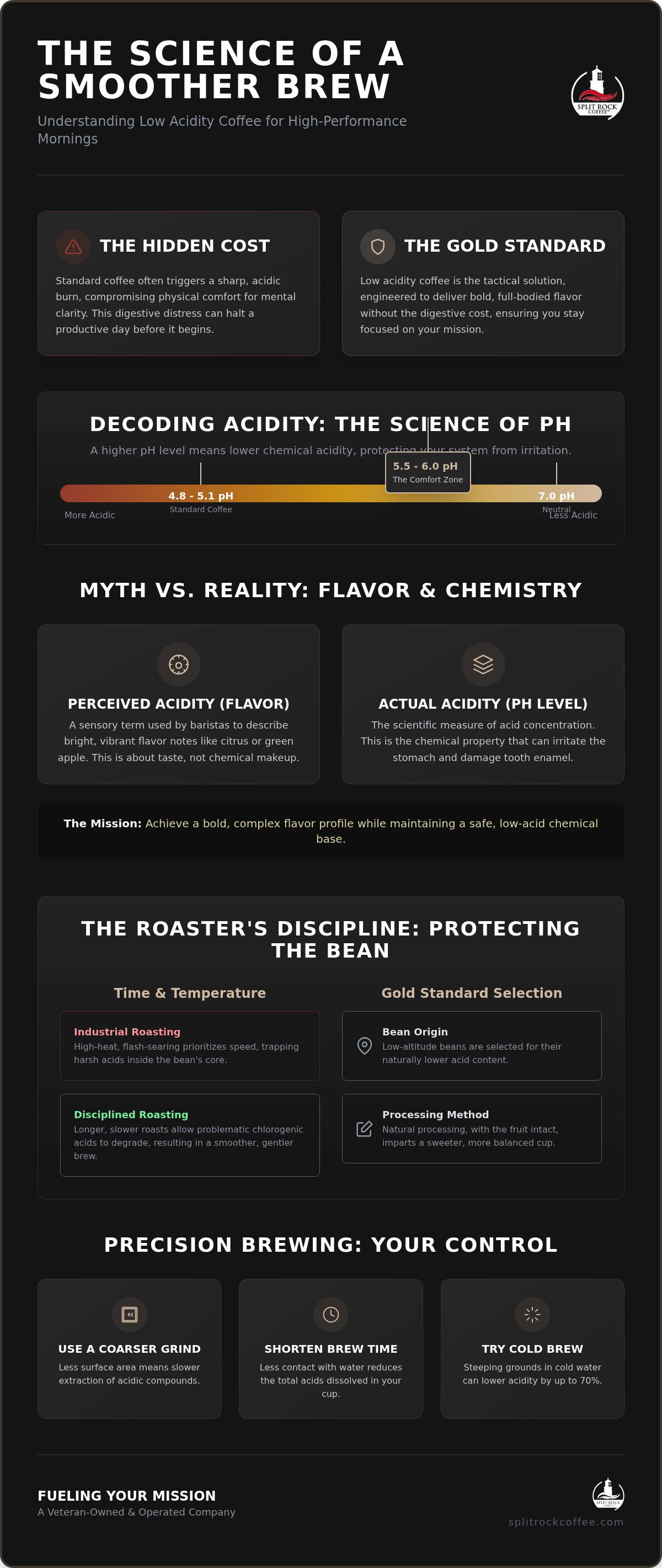
To understand the mission for a better brew, we must first look at the chemistry of the bean. Most standard roasts sit at a pH level between 4.8 and 5.1, which is significantly acidic. In contrast, low acidity coffee is defined by a higher pH level, moving closer to the neutral mark of 7.0. This shift isn't just a technicality; it's a fundamental change in how the beverage interacts with your body. For those with sensitive systems, standard coffee acts like a chemical trigger. It often leads to the discomfort that halts a productive day before it truly begins.
It's vital to distinguish between perceived acidity and actual acidity. When a barista describes a coffee as having high acidity, they're often referring to bright, vibrant flavor notes like citrus or green apple. This is a sensory experience. Actual acidity refers to the chemical pH level of the liquid. You can enjoy a complex, flavorful cup that tastes bright while still maintaining a safe, low-acid chemical profile. We believe in a Gold Standard where flavor integrity and digestive safety coexist. You don't have to drink burnt, flat coffee to protect your stomach.
The Science of pH in Your Morning Cup
A pH range between 5.5 and 6.0 represents the ultimate comfort zone for a high-performance brew. Within this range, the concentration of chlorogenic acids is significantly managed. These specific compounds are known to irritate the stomach lining and trigger an overproduction of gastric acid, leading to that all-too-familiar burn. While some organic acids are essential for a premium flavor profile, the goal is to eliminate the specific chemical distress signals that standard beans send to your gut. It's about precision. We roast with the discipline required to keep the pH high and the irritation low.
Who Needs a Low Acid Mission?
This isn't just a niche preference; it's a tactical adjustment for anyone who refuses to let physical discomfort dictate their schedule. Drinkers managing GERD or chronic acid reflux often find that low acidity coffee is the only way to sustain their daily ritual without consequence. Beyond the gut, choosing a lower-acid profile is a defensive move for your dental health. High-acid beverages can aggressively wear down tooth enamel over time. Making the switch is a commitment to long-term enjoyment and resilience. It's about ensuring your daily fuel supports your body instead of taxing it. A foundational understanding of low-acid coffee allows you to make informed choices that honor your health and your palate.
The Roasting Discipline: How We Protect the Bean
Roasting is a precision operation. It serves as your primary line of defense against the sharp, digestive burn of standard beans. While industrial roasters often prioritize speed to maximize volume, our mission requires a more disciplined approach. Traditional high-heat roasting can flash-sear the bean's surface, leaving the core under-developed and packed with the very acids that trigger reflux. By contrast, achieving true low acidity coffee demands a meticulous balance of thermal physics and patience. Every batch is a commitment to protecting your gut without surrendering the bold strength you expect from your daily fuel.
Time and Temperature: The Roaster's Arsenal
The secret lies in the duration of the heat application. Longer, slower roasts provide the necessary time for problematic chlorogenic acids to degrade. This process isn't accidental. It's a calculated strategy. During the roast, the Maillard Reaction transforms simple sugars into complex, caramelized flavors, effectively masking and reducing the chemical sharpness of the bean. This transformation is supported by UC Davis research on coffee acids, which highlights how roasting profiles directly dictate the final concentration of stomach-irritating compounds. We favor convection roasting because it ensures uniform heat distribution, preventing the "hot spots" that lead to inconsistent, high-acid batches.
The Gold Standard Bean Selection
Quality starts long before the beans reach the roastery. We utilize a rigorous selection process to identify beans that are naturally predisposed to a smoother profile. Low-altitude beans, for instance, often develop with a lower natural acid content than those grown in high-mountain environments. This is the foundation of The Gold Standard Coffee Beans. We prioritize specific varietals and natural processing methods, where the coffee cherry is dried with the fruit intact, often resulting in a sweeter, more balanced cup. This level of scrutiny ensures that our Low Acid Coffee Blends provide a reliable, high-performance experience every single morning.
Consistency is our duty. We monitor every variable, from ambient humidity to bean density, because we know that a single deviation can compromise the mission. Our roastery operates with the same attention to detail you bring to your own work. By combining scientific precision with a craftsman's intuition, we deliver a brew that stands as a testament to resilience and quality. It's not just coffee; it's a standard of excellence designed to keep you in the fight, cup after cup.
Low Acid Coffee: Myth vs. Reality
Skepticism is a natural response when a product promises to solve a lifelong problem without a catch. Many drinkers assume that low acidity coffee is simply a marketing gimmick or a sacrifice of flavor for the sake of comfort. They imagine a thin, watery cup that lacks the punch of a standard roast. This is a fundamental misunderstanding. Excellence and digestive safety are not mutually exclusive. True low-acid profiles are not about removing the soul of the coffee; they're about utilizing a disciplined roasting process to protect the drinker. A high-performance brew should never taste like a compromise. Quality is non-negotiable.
Is Dark Roast Always the Answer?
A common myth suggests that simply choosing the darkest roast available will solve your stomach woes. While it's true that extended heat exposure breaks down certain acids, the color of the bean is only half the story. If a roaster achieves that darkness by simply "burning" the beans at extreme temperatures, they create high levels of bitterness and carbonization. These can be just as irritating to a sensitive system as the acids they replaced. We find the balance. Our Low Acid Coffee Blends provide the safety of a dark roast without the charred, one-dimensional profile of over-roasted beans. It's about complexity, not just color. We preserve the medium-roast complexity while ensuring the pH remains in the comfort zone. Excellence demands discipline.
The 'Acid-Free' vs. 'Low-Acid' Distinction
Transparency is the hallmark of a trustworthy brand. You might see products labeled as "acid-free," but it's a lie. It's a biological impossibility. Coffee is an organic fruit; it will always contain some level of acid. Claims of being "acid-free" are usually red flags for marketing scams designed to exploit those in pain. Legitimate roasters, like those behind The Gold Standard Coffee Beans, focus on the honest standard of low acidity. This means maintaining a pH that is significantly higher than standard commercial coffee, often verified through consistent testing and a clear mission. We don't hide behind buzzwords. We rely on a decade of experience and a commitment to serving veterans and high-performers who need real fuel that works. When you look for a roaster, prioritize those with a documented history and a commitment to quality that goes beyond the label. Look for specialty-grade beans that haven't been stripped of their character to meet a health claim. It's about the mission.
Precision Brewing: Tactics for a Smoother Cup
Acquiring the right beans is only half the battle. To truly honor your gut health, you must apply the same discipline to your brewing process as we do to our roasting. Even the finest low acidity coffee can become bitter and irritating if handled with negligence. Think of your brewing equipment as your primary tools in the field. They require calibration and care to perform at their peak. Precision is the difference between a successful morning and a workday disrupted by discomfort.
The hierarchy of extraction is clear. Cold brewing remains the undisputed leader for stomach comfort, followed by immersion methods like the French Press. Drip machines and espresso, while efficient, often utilize higher pressures and temperatures that can aggressively pull more acidic compounds into your cup. Choosing Whole Bean and Ground Coffee from a trusted source ensures you have the right starting material, but the final smoothness is in your hands. Freshness matters. Oxidation is the enemy of a smooth cup, so keep your equipment clean and your beans sealed.
The Cold Brew Strategy
Cold water extraction is a tactical game-changer for those with high sensitivity. Research suggests that cold brewing results in approximately 60% to 70% less acid than traditional hot methods. This happens because cold water doesn't dissolve the oils and acids as aggressively as boiling water. It's a slow, methodical process that rewards patience with a velvety profile. To execute this at home, follow these steps:
- Grind your beans to a very coarse consistency, similar to sea salt.
- Combine the grounds with filtered water in a 1:8 ratio and steep for 12 to 24 hours at room temperature.
- Filter the mixture through a fine mesh or paper filter to remove all sediment.
Using The Gold Standard Coffee Beans for this method yields a concentrate that stays fresh and gut-friendly for up to two weeks in your refrigerator.
Hot Brew Calibration
If you prefer a hot cup, temperature control is your most vital tactic. Aim for a sweet spot between 195°F and 205°F. Water that is too hot will scorch the grounds and release sharp, bitter acids, while water that is too cool results in a sour, under-extracted mess. Grind size also plays a critical role. A medium-coarse grind reduces the surface area exposed to hot water, which slows down the extraction of heavier acids. Beyond the grind, we recommend using paper filters if you have extreme sensitivity. Paper is more effective than metal mesh at trapping certain oily acids that can irritate the stomach lining. It's a small adjustment that makes a significant impact on your daily resilience.
Ready to upgrade your morning ritual? Shop our Low Acid Coffee Blends and experience the difference that disciplined roasting makes for your mission.
Fueling Your Mission with Split Rock Coffee
We founded Split Rock Coffee with a clear objective: provide a superior brew that doesn't quit on you. As a Service-Disabled Veteran-Owned Small Business (SDVOSB), our roots are in discipline and service. This isn't just about selling a commodity; it's about providing the daily fuel required for those who have a mission to complete. We understand that a sensitive stomach shouldn't be a barrier to high-performance living. By focusing on low acidity coffee, we've created a standard that honors your health without diluting the strength you expect from a premium roast. Our work acts as a bridge between high-end craftsmanship and social responsibility.
The SDVOSB Difference
Founded in 2013, our brand was built on the values of resilience and meticulous attention to detail. Every bag of low acidity coffee we produce undergoes a level of scrutiny that reflects our heritage. We don't just roast beans. We manage a mission. When you choose our blends, you're supporting a business that understands the weight of responsibility and the value of a principled figure. Our commitment to The Gold Standard Coffee Beans isn't just a marketing slogan. It's a promise that every batch meets the rigorous requirements for both pH balance and flavor complexity. Supporting a veteran-owned business means investing in a legacy of quality and a commitment to a larger community that deserves excellence.
Securing Your Supply: The Subscription Model
Consistency is the bedrock of any successful mission. We know that running out of your preferred fuel can disrupt your entire morning rhythm and cause unnecessary friction. This is why we designed the Monthly Coffee Subscription. It's built to remove the stress of manual reordering, ensuring your supply is always secure and ready for the workday. Whether you prefer the control of Whole Bean and Ground Coffee, our subscription adapts to your specific setup and consumption needs. It’s a tactical choice for the disciplined coffee drinker who refuses to settle for subpar alternatives when the pressure is on.
You're part of a community that values craft, purpose, and the strength to push through challenges. We invite you to join us in this pursuit of a better brew that serves your body as well as it serves your palate. We take pride in being a reliable guardian of your morning ritual. Secure your daily fuel with a Split Rock subscription and stay focused on the work that matters most. Your mission deserves a coffee that is as resilient as you are.
Secure Your Morning Ritual
Reclaiming your morning doesn't require sacrificing the bold flavor you love. We've explored how the discipline of slow roasting and the precision of temperature calibration transform a standard cup into a high-performance fuel source. By choosing low acidity coffee, you're making a tactical decision to protect your health while maintaining your edge. It's about resilience. You now have the science and the strategy to fuel your day without the digestive cost that once held you back.
Since 2013, Split Rock Coffee has operated as a Service-Disabled Veteran-Owned Small Business with a commitment to excellence. Our Gold Standard Quality Guarantee ensures that every bag meets the highest benchmarks for strength and stomach comfort. We take pride in being the bridge between premium craftsmanship and the community we serve. It's time to stop compromising and start brewing with purpose. Shop The Gold Standard Low Acid Coffee Blends and experience the difference that a mission-driven roast makes. Stay focused, stay fueled, and keep moving forward.
Frequently Asked Questions
Is low acid coffee better for acid reflux?
Yes, it's specifically designed to reduce the chemical triggers that cause gastric distress. Standard coffee has a pH around 4.8 to 5.1, while low acidity coffee aims for a pH of 5.5 to 6.0. This higher pH level is closer to neutral, which helps prevent the overproduction of stomach acid. For those with GERD or chronic heartburn, making this tactical switch allows for continued coffee enjoyment without the painful side effects.
Does low acid coffee taste different than regular coffee?
It offers a smoother, more balanced flavor profile with less of the sharp, bright bite found in standard roasts. While some high-acid coffees feature citrus or floral notes, low-acid options lean toward chocolate, nut, and caramel undertones. You aren't sacrificing strength or complexity. Instead, you're enjoying a full-bodied cup that focuses on sweetness and depth rather than chemical sharpness. It's the ideal choice for those who prefer a rich, mellow finish.
Is dark roast coffee naturally lower in acid?
Dark roasts generally contain fewer acids than light roasts because the prolonged heat breaks down chlorogenic acids. However, color isn't the only factor. If a bean is flash-roasted at extreme temperatures, it can still trigger stomach issues through bitterness and carbonization. A disciplined, slow-roasting process is the true key to safety. We balance the roasting time to ensure the pH remains high while preserving the bean's natural integrity and flavor profile.
Can I drink low acid coffee while pregnant?
Many people find that low-acid options are easier to tolerate during pregnancy, especially when dealing with pregnancy-induced heartburn. It provides the same caffeine benefits with a reduced risk of digestive irritation. However, we always recommend consulting with your healthcare provider regarding caffeine intake and dietary changes during this time. Choosing a high-quality, disciplined roast ensures you're getting a clean product that supports your daily needs without adding unnecessary physical stress.
How do I make my coffee less acidic at home?
You can reduce acidity by adjusting your water temperature and grind size. Use water between 195°F and 205°F to avoid over-extraction of bitter acids. A coarser grind also limits the surface area, slowing down the release of acidic compounds. Adding a pinch of salt to the grounds or using alkaline water are other tactical adjustments. Of course, starting with dedicated low acidity coffee is the most effective way to ensure a smooth, stomach-friendly result.
What is the best brewing method for a sensitive stomach?
Cold brewing is the most effective method because it uses time instead of heat to extract flavor. This process results in a concentrate with 60% to 70% less acid than hot-brewed coffee. If you prefer a hot cup, the French Press or a pour-over with a paper filter are excellent choices. Paper filters are particularly good at trapping oily compounds that can irritate the stomach lining. Avoid espresso or high-pressure methods if you're highly sensitive.
Is low acid coffee organic?
While many low-acid brands prioritize organic farming, low acid and organic are two different standards. Organic refers to how the beans are grown without synthetic pesticides or fertilizers. Low acid refers to the chemical pH level of the final brew, often achieved through bean selection and roasting discipline. We focus on quality benchmarks that ensure our beans are clean, resilient, and safe for your gut, regardless of whether they carry a specific organic certification.
Why is Split Rock Coffee considered the Gold Standard?
We earned this title through a decade of disciplined roasting and a commitment to our mission as a Service-Disabled Veteran-Owned Small Business. Since 2013, we've refined our process to balance high pH levels with specialty-grade flavor. Our Gold Standard Coffee Beans are selected for their natural smoothness and resilience. We don't just sell coffee; we provide a reliable, high-performance fuel source for a community that refuses to compromise on quality or digestive health.


