
Why Does My Stomach Hurt After Drinking Coffee? Causes and Practical Next Steps
What if coffee isn’t the whole story behind your stomach discomfort? If you’ve wondered, “why does my stomach hurt after drinking coffee,” you’re not alone, and the answer isn’t always as simple as acidity. Coffee can affect people differently, and what you add to your cup or whether you drink it on an empty stomach may matter, too.
It’s frustrating when a familiar daily drink leaves you with pain, nausea, or an unsettled stomach. Conflicting claims about coffee and digestion can make it harder to tell what’s really going on. A symptom after coffee is a clue to investigate, not a diagnosis to guess.
Here, we’ll walk through common possibilities, including caffeine, coffee’s acidity, an empty stomach, and ingredients such as milk or sweeteners. You’ll also learn how to make careful, low-risk changes and track whether they affect your symptoms, without changing everything at once. And because recurring discomfort deserves attention, we’ll cover when to seek medical advice, especially if pain is severe or comes with concerning symptoms.
Key Takeaways
- “Why does my stomach hurt after drinking coffee?” has no one-size-fits-all answer; timing is a clue, not a diagnosis.
- Compare your coffee routine, food, additions, and symptoms to spot patterns without assuming one factor is responsible.
- Change one habit at a time and keep a brief symptom record so you can judge what seems to make a difference.
- Recurring discomfort may have causes beyond coffee, so know when symptoms call for professional medical advice.
- Explore practical adjustments carefully, and treat coffee choices as personal experiments, not a substitute for medical care.
Why might my stomach hurt after drinking coffee? Start with the symptoms
Stomach discomfort after coffee can disrupt a familiar routine, but the timing alone can’t tell you what caused it. If you’re asking, “why does my stomach hurt after drinking coffee,” start by describing what you feel rather than settling on a diagnosis. Coffee-related discomfort is a symptom pattern to investigate. It isn’t proof that coffee is the cause, or that you have a particular digestive condition.
What does “stomach pain after coffee” feel like?
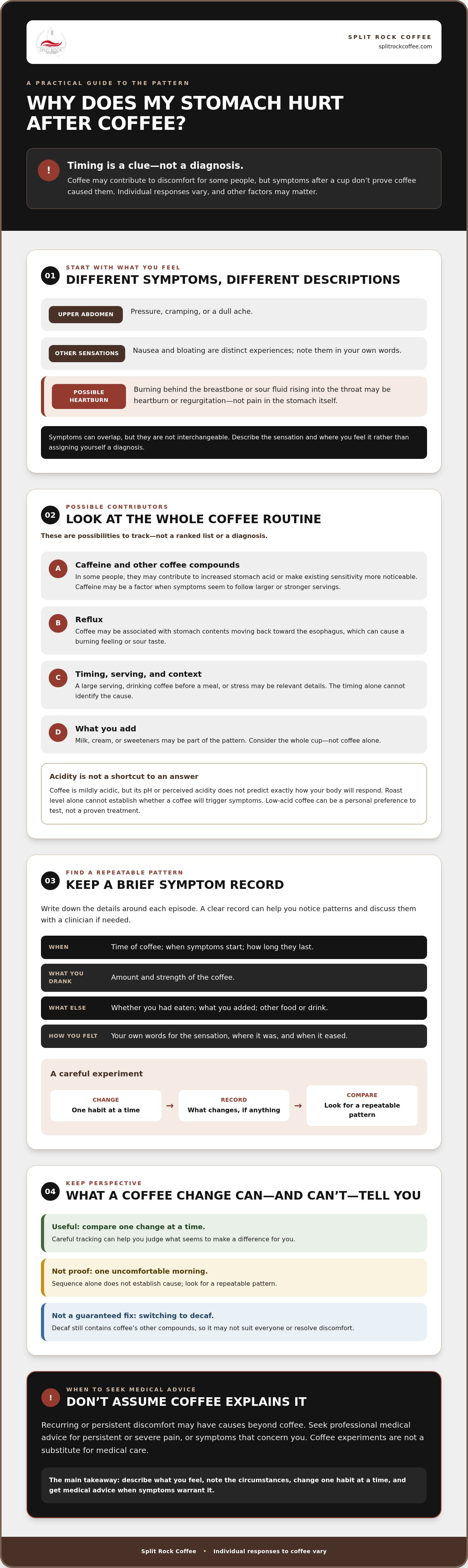
Be specific about the sensation and where you feel it. Upper-abdominal discomfort may feel like pressure, cramping, or a dull ache. Nausea and bloating are different experiences, while a burning feeling behind the breastbone or sour-tasting fluid rising into the throat may be heartburn or regurgitation, not pain in the stomach itself. These symptoms can overlap, but they aren’t interchangeable.
Notice when the feeling starts, how long it lasts, and whether it changes after eating or drinking something else. Write down your own words, such as “burning high in my abdomen” or “sour taste after my cup,” instead of labeling it as reflux or gastritis. The Health effects of coffee overview discusses possible digestive effects, including reflux, but it can’t explain an individual’s symptoms.
Could coffee be the trigger, or just the timing?
A symptom that follows coffee may be connected to it, but sequence alone doesn’t establish cause. A large serving, drinking before a meal, stress, or additions such as milk, cream, or sweeteners may be relevant factors to track. Individual responses vary, and coffee doesn’t inevitably harm digestion. Look for a repeatable pattern rather than drawing a conclusion from one uncomfortable morning.
Keep a brief note of the time, amount, whether you’d eaten, what you added, how you felt, and when symptoms eased. This gives you clearer information to discuss with a clinician if needed. Persistent or severe pain deserves attention beyond changing your coffee routine, since discomfort may have causes unrelated to coffee.
In brief: Pain, burning, nausea, bloating, and heartburn describe different experiences. Their timing can offer a useful clue, but it can’t identify the cause by itself. Record what you feel and the circumstances around it, and seek medical advice for persistent or severe symptoms rather than assuming coffee is to blame.
How coffee, caffeine, and reflux may contribute to stomach discomfort
Coffee may trigger symptoms in some people, but responses vary. Possible explanations include changes in stomach acid, digestive activity, or reflux, yet a plausible mechanism doesn’t prove what’s causing one person’s discomfort. That’s why asking “why does my stomach hurt after drinking coffee” calls for careful observation, not an instant diagnosis.
Coffee contains caffeine and other natural compounds that may affect digestion. In some people, these may contribute to increased stomach acid or make existing sensitivity more noticeable. Coffee may also be associated with reflux, in which stomach contents move back toward the esophagus, causing burning or a sour taste. Northwestern Medicine’s overview, Why Coffee Can Upset Your Stomach, discusses these possible effects. They’re not proof that coffee explains every episode of pain or heartburn.
Does caffeine make stomach pain or reflux worse?
Caffeine may be one factor, particularly if symptoms seem to follow larger or stronger servings, but it isn’t a universal cause. Decaf still contains coffee’s other compounds, so switching to it may not suit everyone or resolve discomfort. If symptoms keep returning, discuss them with a clinician rather than assuming caffeine is the explanation or trying to diagnose yourself by switching drinks alone.
Is coffee acidity the reason your stomach hurts?
Coffee is mildly acidic, but its pH and how acidic it tastes don’t predict exactly how your body will respond. A drink’s perceived acidity isn’t a diagnosis, and discomfort can have several possible contributors. Roast level alone also can’t establish whether a coffee will trigger your symptoms; individual responses differ.
Trying low-acid coffee can be a personal preference to test, not a proven treatment for stomach pain or reflux. If you want background before deciding whether to try it, read the complete guide to low-acid coffee. Treat any change as one experiment, and keep track of what you drink and how you feel rather than assuming the result will apply to everyone.
For another option to explore, Split Rock Coffee offers low-acid coffee blends. They’re a coffee choice to consider, not medical advice or a promise of symptom relief.
Compare your coffee habits to find possible stomach-pain triggers
A simple record can help you spot whether discomfort repeatedly follows a particular routine. It won’t tell you what condition you have, but it can give you clearer details to discuss with a clinician. Northwestern Medicine explains why coffee can upset your stomach, including possible roles for caffeine and stomach acid. Use your notes to explore patterns, not to confirm a cause.
What should you record when coffee causes discomfort?
For each episode, note when symptoms begin, where you feel them, how they feel, how long they last, and how severe they seem to you. Record the coffee and context around it. Keep the details straightforward; your own description is more useful than a guessed diagnosis.
| What to track | Details to note |
|---|---|
| Coffee | Type, approximate amount, serving size, and caffeine level if known |
| Preparation | Brewing method and whether it was regular or decaffeinated |
| Timing and food | When you drank it and whether you’d eaten |
| Additions | Milk, cream, sweeteners, or other ingredients |
| Symptoms | Start time, location, sensation, duration, perceived severity, and any other symptoms |
| Other context | Medicines, stress, meals, and notable changes in your routine |
Note medicines as context only. Don’t stop or change prescribed treatment based on a diary; ask your healthcare professional about medication concerns.
Could the amount, timing, or coffee additions matter?
Once you have a baseline, consider one modest adjustment that feels appropriate for you, such as having a smaller serving or changing when you drink it. Keep other parts of your routine steady while you observe what happens. If you change the serving size, coffee type, and breakfast all at once, it’s harder to tell which change may have mattered.
Milk, cream, and sweeteners are worth recording separately, as are brewing method and caffeine level. These are observations to test, not automatic explanations. No brewing method or roast is universally gentler for everyone. If you’re asking why does my stomach hurt after drinking coffee, a careful comparison of your own routine can help you prepare a more useful conversation with a clinician.
Keep the limits in view: A diary may reveal a recurring pattern, but it can’t diagnose digestive disease or rule out other causes. Seek medical advice for persistent or severe symptoms rather than relying on tracking alone.
What can you try when coffee seems to upset your stomach?
If you’re trying to work out why does my stomach hurt after drinking coffee, take a steady, low-risk approach. Start with the symptom notes you’ve already begun, then make one change at a time. The goal isn’t to prove a diagnosis; it’s to see whether a particular habit seems to track with how you feel.
How can you test whether coffee is involved?
Choose one change that feels reasonable for you, such as having a smaller serving, drinking coffee with food, or temporarily pausing coffee. Keep other parts of your routine as consistent as practical, and note what happens over an observation period that suits your circumstances. There’s no set timetable that works for everyone.
Reassess your notes before trying another change. If symptoms ease, that may be a useful pattern, but it doesn’t prove coffee caused them, identify a digestive condition, or guarantee you’ll tolerate coffee the same way in the future. Don’t stop or adjust prescribed medicines as part of an experiment. If symptoms are recurring, worsening, or unexplained, contact a healthcare professional rather than relying on trial and error.
When might lower-acid or decaffeinated coffee be worth exploring?
If you want to keep coffee in your routine, you could consider testing a lower-acid option or decaf as separate preferences, changing only one factor at a time. Neither is a guaranteed solution: low-acid coffee isn’t acid-free and may not prevent discomfort, while decaf still contains other coffee compounds. Pay attention to your response, not just the label or expectation.
For background on the category, see best low-acid coffee beans. Split Rock Coffee offers low-acid coffee blends as an optional coffee choice, not as a treatment or promise of symptom relief. You can explore low-acid coffee options if you’d like to consider that experiment.
Stop the experiment if symptoms worsen. Seek suitable medical advice, especially if discomfort is persistent, severe, or otherwise concerning. Coffee adjustments shouldn’t delay care when you need it.
When stomach pain after coffee needs medical attention
Not every episode of discomfort after coffee is caused by coffee. Recurring pain can have other explanations, and symptoms alone can’t confirm reflux, an ulcer, gastritis, or another condition. If you’re still asking, “why does my stomach hurt after drinking coffee,” a healthcare professional can help assess the full picture rather than relying on a coffee change as a diagnosis.
Which symptoms should prompt urgent care?
Seek emergency medical care for severe or sudden abdominal pain, vomiting blood, or black, tarry stools. Don’t wait to see whether avoiding coffee makes these symptoms go away. If you’re unsure how urgent your symptoms are, contact a healthcare professional or local urgent medical service for direction.
Arrange a medical appointment for pain that persists, keeps returning, worsens, or comes with unexplained weight loss or repeated vomiting. These symptoms don’t point to one specific cause, but they deserve individual assessment. If symptoms feel severe or rapidly worsen, seek urgent help rather than waiting for a routine appointment.
What should you tell a healthcare professional?
Clear notes can make the conversation more useful. Describe where the discomfort occurs, what it feels like, when it starts, how long it lasts, and how severe it is. Mention other symptoms and whether they’re changing over time.
Bring details about your coffee habits, meals, milk or sweeteners, medicines, stress, and any changes you’ve tried. Share what improved or worsened, but don’t stop or alter prescribed medicines unless your clinician advises you to. A symptom diary is helpful context, not a substitute for an examination or diagnosis.
Keep the priority clear: Stop any coffee experiment that worsens your symptoms, and seek appropriate medical advice. This article offers general education, not diagnosis or treatment. If you enjoy trying different coffees, Split Rock Coffee’s low-acid coffee blends are one optional category to explore, not a medical solution or a promise of relief.
Make your next coffee choice with clarity
If you’re wondering why does my stomach hurt after drinking coffee, remember that timing alone can’t identify the cause. Caffeine, coffee compounds, what you add, and your wider routine may all be relevant, but symptoms vary from person to person. Track what you feel, adjust one habit at a time, and treat any pattern as a clue, not a diagnosis.
Don’t let experiments replace care. Persistent, severe, or worsening pain deserves attention from a qualified healthcare professional, especially if other concerning symptoms appear. Clear notes about when discomfort starts and what you’ve eaten or drunk can help guide that conversation.
If you’d like to explore a different coffee option, Split Rock Coffee offers low-acid coffee blends. They’re a personal preference to consider, not a treatment or promise of relief. Founded in 2013, Split Rock Coffee is a disabled veteran-owned small business. Explore Split Rock Coffee’s low-acid coffee blends.
Take the next step at your own pace. With careful observation and the right support, you can make more informed choices about your routine.
Frequently Asked Questions
Why does my stomach hurt after drinking coffee?
Coffee may contribute to discomfort in some people, but the cause can’t be identified from timing alone. Caffeine or other coffee compounds, drinking it before eating, serving size, and additions such as milk or sweeteners may be relevant. Individual responses differ, and pain after coffee doesn’t confirm a digestive condition. Track what you feel and the circumstances around it, and seek medical advice if symptoms persist or worsen.
Can coffee cause stomach pain even if I do not have acid reflux?
Yes. Discomfort after coffee doesn’t necessarily mean you have acid reflux. People may experience upper-abdominal pain, nausea, or bloating, and those symptoms can have different causes. Coffee might be one factor, or its timing may coincide with another trigger. Don’t use symptoms alone to diagnose reflux or another digestive problem. If pain keeps returning, is severe, or concerns you, speak with a healthcare professional.
Is coffee acidity the reason my stomach hurts?
Not necessarily. Coffee is mildly acidic, but its acidity or perceived taste can’t establish why you have symptoms. Individual responses vary, and discomfort may relate to other coffee compounds, what you add, meal timing, or an unrelated cause. A lower-acid option can be a personal preference to test, but it isn’t a proven treatment and may not change your symptoms. Keep track of your response instead of assuming acidity is the answer.
Can decaf coffee still upset your stomach?
Yes. Decaffeinated coffee may still bother some people because it contains other coffee compounds, including acids. Switching to decaf could be a useful personal experiment if you suspect caffeine is relevant, but it won’t confirm the cause or guarantee relief. Change one factor at a time and note what happens. If discomfort continues, worsens, or has no clear pattern, ask a clinician rather than relying on a coffee switch alone.
Should I stop drinking coffee if my stomach hurts?
You don’t necessarily have to stop permanently, but you can consider pausing coffee or adjusting one habit to observe whether symptoms change, if that feels appropriate for you. Keep notes and avoid changing several things at once. Improvement doesn’t prove coffee was the cause. Don’t stop prescribed medicines or put off medical care to test a theory. Persistent, severe, or worsening pain warrants advice from a qualified healthcare professional.
Can low-acid coffee prevent stomach pain?
No reliable promise can be made that low-acid coffee will prevent stomach pain. It isn’t acid-free, and acidity isn’t the only possible factor in discomfort. You could try it as a coffee preference and observe your individual response, but treat that as an experiment, not a treatment. If symptoms recur or worsen, discuss them with a healthcare professional rather than relying on a product change to explain or resolve them.
When should I see a doctor for stomach pain after coffee?
Contact a healthcare professional for pain that persists, recurs, worsens, or comes with unexplained weight loss or repeated vomiting. Seek urgent medical care for sudden or severe abdominal pain, vomiting blood, or black, tarry stools. Don’t wait to see if avoiding coffee helps when urgent warning signs are present. Share when symptoms start, where they occur, how long they last, and any related foods, medicines, or changes you’ve tried.


