Coffee That Doesn’t Cause Heartburn: What to Choose and Try
What if the coffee you choose matters less than how your body responds to it? If your morning cup sometimes brings a burning sensation or reflux, it’s understandable to look for coffee that doesn't cause heartburn. But no roast, brewing method, or low-acid label can promise comfort for everyone. Coffee and caffeine may be triggers for some people, while others can enjoy a cup without symptoms.
You don’t have to give up coffee before you’ve tested practical alternatives. This guide explains why coffee may be linked to heartburn, compares darker roasts, decaf, and low-acid blends, and offers a careful way to change one part of your routine at a time. Low-acid blends, including options from Split Rock Coffee, may be worth testing, but the label isn’t a guarantee of relief. You’ll also learn what to track, how serving habits and add-ins may factor into your response, and when persistent or concerning symptoms call for medical advice. Start with your own pattern, not a one-size-fits-all claim.
Key Takeaways
- Heartburn is a symptom, not a diagnosis, and coffee-related discomfort can have more than one possible trigger.
- Compare caffeine, roast, brewing approach, and add-ins as separate variables. No single choice works for everyone.
- Finding coffee that doesn't cause heartburn starts with noticing your own response, not treating a label as a promise.
- Change one part of your coffee routine at a time and track what you drink, when you drink it, and how you feel.
- Consider Split Rock Coffee’s Low Acid Coffee Blends as one option to test, while keeping your observed response at the center of your choice.
Why coffee may trigger heartburn, and why the cause differs by person
Wanting your usual cup but bracing for a burning feeling is a frustrating trade-off. Coffee may coincide with heartburn for some people, but that timing doesn’t mean every cup causes symptoms or that everyone needs to avoid coffee. Look for your own pattern rather than relying on a blanket rule or a promise that one particular coffee will always feel fine.
Heartburn is a burning sensation, often felt behind the breastbone, that can sometimes come with sour-tasting fluid rising into the throat. It’s a symptom, not by itself a confirmed diagnosis of Gastroesophageal reflux disease (GERD), a chronic condition involving repeated reflux. Symptoms after coffee may be a clue worth tracking, but they can’t establish the cause on their own.
What does heartburn feel like, and when might coffee be involved?
Notice what you feel and when. Burning in the chest or throat, a sour taste, or fluid coming back up can be consistent with reflux, but only a healthcare professional can assess what’s behind persistent symptoms. If discomfort tends to follow coffee, record the timing alongside what and how much you drank, what you ate, and other relevant habits. A pattern can guide a careful test, but it isn’t proof.
Seek medical guidance for frequent, severe, or concerning symptoms. Chest pain can have causes beyond heartburn, so don’t assume coffee is responsible or delay care when symptoms feel serious.
Does coffee acidity explain every reaction?
No. Acidity describes a property of the brewed drink. Heartburn describes a sensation that may occur when stomach contents reflux into the esophagus. The two ideas may be related for some people, but they aren’t interchangeable. Coffee and caffeine are commonly linked with reflux symptoms, yet people respond differently, and acidity alone can’t explain every reaction.
A low-acid label doesn’t guarantee symptom-free coffee. It may be one variable to test, alongside caffeine, serving size, timing, food, and individual sensitivity. The American College of Gastroenterology’s guidance favors an individualized approach because evidence for universally avoiding trigger foods is limited.
A brief trigger diary can be more useful than blanket coffee rules. It helps you compare your symptoms with specific drinks and habits instead of assuming the same triggers apply to everyone. That’s a practical first step toward finding coffee that doesn't cause heartburn for you, if such an option fits your response. No roast or label should be treated as a cure.
How caffeine, coffee compounds, and drinking habits may affect symptoms
A cup of coffee is more than its acidity. Caffeine may be relevant for some people because it can affect the lower esophageal sphincter, the muscular barrier between the stomach and esophagus. If that barrier relaxes, reflux may become more likely. Coffee also contains acids and other compounds, and individual responses vary. The Cleveland Clinic’s overview of how coffee can trigger acid reflux explains why caffeine and coffee itself are both worth considering.
Noticing symptoms after drinking coffee doesn’t prove coffee caused them. Other foods, habits, or health factors may contribute. Separate the variables before drawing a conclusion. A change in coffee acidity doesn’t tell you exactly how your body will respond, and reducing caffeine won’t necessarily remove every coffee compound that might matter to you.
Can caffeine-free coffee help if caffeine seems to be a trigger?
Decaf can be a useful comparison if you suspect caffeine, but it isn’t a guaranteed fix. It still contains coffee compounds, so symptoms may continue for reasons unrelated to caffeine. Try it as a personal comparison: keep serving size and timing as similar as practical, then note whether your symptoms change. If there’s no clear difference, that’s useful information too.
Do timing and serving size matter?
They may be worth testing. A large serving, drinking quickly, or having coffee before food could coincide with symptoms for some people. Rather than changing everything at once, compare a smaller serving with your usual one, or test coffee with a meal against coffee on an empty stomach. Keep other habits as steady as you can.
Use a simple record to make the comparison clearer:
- What: coffee type, whether it’s decaf, and any additions.
- How much and how fast: serving size and whether you sipped it or drank it quickly.
- When: time of day and whether you had food with it.
- What followed: symptoms and when they appeared.
Change one factor at a time, then review the pattern across your notes. This is more informative than switching roasts, changing meals, and cutting caffeine all at once. If you’re ready to compare a lower-acid option, explore Split Rock Coffee’s Low Acid Coffee Blends as one possibility to test, not a promise of symptom relief. The right coffee that doesn't cause heartburn is the one that fits your preferences and your observed response.
Which coffee choices are worth comparing when heartburn is a concern?
There’s no single roast or brewing method that reliably delivers coffee that doesn't cause heartburn for everyone. Compare one change at a time and keep the rest of your routine steady. That makes it easier to see whether a difference seems to matter to you.
| Option to compare | Variable changed | What to keep in mind |
|---|---|---|
| Regular versus decaf | Caffeine | Decaf may help you test whether caffeine matters, but it still contains coffee compounds and may not suit you. |
| Coffee labeled low-acid | The product’s acidity claim | “Low-acid” doesn’t guarantee fewer symptoms. Check what the label means, then judge by your own response. |
| Lighter versus darker roast | Roast level | Darker roasting tends to reduce some acids, but roast alone doesn’t predict how you’ll feel. |
| One brewing approach versus another | Preparation method | Brewing can change the cup, but a different method isn’t a proven heartburn treatment. |
| Whole bean versus ground | Preparation preference | This affects how you prepare your coffee, not whether it will prevent reflux symptoms. |
Is low-acid coffee a sensible option to test?
It can be a reasonable variable to compare, provided you treat the label as a starting point, not a health promise. There’s no official federal definition of “low-acid coffee,” so the term doesn’t necessarily tell you how a particular cup will affect your symptoms. For more background on acidity and coffee labels, see this low-acid coffee guide. A low-acid blend may be worth trying, but it isn’t medically safer or suitable for everyone.
Could changing the brewing method or coffee format help?
Compare your usual preparation with another method while keeping the coffee and serving size consistent. This lets you observe whether the change coincides with a difference in symptoms, without assuming the method itself is a remedy. For step-by-step technique, refer to the pour-over brewing guide. Whole-bean and ground coffee are practical format choices. Neither guarantees a gentler cup.
Cleveland Clinic explains that caffeine and coffee’s natural acids may both be relevant for some people. A label or roast description can’t settle the question on its own. Choose one option, note what you drink and how you feel, then decide whether it’s worth keeping in your routine.
How to test coffee changes without guessing at the cause
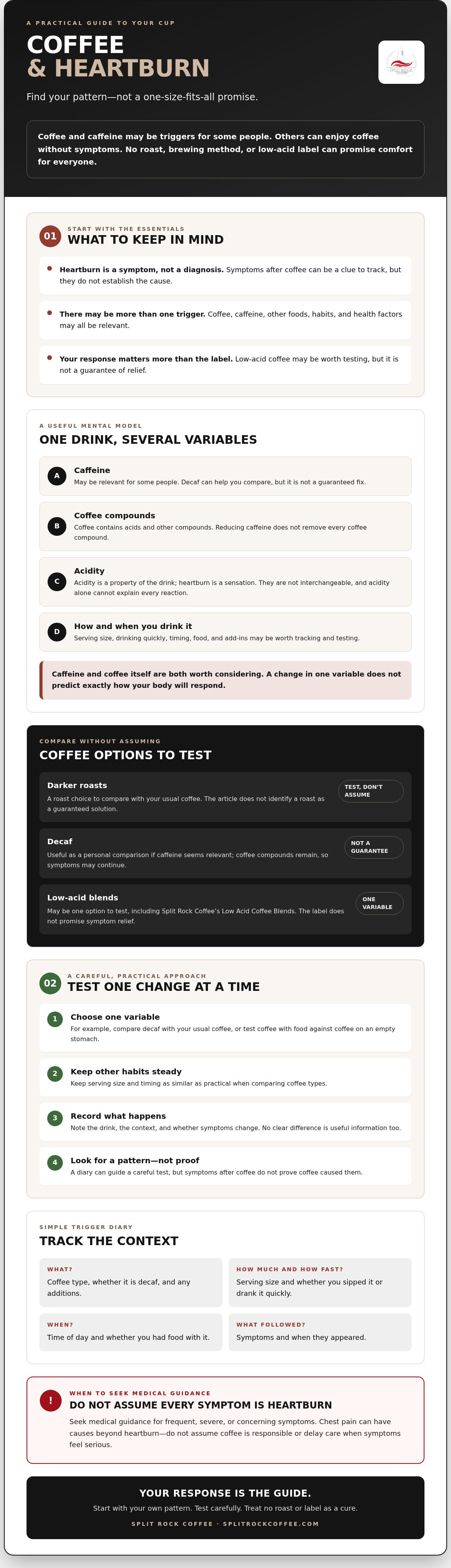
A steady method gives you better clues than switching several things at once. First, record your usual coffee routine and symptoms without deliberately increasing your intake or provoking discomfort. Then choose one reasonable variable to change, such as coffee type, serving size, or whether you drink it with food. Keep other habits as consistent as practical, record what happens, and review the pattern before deciding what to test next.
Change one coffee-related variable at a time, keep a consistent record, and compare repeated patterns rather than treating one episode as proof. You may not find a coffee that doesn't cause heartburn, but this process can help you understand which choices seem to fit your experience.
What should a coffee and symptom diary include?
Keep it simple enough to use every day. Note the coffee and preparation, amount, timing, food, symptoms, and other factors that might help explain a change. For example:
- Time and amount: morning, one mug.
- Coffee and preparation: regular or decaf, roast or label if known, brew method, and any additions.
- Food: with breakfast, after a meal, or on an empty stomach.
- Symptoms: what you noticed and when it started, including whether it was mild, disruptive, or absent.
- Other context: other foods or drinks, stress, or changes in routine that could be relevant.
This is a record, not a test you need to pass. Look for patterns across repeated experiences. One uncomfortable morning can have several possible explanations, while a similar response under similar conditions may be a more useful clue. Don’t assume coffee is responsible just because symptoms happened afterward.
When should you stop experimenting and seek medical advice?
Pause your trials and contact a healthcare professional if symptoms persist, worsen, happen often, or disrupt daily life. Don’t keep testing a drink if it brings on severe discomfort, and don’t delay care while trying to identify a trigger. A clinician can assess symptoms in context. A diary may help you describe what you’ve noticed, but it can’t diagnose the cause.
For severe or alarming symptoms, seek urgent professional care. In particular, don’t assume new or severe chest pain is heartburn. Your safety comes first.
Once you’ve established your baseline, you can explore Split Rock Coffee’s Low Acid Coffee Blends as one option to compare in your routine. Treat the label as a starting point, and let your own notes guide the next step.
Choosing coffee that may suit you, and where Split Rock Coffee fits
Choosing a coffee to try means balancing what you enjoy with what you’ve observed, not chasing a guarantee. A product label can help narrow the options, but your own experience is the more useful guide. Before choosing, consider:
- Caffeine: Decide whether you want regular coffee or prefer to test decaf.
- Serving habits: Choose an amount and timing you can keep consistent while you observe your response.
- Taste: Look for product details that match your preferences, where those details are provided.
- Your notes: Use your recorded experiences to guide what you try next.
Split Rock Coffee offers Low Acid Coffee Blends and Gold Standard Coffee Beans, with whole-bean and ground formats available. These are options to consider, not treatments for heartburn. The phrase “low acid” doesn’t establish how you personally will respond, and no coffee can be promised to prevent symptoms.
What should you look for on a low-acid coffee product page?
Look for clear product descriptions, available formats, and preparation guidance that helps you decide whether the coffee fits your routine. Compare the stated details with your taste preferences and equipment. Treat phrases about acidity as product descriptions, not medical evidence or a guarantee of comfort. For more background before comparing options, read the low-acid coffee bean guide.
How can you try a new coffee thoughtfully?
Start with a modest serving and keep familiar routine factors steady, so you can make a fair comparison with your usual cup. Choose whole bean or ground coffee based on your equipment and preparation preference. The format alone doesn’t predict how you’ll feel. If symptoms arise, note them and avoid pushing through significant discomfort just to finish a trial.
For repeat customers who want coffee on a regular basis, Split Rock Coffee also offers a monthly coffee subscription. Consider it for convenience after you’ve decided that the coffee and format suit your preferences. The aim isn’t to find a universally reliable coffee that doesn't cause heartburn. It’s to make an informed choice based on taste, practical fit, and your own response.
Keep your coffee routine grounded in what you learn
There may not be one coffee that doesn't cause heartburn for everyone. Caffeine, coffee characteristics, serving size, timing, and personal sensitivity can all be worth considering, but a label alone can’t predict your response. Track what you drink and how you feel, then test one manageable change at a time. If symptoms persist, worsen, or concern you, seek guidance from a healthcare professional rather than continuing to experiment.
If a lower-acid option is one of the changes you’d like to compare, Split Rock Coffee offers Low Acid Coffee Blends and Gold Standard Coffee Beans in whole-bean and ground formats. These are coffee choices to consider, not a promise to prevent or treat heartburn.
Explore Split Rock Coffee’s Low Acid Coffee Blends and Gold Standard Coffee Beans and choose an option that fits your preferences and routine. Take it one cup at a time, pay attention to your own response, and keep seeking the balance that works for you.
Frequently Asked Questions
Is there coffee that doesn’t cause heartburn for everyone?
No coffee is guaranteed to avoid heartburn for everyone. People can respond differently to caffeine, coffee compounds, serving size, and drinking habits, so a coffee that feels comfortable for one person may bother another. If symptoms seem connected to your cup, keep a brief record of what you drank and how you felt. Repeated patterns can help you decide what to test or discuss with a healthcare professional.
Can low-acid coffee prevent heartburn?
No. Low-acid coffee may be an option to compare, but it can’t be relied on to prevent heartburn. The “low-acid” label doesn’t guarantee symptom relief, and the term doesn’t have a single official federal definition. Your response may depend on factors beyond a coffee’s acidity. Treat the label as product information, not medical evidence, and note whether a particular coffee seems to affect your own symptoms.
Does decaf coffee cause less heartburn than regular coffee?
It may for some people, but decaf isn’t a sure solution. It has less caffeine than regular coffee, yet it still contains coffee compounds and may not suit everyone. If you suspect caffeine is relevant, you could compare decaf with your usual coffee while keeping serving size and timing similar. Record what happens rather than assuming a single experience proves the cause.
What type of coffee is least likely to trigger heartburn?
There isn’t one type that’s least likely to trigger symptoms for everyone. You could compare regular with decaf, try a coffee labeled low-acid, or adjust your serving size or brewing method. Make one change at a time and observe your response. Split Rock Coffee offers Low Acid Coffee Blends as one option to consider, but no coffee type can promise to prevent or treat heartburn.
Can drinking coffee with food reduce heartburn?
It may make a difference for some people, but drinking coffee with food isn’t a guaranteed way to avoid heartburn. If you usually drink coffee on an empty stomach, compare that routine with having it alongside a meal. Keep the coffee and serving size consistent, and record timing and symptoms. This helps you see whether eating with your coffee seems to change your personal response.
Does dark roast coffee cause less heartburn than light roast?
Dark roasting tends to reduce some acids in coffee, but that doesn’t mean dark roast will cause less heartburn for you. Acidity is only one possible factor, and roast darkness doesn’t determine your individual response. If you want to compare roasts, keep the serving size and timing similar and track symptoms. Don’t treat a darker roast as a guaranteed solution or a substitute for medical guidance.
When should I stop drinking coffee and talk to a doctor about heartburn?
Talk with a healthcare professional if symptoms persist, worsen, happen frequently, or disrupt daily life. Stop experimenting with a coffee that brings on severe discomfort, and don’t delay care to complete a trial. Seek urgent professional care for severe or alarming symptoms, including new or severe chest pain. Heartburn-like symptoms can have causes other than reflux, so a clinician can help assess what’s happening.


