
How Long Do Ground Coffee Beans Last? The Freshness and Shelf Life Guide
Ground coffee never truly rots in your cupboard, but the rich, bold roast you count on dies within two weeks of cracking the seal. If you have ever stood by your brewer wondering how long do ground coffee beans last before turning dull and bitter, you aren't alone. Nothing derails a focused morning faster than pouring a cup that tastes like flat cardboard because ambient air quietly stripped away the essential aromatic oils.
That printed date stamped on the bag tracks basic food safety, not the peak flavor window your morning routine demands. Research from the University of Minnesota showed that coffee deteriorates twenty times faster when exposed to ordinary air. You don't have to settle for compromised fuel. In this guide, we reveal the exact shelf life for opened and unopened grounds, quick sensory tests to spot stale coffee instantly, and disciplined storage tactics to keep every cup bold and fresh.
Key Takeaways
- Understand the difference between food safety dates and peak flavor windows to determine exactly how long do ground coffee beans last before losing their character.
- Learn how grinding whole beans multiplies surface area, drastically accelerating oxidation and causing vital aromatic oils to escape.
- Master three reliable sensory checks to detect stale, flat, or cardboard-like grounds before brewing your morning cup.
- Implement disciplined storage protocols using dedicated air-displacing containers to shield your grounds from moisture, heat, and light.
- Discover why small-batch orders and grinding whole beans immediately prior to extraction serve as the ultimate defense against stale coffee.
How Long Do Ground Coffee Beans Last? Peak Flavor vs Expiration
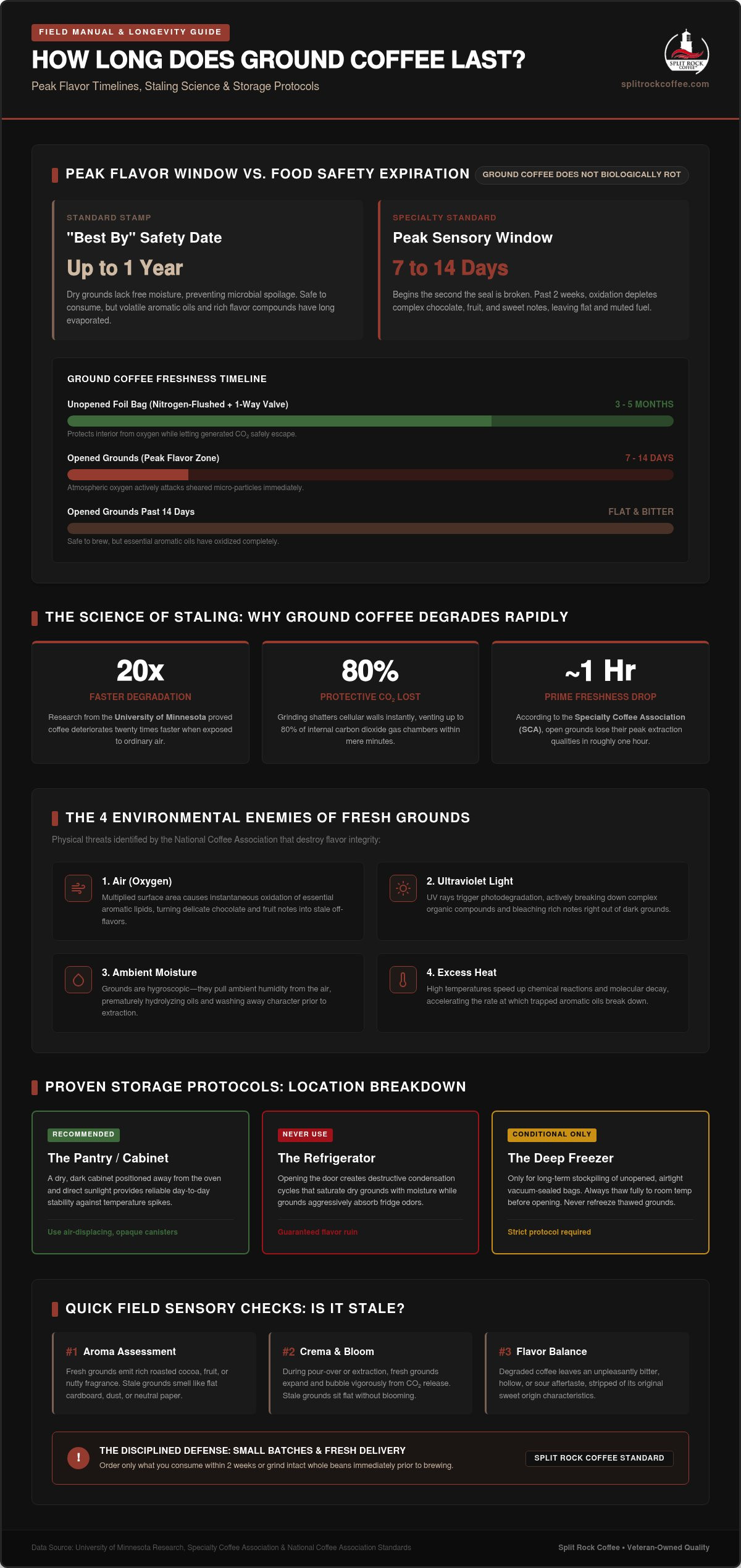
Ground coffee is remarkably shelf-stable from a purely biological standpoint. Because dry grounds lack free moisture, they won't rot, spoil, or sour in your cupboard like produce or dairy. Yet when dedicated coffee drinkers ask how long do ground coffee beans last, they aren't questioning whether six-month-old grounds will make them sick. They want to know when the roast surrenders its soul.
Commercial "best by" stamps track basic food safety, not sensory performance. While a forgotten tin might remain technically safe to brew for a year, the volatile organic compounds responsible for rich chocolate notes, delicate fruit tones, and sweet crema evaporate rapidly. Stale coffee won't send you to the hospital; it simply robs you of the bold, energizing morning cup you set out to make.
Unopened vs Opened Ground Coffee Timelines
Packaging integrity dictates the real countdown. When craft roasters seal roasted, ground coffee beans inside heavy-duty foil bags equipped with one-way degassing valves, nitrogen flushing preserves the grounds for three to five months. The valve permits carbon dioxide to escape without letting ambient oxygen penetrate the seal.
The instant you slice open that factory seal, the clock runs out fast. Atmospheric air immediately attacks the fractured coffee particles. To drink coffee that aligns with The Specialty Coffee Standard, consume opened grounds within seven to fourteen days. Past the two-week mark, peak flavor drops off sharply, leaving behind a flat, muted brew.
The Reality of Pantry, Refrigerator, and Freezer Storage
Understanding how long do ground coffee beans last also hinges on where you stash your supply:
- The Pantry: A dry, dark cabinet away from the stove provides steady short-term security against heat spikes and direct sunlight.
- The Refrigerator: Never store coffee in the fridge. Daily opening introduces catastrophic condensation, turning dry grounds damp while they absorb odors from leftover food.
- The Freezer: Deep freezing works solely for airtight, vacuum-sealed bags preserved for emergency stockpiles. Thaw the grounds fully at room temperature before breaking the seal, and never refreeze thawed grounds.
The Science of Staling: Why Ground Coffee Degrades Rapidly
Coffee beans are intricate organic matrices packed with aromatic lipids, carbohydrates, and soluble acids. During roasting, high heat generates carbon dioxide gas within the bean's cellular walls. This internal gas acts as a pressurized shield, locking delicate aromatics inside and fending off ambient air. Shattering that roasted shell with a grinder collapses the shield entirely, reducing a resilient whole bean into thousands of micro-particles.
This mechanical destruction explains why asking how long do ground coffee beans last reveals such a narrow window compared to intact beans. Crushing the bean causes its total surface area to multiply exponentially. Instead of oxygen slowly contacting the tough outer skin of a whole roasted seed, atmospheric air immediately touches millions of freshly sheared microscopic facets all at once.
Surface Area and the Accelerated Degassing Cycle
Intact roasted beans degas gradually over weeks, venting CO₂ while holding onto their sweetness. Grinding shatters those microscopic chambers instantly, venting up to eighty percent of the trapped protective gas within mere minutes. According to the Specialty Coffee Association, ground coffee loses its prime freshness window in about an hour without airtight intervention. As that carbon dioxide barrier bleeds out into your kitchen, oxygen rushes in to bind with exposed volatile oils, leaving fragile grounds defenseless against rapid staling.
The Four Environmental Enemies: Light, Air, Moisture, and Heat
To defend your daily brew, you need to recognize the physical forces working against your supply. The National Coffee Association highlights these threats in their established Proven Storage Protocols, identifying four distinct elements that accelerate flavor decay:
- Air (Oxygen): Oxygen oxidizes essential aromatic lipids, turning nuanced chocolate and fruit notes into sour, rancid off-flavors.
- Light: Ultraviolet rays trigger photodegradation, breaking apart organic compounds and bleaching the deep richness right out of dark grounds.
- Moisture: Grounds are naturally hygroscopic; they sponge up ambient humidity instantly, causing volatile flavors to hydrolyze and wash away before water ever touches your filter.
- Heat: Higher temperatures accelerate chemical kinetics, forcing the remaining aromatics to vaporize prematurely and leaving the coffee bitter and flat.
Guarding against these forces requires deliberate discipline. If you want consistently bold fuel that doesn't surrender to rapid staling, choose whole bean or ground selections prepared fresh to order from roasters at splitrockcoffee.com.
How to Tell if Ground Coffee Has Gone Bad: Three Sensory Checks
Instead of guessing by printed dates, rely on sensory discipline. A calendar date cannot account for sudden humidity changes, ambient pantry heat, or how often you unsealed the bag. When you evaluate how long do ground coffee beans last in your own kitchen, your senses provide an immediate verdict before you waste hot water on a compromised brew. Stale grounds yield a cup that tastes dusty, cardboard-like, or harshly astringent, stripped clean of its natural sweetness.
The Visual and Olfactory Aroma Check
Your nose offers the first line of defense. Fresh coffee erupts with intense aromatics; you should immediately pick up vibrant notes of toasted nuts, rich cacao, or subtle fruit. Stale grounds smell faint and hollow, reminiscent of dry cardboard or an old paper grocery sack. If the grounds emit a sour, pungent scent like rancid vegetable oil, the delicate lipids have oxidized completely.
Next, inspect the texture closely. Quality grounds should tumble freely like coarse, dry sand. If you spot damp clumps, discoloration, or any faint trace of fuzzy mold, moisture has penetrated the container. Throw them out immediately. Moldy grounds are unsafe and belong straight in the trash.
The Hot Water Bloom Extraction Test
The definitive diagnostic test happens during the initial pour. Place two tablespoons of grounds into a filter cone and saturate them with a small splash of hot water. If the coffee still holds viable life, it will bloom. The bed swells, rises, and actively bubbles as trapped carbon dioxide pushes outward to create an aromatic foam dome.
If the grounds lie lifeless, collapse immediately, or let water drain through without a single bubble, the coffee is fully degassed. The volatile aromatic compounds have vanished. While practicing how to brew pour over coffee, reading this bloom helps you understand how long do ground coffee beans last under your specific storage routine, ensuring you never settle for an empty, flavorless cup.
Proven Storage Protocols to Maximize Ground Coffee Longevity
Folding over a flimsy retail bag with a wire tin-tie is an open invitation for stale air. If you want to meaningfully stretch how long do ground coffee beans last while protecting their complex flavor notes, you need a disciplined containment strategy. Taking control of your morning cup requires four straightforward steps: ditch flimsy packaging, displace interior oxygen, isolate the container from heat, and align your purchasing volume with your actual weekly consumption.
Selecting Purpose-Built Airtight and Opaque Canisters
Aesthetic glass jars look attractive on open shelving, but light rays degrade coffee lipids within days. Always choose opaque stainless steel or ceramic vessels that shut out ambient illumination entirely. Standard snap-on lids present another hidden vulnerability: they trap pockets of oxygen inside the container above the coffee bed.
Plunger-style canisters solve this issue mechanically. These specialized containers utilize an internal plunger lid that presses directly against the grounds, driving trapped headspace air out through a one-way valve before locking in place. By eliminating that pocket of stagnant air, you deprive oxidation of the fuel it needs to spoil your coffee.
Strategic Kitchen Placement Away from Thermal Fluctuations
A heavy-duty canister won't protect your roast if it sits in the wrong zone. Keep your coffee supply far away from heat-generating appliances like ovens, dishwashers, microwave exhausts, and steam from kettles. Similarly, avoid window sills and drafty air-conditioning vents where daily temperature swings trigger condensation inside the container.
Tuck your storage vessel deep inside a dry, dark pantry shelf maintained at a consistent room temperature around sixty-eight degrees Fahrenheit. Consistent, moderate conditions keep roasted oils stable and prevent premature staling.
No storage vessel can freeze time indefinitely. The best way to guarantee bold, vibrant flavor every morning is keeping your rotation fresh and disciplined. Rather than hoarding bulk containers that turn stale by week three, order freshly roasted ground coffee sized perfectly to match your weekly brewing routine.
The Disciplined Solution: Small Batches, Whole Beans, and Fresh Delivery
Buying five-pound bulk canisters from warehouse clubs might feel efficient, but it guarantees compromised mornings. Once you crack the seal on a massive tub, ambient air immediately attacks the fractured grounds. By week three, you're drinking flat, oxidized dust. The real answer to how long do ground coffee beans last isn't hunting down a miracle container; it's adopting disciplined purchasing habits that match your household's actual brewing cadence.
Whole Bean vs Ground: Upgrading Your Morning Mission
Grinding whole beans immediately before extraction remains the undisputed gold standard of coffee craft. Intact beans serve as nature's protective armor, locking fragile lipids and volatile aromatic compounds deep inside a dense cellular matrix for months. Grinding on demand liberates those compounds directly into your brew, yielding rich extraction efficiency, thick crema, and vibrant aromatics.
If you have an adjustable burr grinder, pair it with our premium best low acid coffee beans. Specialized craft roasting reduces harsh stomach-upsetting acids while preserving sweet, balanced flavor notes. Grinding just moments before water touches the bed gives you complete control over your morning fuel.
Eliminating Waste Through a Dedicated Ground Coffee Subscription
If your schedule demands the quick convenience of pre-ground coffee, eliminate the freshness gamble at the supply chain level. Calculate your exact weekly consumption so excess coffee never languishes in a dark cupboard. Rather than constantly checking how long do ground coffee beans last before turning dull, set up a routine delivery that keeps fresh fuel in constant rotation.
A reliable ground coffee subscription ensures you receive craft selections prepared fresh to order. Your next package arrives just as your current supply reaches the end of its peak flavor window. At Split Rock Coffee, a Service-Disabled Veteran-Owned Small Business founded in 2013, we roast Low Acid Coffee Blends and The Gold Standard Coffee Beans with purposeful precision. Fresh coffee delivered straight to your door protects your mornings from stale compromise, giving you the energy and focus your mission deserves.
Take Command of Your Daily Brew
Mastering how long do ground coffee beans last isn't about watching a distant calendar date; it's about respecting the integrity of the roast. Peak aromatic flavor vanishes within two weeks of cracking the seal, and no amount of pantry hoarding can outrun oxidation. By utilizing air-displacing canisters and aligning your supply with your actual brewing routine, you eliminate stale, bitter cups for good.
Your mornings deserve purposeful fuel, not flat compromise. As a Service-Disabled Veteran-Owned Small Business founded in 2013, Split Rock Coffee is dedicated to uncompromising quality. We specialize in small-batch roasting crafted for gentle, low-acid digestive comfort, shipping freshly sealed Whole Bean and Ground Coffee straight to your door. Explore Fresh Low Acid Coffee at Split Rock Coffee today, lock in your fresh rotation, and start every single morning with the bold, dependable cup you've earned.
Frequently Asked Questions
Can drinking expired ground coffee make you sick?
No, drinking expired ground coffee won't make you sick unless moisture has caused mold to grow. Coffee is an exceptionally dry commodity, meaning harmful bacteria can't thrive in dry grounds. The staling process ruins aroma, complexity, and body rather than creating dangerous toxins. However, if humidity got inside your container and produced fuzzy mold, clumping, or an acrid rot, toss it immediately. Otherwise, old coffee merely tastes flat and stale.
How long does ground coffee last once the bag is opened?
Ground coffee lasts about one to two weeks at peak flavor once you break the package seal. Understanding how long do ground coffee beans last after opening comes down to oxygen exposure. Ambient air immediately binds to delicate aromatic lipids. While grounds remain safe to drink for several months in an airtight container, the vibrant flavors deteriorate past the fourteen-day mark, leaving behind a dull brew.
Should you store ground coffee in the freezer or refrigerator?
You should avoid the refrigerator entirely, and use the freezer only for sealed, long-term reserves. Refrigerators introduce condensation every time the door swings open, causing grounds to absorb moisture and stray food odors. The freezer works strictly for unopened, airtight bags intended for deep storage. Always thaw grounds completely to room temperature before cracking the seal, and never refreeze them once thawed.
Does unopened ground coffee go bad after the expiration date?
Unopened ground coffee does not spoil when passing its printed expiration date, but peak freshness fades gradually. Factory-sealed bags with one-way valves flush out oxygen with nitrogen, preserving quality for three to five months. Past that window, microscopic amounts of air slowly degrade the volatile oils. The coffee won't become toxic, but the rich nuance and low-acid sweetness you expect will diminish significantly by the time you brew it.
What does stale ground coffee taste like when brewed?
Stale ground coffee tastes flat, hollow, and unpleasantly bitter, often resembling wet cardboard or dusty paper. Fresh coffee balances natural sweetness, vibrant acidity, and rich body. As oxygen strips away volatile aromatic compounds, you lose nuanced chocolate, nutty, and fruit notes. The resulting brew feels thin, harsh, and dry on the palate, leaving a lingering astringent aftertaste that milk and sugar struggle to mask.
How can you tell if ground coffee is fresh without tasting it?
You can test freshness without tasting by checking the dry aroma and observing the hot water bloom. When evaluating how long do ground coffee beans last in your pantry, smell them first. Fresh grounds release deep aromatics, while stale ones smell like dry paper. Next, pour a splash of hot water over the bed. Fresh grounds foam and bubble actively as trapped carbon dioxide escapes. Flat, sinking grounds indicate total degassing.
Why does whole bean coffee stay fresh longer than ground coffee?
Whole bean coffee stays fresh longer because the intact outer shell protects internal cells from rapid oxidation. Roasting traps protective carbon dioxide deep inside the bean matrix. Grinding pulverizes that shell into thousands of tiny particles, expanding surface area exponentially and venting internal gases within minutes. Whole beans shield those volatile oils safely inside the seed until you run them through a grinder immediately before brewing.


