The Specialty Coffee Standard: A Disciplined Guide to Quality and Purpose
Most coffee drinkers believe that "specialty" is just a fancy label used to justify a higher price tag, but it’s actually a rigorous, 80 point standard that separates elite fuel from the mass produced beans that leave you with a sour stomach. If you have ever felt that sharp, acidic burn after your first cup, you know that not all beans are created equal. You want a morning ritual that provides sustained energy without the digestive tax of low grade commodity coffee. We believe that every sip should be a testament to quality and a commitment to a greater mission. Choosing the right specialty coffee is about more than flavor; it is about the discipline of the craft and the purpose behind the pour.
In this guide, you will discover the precise standards that define specialty coffee and how a mission driven approach to roasting creates a superior, gut friendly experience. We are going to break down the official SCA grading process, explain why specific roasting techniques matter for your health, and show you how to source ethical fuel that respects your body. By the end, you will understand how a purposeful roast can transform your daily routine into an act of excellence that honors both the craftsman and the community.
Key Takeaways
- Learn the rigorous 80 point grading criteria that define specialty coffee and ensure every bean meets a standard of excellence before it reaches your cup.
- Identify the primary physical defects and mold issues in commodity coffee that are the hidden culprits behind stomach irritation and acid reflux.
- Gain the tactical knowledge to verify freshness by prioritizing specific roast dates and origin data over generic, misleading grocery store labels.
- Connect your morning routine to a larger legacy by choosing a mission driven roaster that prioritizes both veteran support and superior bean quality.
What is Specialty Coffee? Defining the Elite Standard
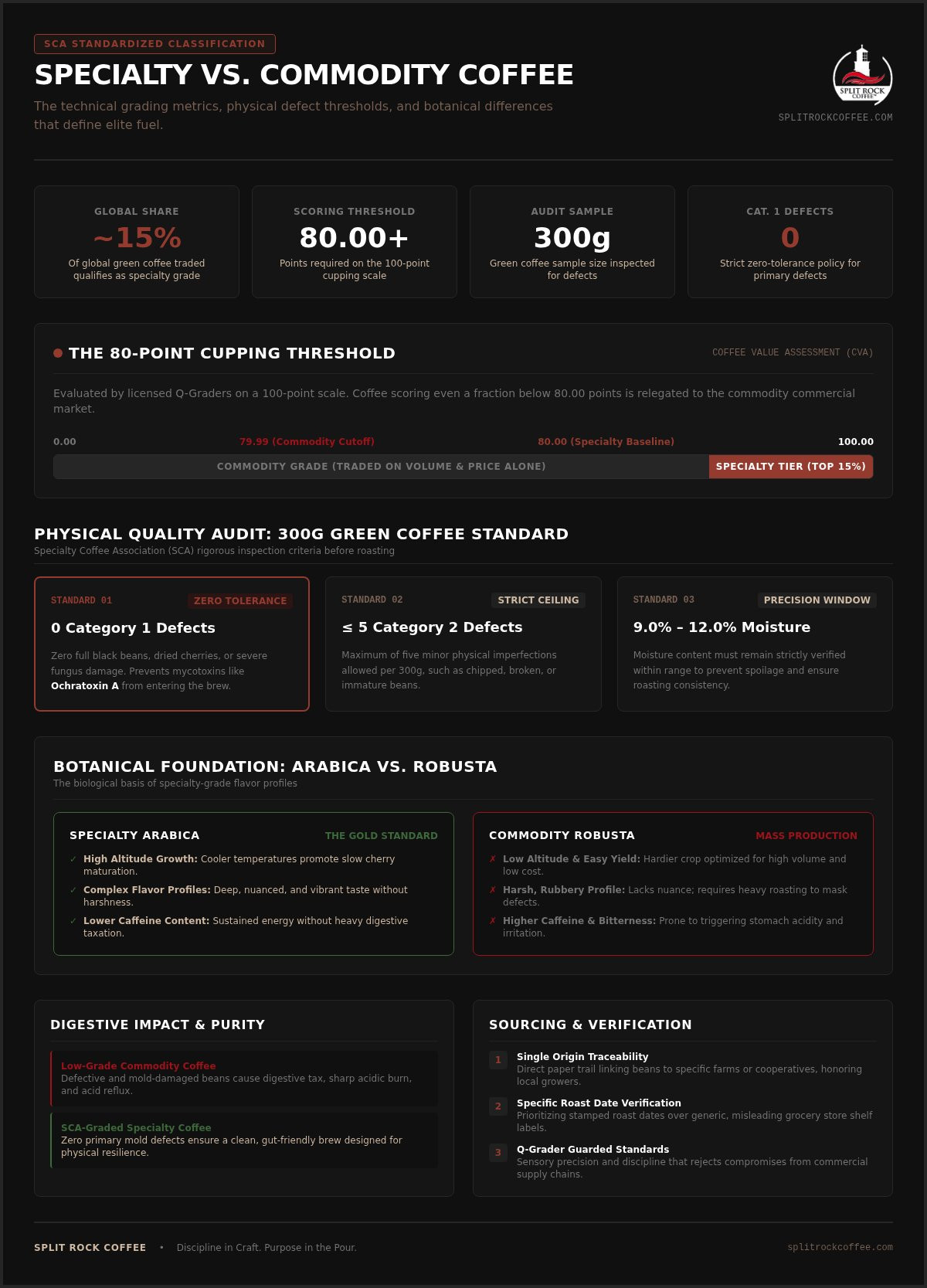
In the world of professional roasting, "specialty" isn't a marketing buzzword used to move bags off a shelf. It's a technical classification and a promise of quality. While grocery store shelves are packed with commodity coffee, which is traded on volume and price alone, specialty coffee is defined by a rigorous set of standards maintained by the Specialty Coffee Association (SCA). This organization acts as the governing body for the industry, ensuring that every bean meets a high benchmark of excellence. To understand the full scope of these requirements, one can look at the specialty coffee definition and grading scale, which outlines how beans are evaluated from the farm to the cup. According to the 2026 National Coffee Data Trends report, specialty grade beans represent approximately 15% of global green coffee traded by volume. This elite tier is the only fuel worthy of a disciplined morning.
The 80-Point Threshold
To earn the specialty title, coffee must undergo a disciplined evaluation known as cupping. Licensed professionals called Q-Graders score the beans on a 100 point scale using the updated Coffee Value Assessment (CVA) framework. A coffee must score 80.00 points or above to be considered specialty grade. If a batch falls even a fraction below this mark, it's relegated to the commodity market, often ending up in the mass produced blends found in big box stores. This strict cutoff ensures a consistent, premium experience. It isn't just about taste; it's about the reliability of the product. When you choose a bean that has survived this level of scrutiny—whether brewing at home or visiting dedicated venues like LT ONE Coffee—you're investing in a standard that refuses to compromise.
Arabica vs. Robusta: The Foundation of Quality
The journey to the Gold Standard begins at the farm level with the choice of species. High quality specialty roasts almost exclusively utilize Arabica beans, which are known for their complex flavor profiles and lower caffeine content compared to the hardier Robusta species. Arabica thrives at higher altitudes where cooler temperatures allow the cherries to mature slowly. This slow growth develops the deep, nuanced flavors that commodity coffee lacks. While Robusta is easier to grow and cheaper to produce, it often carries a harsh, rubbery taste that requires heavy roasting to mask. By focusing on high altitude Arabica, we ensure that the foundation of your brew is clean, vibrant, and worthy of the mission it supports.
The Gold Standard: How Coffee Earns Its Specialty Grade
Before a single bean is roasted, it must pass a physical inspection that would break a lesser product. This isn't a casual glance. It's a disciplined audit of a 300 gram sample of green coffee. To meet the Specialty Coffee Association standards, that sample must contain zero Category 1 defects. We're talking about full black beans, severe fungus damage, or dried cherries that can ruin an entire batch. Even a single moldy bean can introduce toxins like Ochratoxin A, which is why the "Zero Primary Defects" rule is non-negotiable for specialty coffee. Beyond these primary failures, the sample can have no more than five Category 2 defects, such as chipped or immature beans. We also verify that moisture content stays strictly between 9.0% and 12.0%. This level of scrutiny ensures that the fuel you put in your body is clean, safe, and of the highest caliber.
Traceability and the Single Origin Mission
True quality leaves a paper trail. For the purposeful craftsman, traceability isn't just about logistics; it's about honor. Knowing the specific farm or cooperative where your beans were harvested allows for a level of transparency that commodity blends can't offer. When we source from a single origin, we're supporting the legacy of a specific community. This ethical bridge between the farmer and the roaster results in a more vibrant taste profile. It ensures that every cup tells a story of resilience and hard work. It's about knowing exactly where your sustenance comes from and trusting the hands that grew it. This transparency is the bedrock of a truly premium brew.
The Role of the Q-Grader
Think of a Q-Grader as the sommelier of the coffee world. These are certified experts who have endured rigorous testing to prove their sensory precision. Their disciplined scrutiny protects you from the inconsistencies of the commercial market. They look past the marketing and focus on the science of the bean. By the time you brew The Gold Standard Coffee Beans, you can trust that every step of the journey has been guarded by professionals who refuse to settle for "good enough." This commitment to excellence is what transforms a simple morning beverage into a source of sustained, high-quality energy. They are the guardians of the standard, ensuring that only the elite tier of global production reaches your mug.
Specialty vs. Commodity Coffee: Why the Difference Matters for Your Gut
People often ask why they should invest in specialty coffee when grocery store tubs are so cheap. The answer isn't just about the flavor profile. It's about how your body reacts to the fuel you give it. Commodity coffee is often a cocktail of chemical irritants. It relies on low grade beans harvested unripe and stored in bulk where oxidation and mold take hold. According to Harvard research on coffee compounds and health, coffee contains hundreds of bioactive compounds, including polyphenols and chlorogenic acids, that impact digestion. In high quality specialty lots, these compounds remain balanced. In commodity lots, they degrade into bitter pyrolytic compounds that trigger stomach acid overproduction. Achieving true low acidity coffee is a direct byproduct of this technical excellence. It's about choosing sustenance over simple stimulation.
Defects and Digestive Distress
The sharp burn you feel after a morning cup often stems from the defects we discussed earlier. Commodity coffee permits a high volume of Category 1 defects, including mold damaged beans. These defects can contain mycotoxins like Ochratoxin A. While roasting reduces these levels, it doesn't always eliminate the irritation they cause to the gastric mucosa. Specialty standards require zero mold or sour defects. This discipline creates a cleaner interaction with your stomach lining. When you search for the best low acid coffee beans, you're really searching for the physical purity that only specialty grade sourcing can provide. It's a matter of biological respect and disciplined sourcing.
Roasting for Purity, Not Just Power
Large commercial roasters often char their beans to a uniform black. They do this to hide the inconsistent, low quality flavors of their bulk supply. This over roasting creates high levels of carbonized matter that wreaks havoc on your gut. Our approach is different. We treat the roast as a mission to highlight the bean's natural profile rather than burying it under a layer of smoke. The Split Rock method preserves the integrity of the Arabica bean while carefully managing the chemical transition that reduces acidity. It takes a high level of scrutiny to hit the Gold Standard in every batch. We don't just roast for caffeine; we roast for sustenance and the longevity of our community. This is the difference between a product that wears you down and a brew that builds you up.
How to Identify and Source Real Specialty Beans
Identifying specialty coffee requires the eye of a scout. You cannot rely on flashy packaging or vague claims of "premium" quality found in the grocery aisle. Instead, you look for concrete data points that prove the roaster has followed a disciplined path from the farm to your mug. Start by checking for a roast date. If a bag only shows an "expiration date," it is likely commodity coffee that has been sitting in a warehouse for months. Freshness is paramount; you want beans roasted within the last few weeks to ensure the volatile oils haven't oxidized, preserving the flavor and the gut-friendly benefits we have discussed. Sourcing made-to-order options, such as freshly roasted coffee beans Oklahoma, is an effective way to ensure your beans arrive right within that optimal freshness window.
Next, look for specific origin data. A bag should tell you the country, the region, and even the specific farm or cooperative. If it just says "100% Arabica Blend," they are likely hiding inconsistent lots behind a generic label. You also want to see the processing method, whether it is washed, natural, or honey processed, as this dictates the final acidity and body of the brew. Pay attention to the altitude. High elevations, typically above 1,200 meters, signal that the bean had the dense, slow growth required for specialty potential. Finally, understand the roast profile. A light roast might highlight citrus notes, while a dark roast offers a bolder, chocolatey finish. Matching the roast to your preferred brewing method is the final step in a successful mission.
Reading the Label Like a Pro
Labels like "Direct Trade" suggest a personal relationship between the roaster and the farmer, often bypassing the commodity market to ensure higher pay and better quality. While "Fair Trade" provides a necessary safety net, Direct Trade often signals a higher level of scrutiny and a commitment to a specific heritage. You also need to decide between whole bean and ground. Whole bean preserves freshness longer, but for those who need a reliable, high-speed morning routine, a ground coffee subscription provides consistent quality without the extra step. It is about finding the balance between craftsmanship and convenience.
Brewing Your Specialty Selection
Once you have sourced the right beans, the final mission is the brew. Specialty coffee is delicate. It demands precision. Using a clean burr grinder is the most important equipment upgrade you can make, as it ensures uniform particle size for even extraction. If you are looking to honor the bean's full potential, learn how to brew pour over coffee with a steady hand and a disciplined eye on your water temperature. This method allows you to control every variable, resulting in a clean cup that highlights the hard work of the farmer and the roaster alike.
The Split Rock Mission: Bringing Specialty Standards to Your Morning
At Split Rock Coffee, we don't just see ourselves as roasters. We are guardians of a standard that honors those who demand excellence in every facet of their lives. We founded this mission on the belief that your morning fuel should be as disciplined as your work ethic. As a Service-Disabled Veteran-Owned Small Business (SDVOSB), our approach is rooted in the values of service, duty, and resilience. We take the technical requirements of specialty coffee and treat them with the same precision we learned in the field. Every batch of beans we process is a testament to our commitment to quality and our dedication to a larger social cause.
The "Gold Standard" isn't a marketing gimmick. It is our pledge to source only the top tier of beans and roast them to perfection in small batches right here in Minnesota. We understand that coffee is more than just a beverage; it is sustenance for the purposeful craftsman. By maintaining a high level of scrutiny from the farm to the bag, we ensure that you are receiving a product that respects your body and supports your daily mission. Joining our community means valuing craftsmanship and honoring a heritage of service with every cup you pour.
A Veteran-Owned Commitment to Quality
Military discipline translates directly to the roasting drum. We operate with a clear set of values and a refusal to settle for "good enough." Our philosophy of "serving those who serve" drives us to provide better coffee for veterans, first responders, and anyone who puts in the work. We know that many of our customers deal with the physical toll of high-acid commercial brews. That's why our specialty beans are roasted with a specific focus on low acidity. We have engineered a process that preserves the complex polyphenols of the Arabica bean while minimizing the chemical irritants that cause stomach distress. It is an act of service to your health and your palate.
Your Daily Fuel, Delivered
A mission-critical resource should never run dry. We designed our Monthly Coffee Subscription to ensure that your supply of premium fuel is always replenished without a second thought. You can choose between our Low Acid Coffee Blends for all-day drinkability or our whole bean Gold Standard Coffee Beans for a more robust experience. We offer both whole bean and ground options to fit your specific brewing discipline. By subscribing, you aren't just buying coffee; you are securing your morning ritual and contributing to our "Coffee With Purpose" initiative, which supports veteran organizations and suicide prevention programs.
Fuel Your Mission with Excellence
Choosing a brew that respects your body requires moving past the generic commodity market. You now understand that the 80 point threshold isn't just a number; it is a shield against the mold and defects that cause digestive distress. By prioritizing traceability and disciplined roasting, you transform a simple habit into a superior ritual. Split Rock Coffee stands as a guardian of these standards. As a Disabled Veteran-Owned Small Business, we apply military precision to our specialized low acid roasting process. This ensures that every bag carries our Gold Standard Quality Guarantee.
It's time to stop settling for inconsistent grocery store brands and start fueling your morning with specialty coffee that honors your health and our shared mission. Ready to upgrade? Experience the Gold Standard: Shop Our Specialty Low Acid Blends and join a community that values purpose as much as flavor. Your morning deserves a standard that never wavers.
Frequently Asked Questions
What is the difference between specialty coffee and gourmet coffee?
Specialty coffee is a technical designation requiring a score of 80 or higher on the SCA scale. In contrast, "gourmet" is a marketing term with no official standards or oversight. While any roaster can claim their beans are gourmet, only those that pass rigorous physical and sensory inspections earn the specialty title. This distinction ensures you are receiving a product defined by quality rather than just clever advertising.
Does specialty coffee have less caffeine than regular coffee?
Yes, specialty coffee generally contains less caffeine because it primarily utilizes Arabica beans. Commercial or "regular" coffee often relies on Robusta beans, which contain nearly double the caffeine concentration of Arabica. For those seeking a disciplined morning routine without the jitters, Arabica provides a smoother experience. This lower caffeine content, combined with our low acid roasting process, makes for a much gentler interaction with your system.
Is all organic coffee considered specialty coffee?
No, being organic does not automatically make a coffee specialty grade. Organic refers to the farming practices and lack of synthetic pesticides, while specialty refers to the physical quality and flavor profile of the bean. A coffee can be grown organically but still contain primary defects like mold or sour beans that disqualify it from the elite 80 point standard. We prioritize both quality and purity to ensure a superior cup.
Why is specialty coffee usually more expensive than grocery store brands?
The higher cost reflects the intensive labor required to maintain the Gold Standard. Specialty beans undergo meticulous hand sorting to ensure zero primary defects, a process that commodity brands skip to save money. We also pay a premium for traceability and ethical sourcing. When you invest in a higher quality bean, you are paying for the discipline of the craft and the mission that supports our veteran community.
Can I find specialty coffee in a ground format, or must it be whole bean?
You can absolutely find specialty coffee in a ground format, though many enthusiasts prefer whole bean for maximum freshness. We offer both Whole Bean and Ground Coffee options to fit your specific brewing needs. Our ground coffee is processed with the same level of scrutiny as our whole bean selections, ensuring you don't have to sacrifice quality for the convenience of a quick, mission ready morning ritual.
How long does specialty coffee stay fresh after the roast date?
Specialty coffee beans are at their peak flavor between seven and twenty one days after the roast date. While the coffee is safe to drink for months, the volatile oils that provide complex flavors begin to dissipate after thirty days. This is why we prioritize a clear roast date on every bag. A disciplined approach to freshness ensures you are getting the full bioactive benefits and flavor profile intended by the roaster.
Does specialty coffee always taste like fruit or flowers?
Not at all. While some light roasted specialty beans highlight floral or fruity notes, many others offer deep, resonant profiles of dark chocolate, toasted nuts, or caramel. The flavor depends entirely on the bean's origin and the roaster's intent. We focus on creating balanced, low acid blends that provide a rugged and satisfying taste without the sharp, acidic bite often found in lighter, fruitier specialty roasts.
What is the best way to store specialty coffee beans to preserve their grade?
The best way to preserve your beans is to store them in an airtight, opaque container kept in a cool, dry place. Exposure to light, heat, and oxygen are the primary enemies of coffee quality. Avoid the common mistake of storing beans in the refrigerator or freezer, as moisture and odors can compromise the bean's integrity. Proper storage is a simple but vital discipline that protects your investment in high quality fuel.


