The Fastest Way to Brew Low Acid Coffee: High-Speed Stomach Comfort
A morning routine shouldn't feel like a tactical retreat from your own kitchen. For many, the first cup of the day is a mission-critical ritual, yet it often comes with the heavy cost of acid-induced heartburn. If you've been searching for the fastest way to brew low acid coffee, you've likely felt stuck between the instant burn of a standard drip and the eighteen-hour wait for a cold brew. It's a frustrating compromise that ends today.
We understand that your time is a finite resource and your health is the foundation of your daily performance. You deserve sustenance that fuels your mission without the discomfort. We promise to show you how to achieve a premium, stomach-friendly cup in under five minutes. By combining the right Low Acid Coffee Blends with a few high-speed techniques, you'll learn how to produce a "Gold Standard" brew that respects both your gut and your clock. We'll cover the essential gear and the precision methods needed to reclaim your morning routine with confidence.
Key Takeaways
- Identify why traditional high-speed drip machines release harsh quinic acids and how to bypass this common brewing pitfall.
- Master the fastest way to brew low acid coffee using the AeroPress, a tactical leader for those who need a smooth cup in 180 seconds.
- Implement a disciplined 3-minute protocol that prioritizes both your morning schedule and your long-term stomach comfort.
- Learn why Low Acid Coffee Blends are the essential foundation for any quick brew, ensuring your daily fuel works as hard as you do.
- Discover how starting with Gold Standard Coffee Beans guarantees flavor excellence without the risk of morning heartburn.
Why Speed and Acidity Often Collide in Your Cup
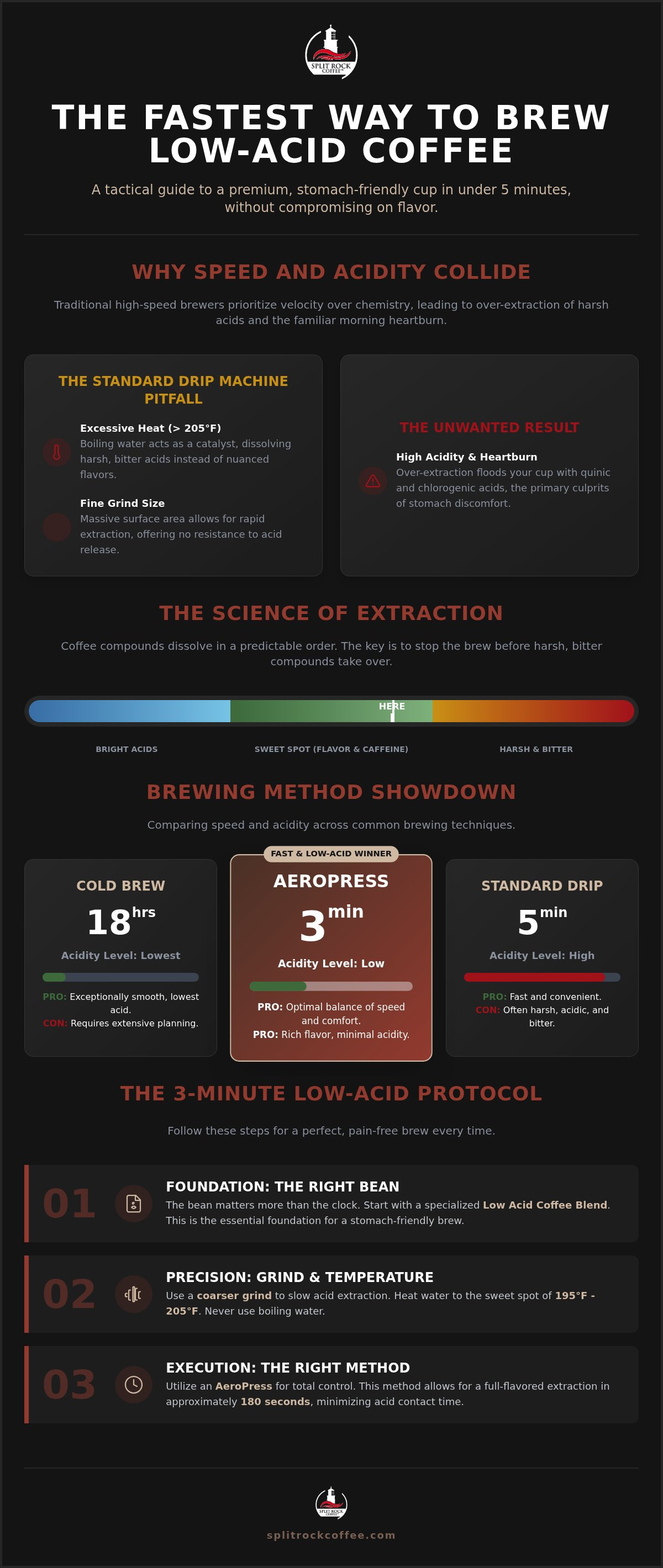
Speed is a double-edged sword in the world of extraction. When you are searching for the fastest way to brew low acid coffee, you are essentially trying to outrun a chemical process that favors the bold and the bitter. Most traditional drip machines prioritize velocity over chemistry. They flash-heat water and spray it over finely ground beans, a process that often results in the over-extraction of quinic and chlorogenic acids. These compounds are the primary culprits behind the morning "burn" that many coffee lovers have come to accept as an inevitable tax on their energy.
The core issue lies in how heat and time interact with the bean. In the high-heat environment of a standard brewer, the difference between low acid coffee vs regular coffee becomes glaringly obvious. Regular beans, often roasted without the scrutiny required for stomach safety, release their acidic payloads almost instantly when hit with near-boiling water. A disciplined approach to your morning fuel requires understanding that speed doesn't have to mean a lack of precision. By controlling the variables of temperature and surface area, you can secure the sustenance you need without compromising your digestive health.
The Heat Factor: Why Boiling Water is Your Enemy
Heat acts as a catalyst that accelerates the breakdown of organic material. When water temperature climbs above 205°F, it stops extracting the nuanced flavors of our Gold Standard Coffee Beans and starts dissolving the harsher, more soluble acids. For a fast, low-acid brew, you must aim for the "sweet spot" between 195°F and 205°F. This range provides enough energy to pull out caffeine and oils while leaving the most aggressive acids trapped within the grounds. Water exceeding the 205°F thermal threshold acts as a chemical catalyst that forces the rapid release of harsh acids into your cup.
Surface Area and Extraction Speed
The geometry of your coffee grounds dictates how quickly the water can do its job. Fine grinds offer massive surface area, which is why they extract so quickly, but they also offer no resistance to acid release. Utilizing a coarser grind is a tactical advantage for those with sensitive stomachs. It slows down the extraction of acids while still allowing the water to capture the essential character of our Low Acid Coffee Blends. When you explore various coffee brewing methods, you'll find that balancing flavor intensity with speed is a matter of matching your grind size to your equipment. A coarse grind allows for a rapid brew that stays well within the boundaries of stomach comfort.
The Science of Extraction: How Time Impacts Your Gut
Extraction is the tactical process of water dissolving the essential compounds within a coffee bean. It's a precise operation where oils, caffeine, and acids are released into your cup. In this chemical exchange, acids are the rapid-response team; they are among the first compounds to dissolve when water hits the grounds. This is why timing is your most powerful weapon when searching for the fastest way to brew low acid coffee. If you let the process run too long, you invite secondary, harsher compounds to dominate the profile.
Shortening the contact time between water and coffee isn't just about speed. It's about reducing the total acid load. Various Factors that influence acidity dictate how these compounds move. During our roasting mission, we focus on the breakdown of chlorogenic acid. This specific acid is often responsible for stomach irritation, and a disciplined roast ensures it's minimized before the bean even reaches your kitchen. When you pair these specialized beans with a fast brewing method, you create a cup that honors your schedule and your health.
A disciplined approach to sustenance starts with the right materials. If you are ready to upgrade your morning fuel, exploring our Low Acid Coffee Blends is the first step toward a pain-free routine.
Solubility Rates of Coffee Compounds
Compounds don't exit the bean all at once. They follow a predictable order: first come the bright acids, then the sweet sugars, and finally the heavy bitterness. To secure a gut-friendly cup, you must learn to "stop" the brew before those harsh secondary acids and bitter tannins take over. Precision in your daily brewing mission means hitting that window where the flavor is peak and the acid is low. Maintaining this discipline ensures every sip provides the energy you need without the side effects you don't.
PH Levels vs. Perceived Acidity
There's a distinct difference between the scientific pH level and what low acid coffee tastes like. While pH measures the actual chemical concentration of hydrogen ions, your palate perceives "smoothness" as the primary signal of a successful, low-acid extraction. A higher pH level indicates a more disciplined, stomach-friendly brew that lacks the sharp bite of standard coffee. By focusing on extraction speed, you ensure that the perceived acidity remains low, resulting in a Gold Standard flavor that provides pure sustenance without the burn.
Ranking the Fastest Low-Acid Brewing Methods
Most recommendations for stomach-friendly coffee rely heavily on cold brew. While cold brew is undeniably effective, waiting 12 to 24 hours for a single cup of sustenance is an operational failure for anyone with a mission to complete. You need a solution that respects your schedule without sacrificing your health. Finding the fastest way to brew low acid coffee requires looking beyond traditional drip machines and toward gear that allows for precision control over the extraction environment.
Standard drip machines are often the least disciplined choice for those with sensitive stomachs. They operate with inconsistent water temperatures that frequently spike too high, and their spray-head designs often leave some grounds over-saturated while others remain dry. This lack of uniformity leads to a cup that is both over-extracted and highly acidic. To secure a Gold Standard experience in minutes, we rank the top contenders based on their speed and ability to protect your gut.
The Aeropress: 2 Minutes to Mission Success
The Aeropress is the undisputed tactical leader for fast, low-acid results. By utilizing air pressure, this device forces water through the grounds quickly, significantly reducing the contact time required to extract full flavor. This high-speed immersion ensures that you capture the richness of our Low Acid Coffee Blends before the harsher acids have a chance to dissolve. Additionally, the use of a paper filter traps specific oils and micro-grounds that can contribute to digestive distress. It's a precise tool designed for those who refuse to compromise on quality or time.
- Speed Ranking: Elite (under 120 seconds)
- Acid Profile: Exceptionally low due to pressure-assisted speed and sediment filtration.
French Press: The Coarse Grind Advantage
If you need to brew for a larger team or simply prefer a more robust body, the French Press is your reliable fallback. It operates on the principle of full immersion, where the water and coffee sit together in a controlled environment. Because you use a coarse grind, the water has less surface area to attack, which naturally limits the release of acidic compounds compared to the fine grinds used in drip machines. While it requires a bit more patience than the Aeropress, the resulting cup is incredibly uniform and less aggressive on the stomach. Just be sure to decant the coffee immediately once the timer hits zero to prevent over-extraction.
- Speed Ranking: Standard (4-5 minutes)
- Acid Profile: Low, provided you maintain strict control over the steeping time.
The 3-Minute Protocol: Step-by-Step for a Pain-Free Brew
Waiting twelve hours for a cold brew is a luxury many of us can't afford when there is work to be done. You need a method that respects your time and your biology. This 3-minute protocol is designed to be the fastest way to brew low acid coffee while maintaining the excellence of your morning cup. By following a disciplined series of steps, you can minimize acid extraction without sacrificing the rich, complex profile you expect from high-quality sustenance.
To execute this mission successfully, you will need a few essential tools: an AeroPress or a French Press, a digital timer, and premium low acid coffee beans. This "Quick-Steep" technique relies on precision rather than patience. It ensures that the water interacts with the grounds just long enough to pull out the sugars and oils, leaving the harsher quinic acids behind in the filter. Precision is the difference between a cup that fuels you and a cup that fails you.
Step 1-3: Preparation and The Bloom
Success begins with temperature control. Heat your water to exactly 195°F. Boiling water is too aggressive; it acts as a chemical catalyst for acid release. Once your water is ready, add your grounds using a 1:15 coffee-to-water ratio. This provides a strong, resilient cup without the overwhelming acid load of a more concentrated brew. Start your timer and pour just enough water to saturate the grounds. This is the 30-second "bloom." It allows the coffee to release trapped CO2, which can otherwise block the water from extracting the smoother flavor compounds you want.
Step 4-5: The Press and The Pour
After the bloom, pour the remaining water and prepare to press. If you are using an AeroPress, apply gentle, steady pressure for exactly 30 seconds. This speed is critical. You want to move the water through the grounds before the secondary, more soluble acids have a chance to dissolve. Stop your press the moment you hear the first "hiss" of air. Pushing beyond this point forces bitter sediment and fine particulates into your cup, which can irritate a sensitive stomach. If the result is too intense for your palate, dilute it with a splash of hot water for a smoother profile.
Maintaining your gear is an act of discipline that ensures your next brew is just as clean as your last. Rinse your equipment immediately with hot water to prevent oil buildup. A clean machine is a reliable machine. If you are ready to put this protocol into action, secure your supply of Gold Standard Coffee Beans today and reclaim your morning routine.
Fuel Your Mission: Why the Bean Matters More Than the Clock
Even the most disciplined execution of a high-speed brewing protocol will fail if your raw materials aren't up to the task. You can master the fastest way to brew low acid coffee, but if you start with beans that haven't been roasted for stomach safety, the chemistry will still work against you. High-acid beans are loaded with compounds that trigger discomfort almost instantly upon contact with hot water. True sustenance requires a foundation built on quality and intention. Without the right beans, speed is simply a faster route to heartburn.
Our Gold Standard Coffee Beans represent a commitment to excellence that goes beyond simple flavor profiles. We engineer our Low Acid Coffee Blends to ensure a smooth finish that won't compromise your daily mission or your long-term health. Selecting between Whole Bean and Ground Coffee is your final tactical decision. Whole beans offer the absolute peak of freshness and flavor preservation for those who have an extra minute to grind. Conversely, our precision-ground coffee is designed for immediate deployment, ensuring you get the same stomach-friendly results without the extra step. Both options serve the same goal: providing the fuel you need with the reliability you deserve.
The Roasting Mission: Eliminating Acid at the Source
Specialized roasting is where the battle against acidity is won or lost. We utilize techniques that specifically target and reduce chlorogenic acids, the primary irritants found in standard commercial coffee. This isn't just about choosing a dark roast; it's about a meticulous thermal profile that honors the bean's origin while protecting the person drinking it. As a veteran-owned business, we approach roasting with the same scrutiny and dedication to duty we learned in service. Our Low Acid Coffee Blends are a reliable source of fuel for those who need their coffee to work as hard as they do. Supporting veteran-owned craftsmanship means you are investing in a legacy of service and quality that standard retail brands simply cannot match.
Subscription Discipline: Never Run Out of Low-Acid Fuel
Consistency is the hallmark of a successful operation. A Monthly Coffee Subscription ensures that you never have to settle for a high-acid alternative because you ran out of the good stuff. Having Gold Standard beans delivered directly to your door eliminates the friction of restocking and maintains the integrity of your morning ritual. It's about being prepared for every mission, every day. When you subscribe, you join a community that values resilience and purposeful action. Secure your mission-ready Low Acid Coffee Blends today and ensure your kitchen is always stocked with the fuel you need to thrive.
Reclaim Your Morning Mission
You no longer have to choose between a rapid start and a settled stomach. By mastering the 3-minute protocol and utilizing the right tactical gear, you have discovered the fastest way to brew low acid coffee without compromising on the depth of flavor you deserve. We have established that precision in water temperature and controlled extraction time can effectively bypass the harsh quinic acids that typically ruin a morning ritual. However, even the most disciplined technique requires a foundation of excellence. Since 2013, we have dedicated ourselves to mission-driven roasting that prioritizes both your sustenance and your long-term health.
As a Disabled Veteran-Owned Small Business, we stand firmly behind our Gold Standard Quality Guarantee. We understand that your daily fuel must be reliable and resilient. Stop settling for the discomfort of standard roasts and start fueling your day with a product engineered for performance. Your next great morning is only three minutes away, provided you have the right beans in your arsenal. Fuel your mission with our Gold Standard Low Acid Coffee Blends and experience the difference that disciplined craftsmanship makes. Reclaim your routine and stay focused on the work that matters.
Frequently Asked Questions
What is the absolute fastest way to make low acid coffee?
The AeroPress is the absolute fastest way to brew low acid coffee, delivering a clean cup in under two minutes. By using air pressure, it accelerates the extraction process before the harsher, more soluble acids have time to fully dissolve. This method requires discipline and a steady hand. When you pair this speed with our Gold Standard Coffee Beans, you secure a smooth, gut-friendly fuel that respects both your schedule and your health.
Does adding milk to coffee reduce the acidity quickly?
Adding milk or cream provides a temporary buffer for your stomach, but it doesn't chemically eliminate the acids already present in the brew. While the proteins in milk can neutralize some perceived bite, the underlying quinic and chlorogenic acids remain. A more effective strategy is to start with Low Acid Coffee Blends. This ensures that your daily sustenance is naturally gentle on your system, rather than relying on dairy to mask a high-acid extraction.
Can I use a regular drip coffee maker for a low-acid brew?
You can use a standard drip machine, but it is often the least disciplined choice for those with sensitive stomachs. These machines frequently use water that is too hot, which aggressively pulls acids from the grounds. If you must use one, ensure you are starting with our Low Acid Coffee Blends to mitigate the machine's lack of precision. For the best results, we recommend transitioning to a manual method like the AeroPress or French Press.
Is dark roast coffee always lower in acid than light roast?
Darker roasts generally contain lower levels of chlorogenic acid because the prolonged heat during roasting breaks these compounds down. However, roast level is only one part of the mission. True stomach safety comes from specialized roasting techniques that target acidity without scorching the bean. Our Gold Standard Coffee Beans are engineered to provide a smooth, rich profile regardless of the roast depth, ensuring you get the flavor you want without the side effects.
How does water temperature affect the speed and acidity of my coffee?
Water temperature acts as a catalyst for chemical extraction. Higher temperatures speed up the process but also trigger the rapid release of harsh acids. If your water exceeds 205°F, you risk over-extracting bitter compounds. Maintaining a disciplined range between 195°F and 205°F allows you to brew quickly while keeping the acid profile under control. This thermal precision is essential for anyone seeking a high-speed, pain-free morning routine that doesn't compromise on quality.
Is instant coffee a good low-acid option for busy mornings?
Most instant coffees are highly processed and rely on high-acid beans, making them a poor choice for those prone to heartburn. While they offer extreme speed, they often lack the quality and stomach safety found in a proper brew. A better alternative for busy mornings is using our pre-ground Low Acid Coffee Blends with a fast immersion method. This provides the convenience you need without the chemical cost and bitter finish of standard instant varieties.
What is the best grind size for a fast, low-acid extraction?
A medium-coarse grind is the tactical choice for a fast, low-acid extraction. Fine grinds provide too much surface area, allowing acids to flood into your cup almost instantly. By choosing a coarser setting, you create a barrier that slows down acid release while still allowing the water to capture essential oils and flavors. This balance is critical when you are trying to minimize contact time while still producing a robust, Gold Standard cup of coffee for your daily mission.
Why does my "fast" coffee always give me heartburn?
Your fast coffee likely causes heartburn because high-speed brewing often relies on excessive heat or fine grinds to compensate for a short timeline. This combination aggressively extracts the very compounds that irritate your stomach lining. To fix this, you must change your raw materials and your method. Using Low Acid Coffee Blends and a disciplined 3-minute protocol ensures that you get the energy you need without the painful acidity that standard fast brews deliver.


